Economic Events and Corporate Reports on Friday, January 23, 2026: Bank of Japan Rate Decision, Inflation and PMI Worldwide, World Economic Forum in Davos, Earnings Reports from Major Public Companies in the U.S. and Europe. Analytical Overview for Investors.
Daily Overview for Investors
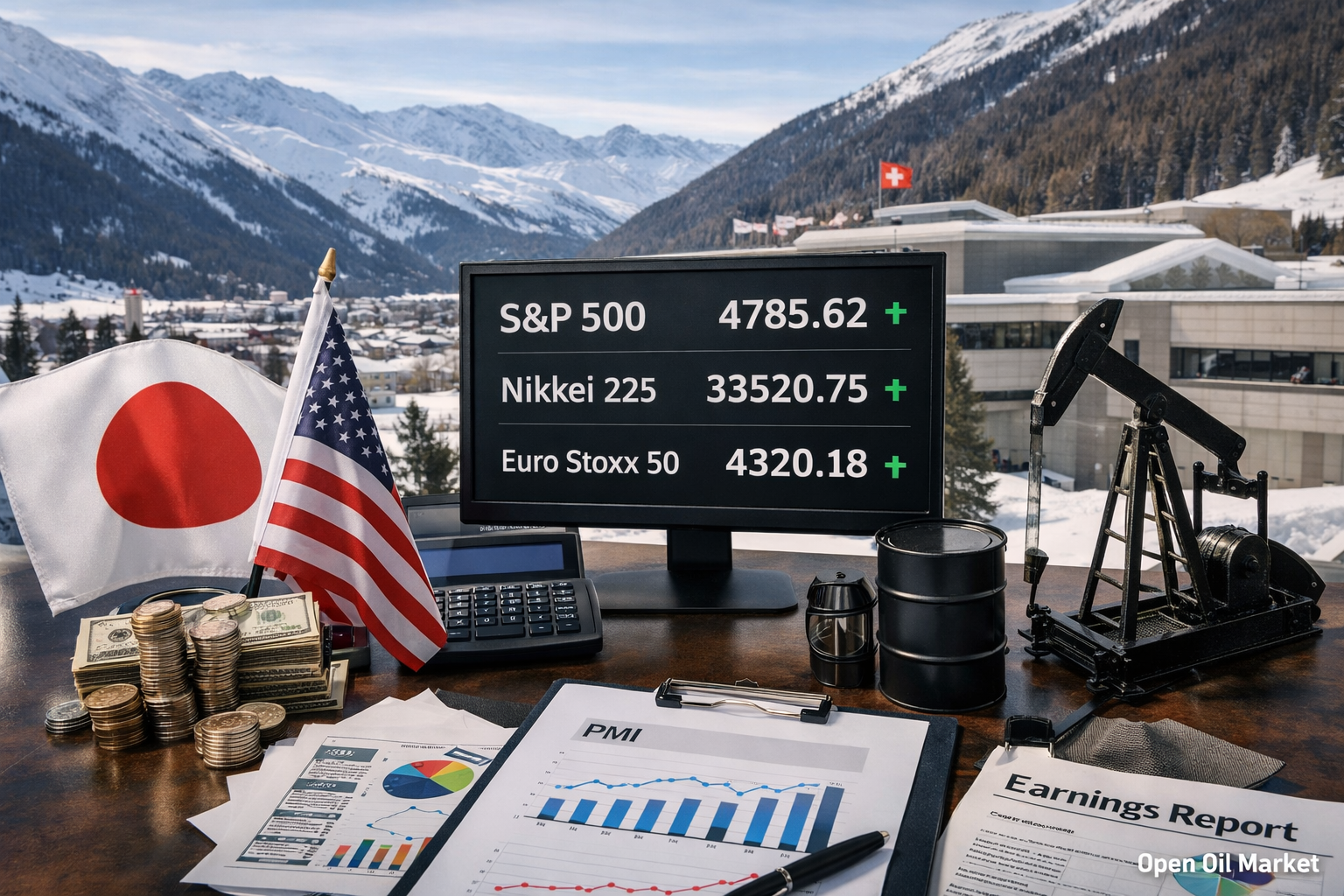
The focus of the global equity market on Friday shifts to Asia and the first wave of "flash" indicators for January. Central to the discussion is the Bank of Japan's rate decision and subsequent comments from the regulator following the release of inflation data, along with a synchronized package of preliminary PMIs from key economies (Australia, Japan, India, Germany, Eurozone, United Kingdom, United States). Concurrently, the World Economic Forum in Davos continues (Day 4), setting the tone for discussions around risks and prospects for the global macroeconomy.
For investors, the linkage of “inflation and rates → bond yields → currencies → commodities → reevaluation of multiples” is crucial, which can lead to increased volatility in the S&P 500, Euro Stoxx 50, Nikkei 225, and emerging markets, including segments of the MOEX.
Key Economic Events (Times in MSK)
- 00:45 — New Zealand: CPI, Q4 2025 (consumer inflation).
- 01:00 — Australia: preliminary PMIs (Manufacturing/Services/Composite), January.
- 02:30 — Japan: CPI for December (consumer inflation).
- 03:30 — Japan: preliminary PMIs (Manufacturing/Services/Composite), January.
- 06:00 — Japan: Bank of Japan rate decision.
- 08:00 — India: preliminary PMIs (Manufacturing/Services/Composite), January.
- 09:30 — Japan: Bank of Japan press conference.
- 11:30 — Germany: preliminary PMIs (Manufacturing/Services/Composite), January.
- 12:00 — Eurozone: preliminary PMIs (Manufacturing/Services/Composite), January.
- 12:30 — United Kingdom: preliminary PMIs (Manufacturing/Services/Composite), January.
- 16:00 — Russia: trade balance.
- 17:45 — United States: S&P Global PMI (Manufacturing/Services/Composite), January (preliminary).
- 18:00 — United States: Michigan Consumer Sentiment, January; consumer inflation expectations.
- 21:00 — United States: Baker Hughes — number of drilling rigs (oil and gas).
Davos (Day 4): Signals for the Global Economy and Risk Appetite
The fourth day of the World Economic Forum in Davos traditionally amplifies the information landscape for investors: assessments of the global macroeconomy, risks of trade restrictions, energy transition, and technology regulation come to the forefront. For the equity market, the tone of the discussions is of paramount importance: increased confidence in a "soft landing" supports cyclical sectors, while emphasis on geopolitics and inflation risks boosts demand for defensive assets and enhances the dispersion of returns among sectors.
- What to Monitor for Investors: rhetoric regarding global growth, trade chains, energy, and any comments on the future trajectory of interest rates and inflation.
- Market Reaction: often manifests through FX and interest rates, then translates into a reevaluation of rate-sensitive segments (technology, real estate, consumer sector).
Bank of Japan, CPI, and Yen: Key Drivers for Nikkei 225 and Global Rates
The Bank of Japan's rate decision at 06:00 MSK and the press conference at 09:30 MSK are central themes for the Asian session. In light of December's CPI, the market compares actual inflation and the trajectory of real rates. Even with an unchanged rate, the "rigidity" of the statements could strengthen the yen and lift JGB yields, potentially triggering a chain reaction: rising global yields, adjustment in carry-trades, and pressure on growth stocks.
Practical Insight: for equity and bond investors, the future directions of policy are more critical than the current rate level. The response of USD/JPY and yield dynamics often precede movements in the Nikkei 225 and broader indices.
Global PMIs: Early Assessment of Global Business Activity Pace
The package of preliminary PMIs for January represents one of the most timely indicators affecting expectations for company earnings and economic growth forecasts. For investors, this serves as a direct signal for cyclical assets: industry, transport, commodities, and financial sector.
- Europe (Germany/Eurozone/United Kingdom): the dynamics of production and services are important; an improvement in PMIs supports the Euro Stoxx 50 and banking sector, while weakness reinforces a defensive tilt.
- United States (S&P Global PMI): impacts expectations for Fed rates through the channel of "growth → inflation → policy," reflecting in evaluations of the S&P 500.
- Asia (Australia/Japan/India): sets the tone for global commodity demand and supply chains.
United States: Consumer Expectations, Inflation, and Revaluation of the S&P 500
Data from Michigan Consumer Sentiment and inflation expectations (18:00 MSK) are crucial as a "bridge" between the real economy and Fed policy. Rising inflation expectations typically increase the risk premium on rates and may pressure high-multiple stocks. Simultaneously, strong consumer confidence supports the consumer sector and services—if the market interprets this as resilient demand without inflation acceleration.
- Scenario 1 (Risk-On): confidence grows, inflation expectations remain stable → support for equity markets, moderate demand for cyclical sectors.
- Scenario 2 (Risk-Off): inflation expectations rise → increasing yields, pressure on growth stocks and long duration.
Commodities and Oil & Gas: Baker Hughes and Sensitivity of the Energy Sector
Weekly data from Baker Hughes on drilling rigs (21:00 MSK) serves as a tactical indicator for oil and gas. Rising drilling activity may enhance expectations for future supply and influence sentiment in the energy sector, especially in conjunction with earnings reports from oil service companies. For commodity investors and energy stocks, this metric is key in assessing the balance of the oil and gas market and the investment cycle in extraction.
Corporate Reports: Major Public Companies Reporting on January 23, 2026
The corporate earnings season remains a key driver for the equity market: investors assess profits, margins, cash flows, and forecasts. For Friday, January 23, 2026, the calendar features the following major public companies (U.S. and Europe). For Asia and Russia, significant earnings releases from blue-chip companies within the context of major international calendars are not recorded for this date; investor focus in these regions shifts towards macroeconomics, currencies, and rates.
- SLB (Schlumberger) — U.S., Oil Service (Energy): Q4 2025 report. Focus areas include demand for services, drilling activity, margin resilience, and market forecasts for the Middle East/U.S./Latin America.
- First Citizens BancShares — U.S., Banks (Financials): Q4 2025 report. Market analysis looks at net interest margin, funding cost, asset quality, and deposit dynamics.
- Booz Allen Hamilton — U.S., Consulting and Defense/IT Contracts: Q3 2026 (fiscal year) report. Key focus on order book volume, contract pacing in cybersecurity, and margins.
- Webster Financial — U.S., Banks (Financials): Q4 2025 report. Critical metrics include margin, credit quality, reserves, and commercial lending dynamics.
- Ericsson — Sweden, Telecom Equipment (Technology/Telecom): Q4 2025 report. Central to the report is demand for 5G/networks, gross margins, expenses, and CAPEX outlook from operators in Europe and the U.S.
- HBM Healthcare Investments — Switzerland, Investments/Healthcare: Q3 2026 report. Important for investors is portfolio reassessment and market conditions in biotech.
What Matters to Investors at the End of the Day: Risk Management Checklist
- Bank of Japan Rate Decision and Press Conference: monitor the reaction of the yen and yields — this is often the main source of "transferring" volatility between regions.
- Global PMIs: compare the dynamics of services and manufacturing; divergences between the U.S. and Europe may alter regional portfolio structures (S&P 500 vs Euro Stoxx 50).
- U.S. (Michigan + Inflation Expectations): check if the risk of a more hawkish Fed rhetoric enhances — this directly impacts the evaluation of growth stocks and the debt market.
- Company Earnings: the key is not just the fact of profit but also outlooks, commentary on demand and margins; especially for energy and banking, where expectations on rates and credit cycles are critical.
- Commodities and Baker Hughes: use the data as confirmation/disproof of scenarios regarding oil and gas supply, as well as context for results from oil service companies.
In conclusion, Friday, January 23, 2026, combines high-density macroeconomics (PMIs, inflation, rates) with pinpoint corporate reports. For investors, the optimal strategy is to maintain risk management discipline, pre-determine scenarios for reacting to the Bank of Japan’s rate decision and PMI data, and evaluate earnings reports through the lens of cash flow and outlooks, rather than merely the profit figure.