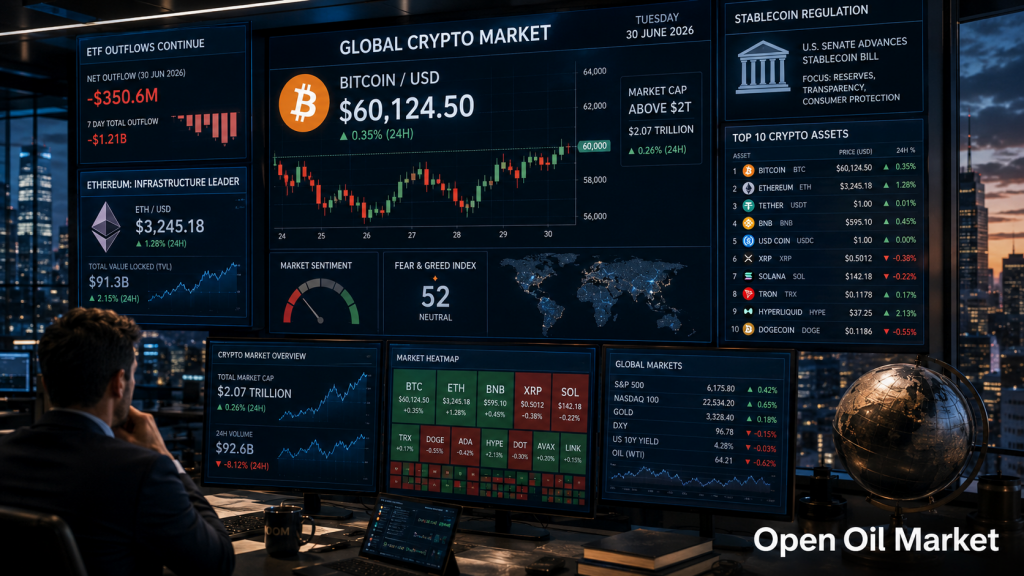
Cryptocurrency News for Tuesday, June 30, 2026: Bitcoin Holds Around $60,000 as Market Evaluates ETF Outflows, Stablecoin Regulations, Ethereum, Solana, XRP, BNB Trends, and Top 10 Cryptocurrencies
The cryptocurrency market enters Tuesday, June 30, 2026, in a state of cautious recovery following a strong correction in June. For investors, a key topic remains not only the price of Bitcoin but also the behavior of institutional capital: outflows from spot Bitcoin ETFs, a decreased risk appetite, heightened discussions around stablecoins, and a stricter regulatory backdrop are shaping a new configuration for the digital asset market.
The global cryptocurrency market capitalization remains above $2 trillion; however, the structure of demand has significantly shifted. Investors no longer evaluate cryptocurrencies solely through the lens of expectations for rapid growth. Liquidity, issuer stability, quality of reserves, institutional flows, regulation, and the ability of blockchain projects to generate real use cases are coming to the forefront.
Top Theme of the Day: The Crypto Market Tests Its Resilience After June’s Sell-Off
The main market signal for June 30 is that Bitcoin remains around the psychologically important zone of $60,000. This area has become an indicator of investor trust in digital assets following a sharp decline from last year's highs. For global cryptocurrency market participants, three factors are critical:
- ETF Flows: June has proven to be one of the weakest months for American spot Bitcoin ETFs since their inception.
- Macroeconomics: Investors continue to assess the trajectory of interest rates in the U.S. and the impact of a strong dollar on risk assets.
- Regulation: Stablecoins, cryptocurrency exchanges, and DeFi platforms remain in the regulatory spotlight in the U.S., Europe, and Asia.
For investors, this signifies that the cryptocurrency market is becoming more mature, yet simultaneously more reliant on traditional financial factors such as liquidity, stock indices, ETF flows, bond yields, and geopolitical risks.
Bitcoin: The $60,000 Zone Becomes a Test for Institutional Demand
Bitcoin remains the primary benchmark for the entire digital asset market. According to the current market structure, BTC maintains a dominance of about 58% of the cryptocurrency market capitalization, underscoring its status as a foundational asset for institutional investors.
However, the news surrounding Bitcoin remains mixed. On one hand, the asset retains high liquidity and remains the main access tool to the cryptocurrency market for funds, public companies, and private investors. On the other hand, record outflows from spot Bitcoin ETFs indicate that some institutional capital is reducing exposure amid an overall reassessment of risk.
Investors should monitor three risk levels:
- Bitcoin holding above the $60,000 zone;
- The dynamics of new applications and redemptions in Bitcoin ETFs;
- The behavior of companies with significant BTC reserves on their balance sheets.
If ETF outflows continue, pressure on Bitcoin may persist. Conversely, if the background in the stock market stabilizes, the $60,000 zone could serve as a base for consolidation.
Ethereum: Price Weakness but Infrastructure Role Remains Intact
Ethereum continues to be the second-largest cryptocurrency by market capitalization and the primary infrastructure asset for smart contracts, DeFi, tokenization, and stablecoins. However, ETH appears significantly weaker than Bitcoin in terms of market dynamics, as investors continue to evaluate the competition from Solana, BNB Chain, TRON, and new high-performance networks.
A key issue for Ethereum is the gap between the network's fundamental role and the price dynamics of ETH. The Ethereum ecosystem remains the largest platform for developers and institutional experiments with tokenized assets, yet investors increasingly demand a clear economic model that includes rising fees, sustainable demand for blockchain space, and increased activity in applications.
For global investors, Ethereum remains less a bet on a short-term rally and more a wager on the long-term infrastructure of Web3, real asset tokenization, and decentralized finance.
Stablecoins: The Main Regulatory Frontier of the Crypto Market
Stablecoins have become a central theme for the cryptocurrency market by the end of June 2026. USDT and USDC rank among the largest digital assets by capitalization, and their role extends far beyond cryptocurrency trading. They are utilized for settlements, storing dollar liquidity, transfers between exchanges, and accessing DeFi.
Yet, regulators are increasingly scrutinizing stablecoins. The primary question is whether stablecoins represent a complete form of money or an investment tool tied to the quality of reserves, the issuer, and the regulatory environment. For investors, this presents a critical risk: even if the price of USDT or USDC remains close to $1, the underlying structure of stablecoins may face new demands concerning reserves, customer identification, reporting, and yield limitations.
Practically speaking, this means that stablecoins are becoming a bridge between the cryptocurrency market and the banking system. The greater their market capitalization, the higher the likelihood that regulators will view them as a systemically significant part of the financial infrastructure.
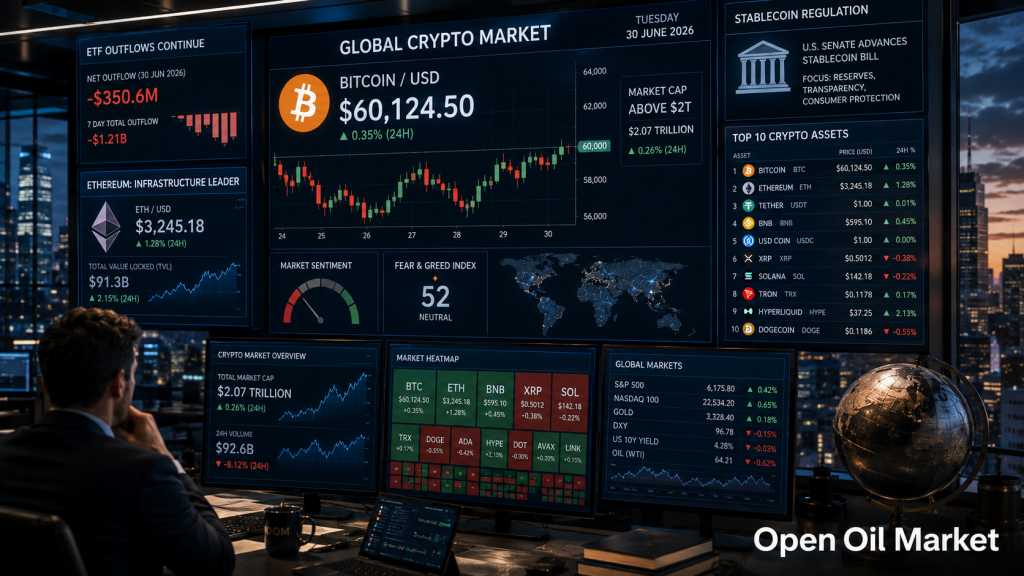
Top 10 Most Popular Cryptocurrencies: Market Structure as of June 30
In terms of capitalization and liquidity, investors remain focused on the following digital assets:
- Bitcoin (BTC) — the primary asset of the market, an indicator of institutional demand, and the foundation for ETF products.
- Ethereum (ETH) — the largest smart contract network and a foundation for DeFi, NFTs, tokenization, and Web3 infrastructure.
- Tether (USDT) — the largest stablecoin and the primary tool for dollar liquidity on cryptocurrency exchanges.
- BNB (BNB) — the token of the Binance ecosystem and BNB Chain, which is sensitive to centralized exchange regulations.
- USDC (USDC) — a regulated dollar stablecoin, crucial for the institutional segment and on-chain payments.
- XRP (XRP) — an asset focused on cross-border payments and banking infrastructure.
- Solana (SOL) — a high-performance blockchain competing for users in DeFi, NFTs, and consumer applications.
- TRON (TRX) — a network with high activity in stablecoin transfers and low fees.
- Hyperliquid (HYPE) — a fast-growing DeFi project associated with on-chain derivatives and professional trading.
- Dogecoin (DOGE) — the largest meme cryptocurrency, still serving as an indicator of retail risk appetite.
It is important to note that the top 10 cryptocurrencies increasingly reflect not only speculative demand but also functional segmentation of the market: Bitcoin as a reserve digital asset, Ethereum and Solana as infrastructure, USDT and USDC as liquidity, XRP and TRON as payment scenarios, HYPE representing DeFi derivatives, and DOGE as retail sentiment.
Solana, XRP, TRON, and BNB: Altcoins Depend on Liquidity and User Activity
The altcoin market remains heterogeneous. Solana appears stronger than many competitors thanks to the speed of its network, developer activity, and interest in low-fee applications. However, SOL remains more volatile than BTC and ETH.
XRP maintains investor interest due to its tie to international payments and potential institutional use. Nonetheless, its dynamics depend not only on market demand but also on regulatory clarity surrounding tokens linked to payment infrastructure.
TRON remains an important blockchain for stablecoin transfers, particularly in regions where users seek cheap and fast dollar transactions. BNB, in turn, remains closely tied to the Binance ecosystem, amplifying both its utility profile and regulatory risks.
ETFs, Funds, and Public Companies: Crypto Becomes Part of the Traditional Market
The key difference in the current cycle compared to previous periods is that cryptocurrencies are already embedded in the traditional financial infrastructure. Bitcoin ETFs have made the market accessible to asset managers, pension strategies, family offices, and private investors through brokerage accounts. However, this same factor has heightened Bitcoin's dependence on capital flows from traditional finance.
When investors reduce risk in tech stocks, the AI sector, or growth funds, that pressure often spills over to cryptocurrencies. Hence, Bitcoin in 2026 behaves less like an isolated alternative asset and more like a highly liquid risk asset with a strong correlation to the global investment cycle.
For investors, this changes the approach to portfolio management. Cryptocurrencies need to be analyzed not in isolation but in conjunction with:
- Federal Reserve interest rates and U.S. Treasury bond yields;
- The dynamics of the Nasdaq and tech sector stocks;
- Flows into ETFs and crypto funds;
- Stablecoin and cryptocurrency exchange regulation;
- Geopolitical risks and the demand for dollar liquidity.
What is Important for Investors on June 30, 2026
The cryptocurrency market remains attractive for long-term investors, but the current backdrop demands stricter discipline. The main risk is not a separate correction of Bitcoin or Ethereum, but the potential continuation of institutional capital outflows amid sustained tight financial conditions.
On Tuesday, June 30, investors should pay attention to the following signals:
- Bitcoin ETF: will outflows slow down or will the market see new redemptions?
- The $60,000 Zone for BTC: will it hold as a consolidation level?
- Ethereum: can ETH show relative strength after a weak month?
- Stablecoins: will regulatory pressure on USDT, USDC, and other dollar tokens increase?
- Altcoins: will Solana, XRP, TRON, and BNB maintain liquidity in a cautious market?
- DeFi: will interest in new infrastructure projects like Hyperliquid persist?
The Cryptocurrency Market Shifts from Euphoria to Quality Asset Evaluation
Cryptocurrency news for Tuesday, June 30, 2026, suggests that the digital asset market is entering a phase of reassessment. Bitcoin remains a central asset but can no longer rise solely on expectations of capital inflow into ETFs. Ethereum retains its infrastructural role but needs to demonstrate economic viability. Stablecoins are becoming a key part of the global financial infrastructure, which is why they are increasingly under regulatory scrutiny.
For investors, the main takeaway is simple: the crypto market is becoming more professional, more regulated, and more sensitive to macroeconomic conditions. In such an environment, it is not the loudest assets that win, but projects that offer liquidity, have a clear role in the ecosystem, possess a stable user base, and feature a transparent regulatory outlook.