Economic Events and Corporate Reports — Friday, August 7, 2026: US Nonfarm Payrolls, China's Trade Balance, German Industry, and Allianz Results
Friday, August 7, 2026, closes one of the busiest weeks of the summer for global markets. The main event of the day — the July US employment report (Nonfarm Payrolls) — will set expectations for the Fed's rate path heading into the fall. The agenda also includes China's trade balance, German industrial production and foreign trade, Canada's labour market, as well as quarterly results from Allianz, Enbridge, Under Armour, Wendy's, Fluor, and Take-Two Interactive.
Key Economic Events and Corporate Reports for August 7, 2026: US Labour Market, Asian and European Data, Public Company Results
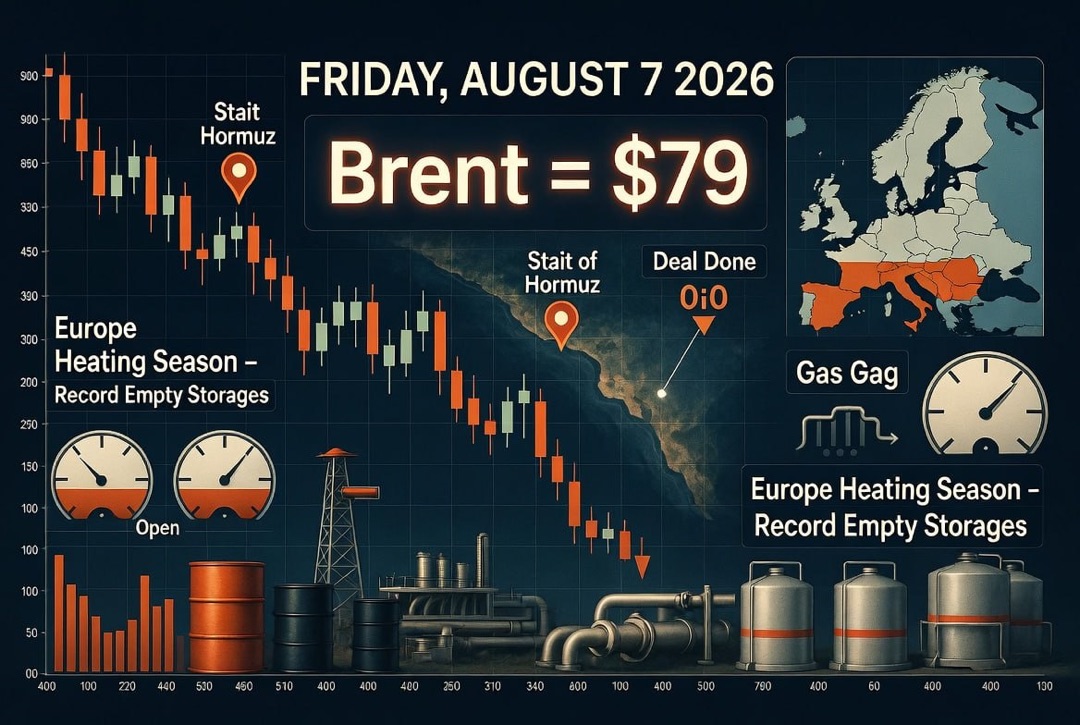
For CIS-based investors, this Friday offers particular value: it provides a condensed snapshot of the entire global economy within a single trading day. Asia will show the state of external demand in the morning, Europe the resilience of industry, the US the quality of its labour market, and corporate earnings will translate macroeconomics into the language of revenue, margins, and guidance. The day unfolds against a backdrop of a 3.75% Fed funds rate, US inflation near 3.5%, Brent crude around US$79 per barrel, and gold above US$4,200 per ounce — conditions in which any deviation of data from consensus quickly reverberates through bonds, the dollar, and equity indices such as the S&P 500, Euro Stoxx 50, Nikkei 225, and MOEX.
A Brief Introduction: What Sets the Agenda
Friday's intrigue centres on three questions:
- Is the US labour market cooling enough for the Fed to resume policy easing as early as this fall;
- Is China sustaining its export momentum, on which commodity markets and Asian exporters depend;
- Does European industry confirm its emergence from a prolonged period of stagnation.
The week was structured so that the entire block of US employment data was pushed to its end: JOLTS on Tuesday, the ADP report and ISM Services on Wednesday, weekly jobless claims and productivity on Thursday — and finally, the comprehensive jobs report on Friday. This sequencing concentrates risk precisely in the final day, which is why volatility on August 7 is expected to be the highest of the week.
Asia: China's Trade Balance and Japan's Leading Indicators
Early in the morning Moscow time, China's trade balance for July is released. This is one of the most telling indicators of the state of global trade: export dynamics reflect external demand, while import dynamics signal domestic activity and demand for commodities. Strong figures traditionally support industrial metals, the oil and gas sector, and Asian exporter equities; weak ones heighten caution around cyclical assets.
In Japan, preliminary leading indicators for June and machine tool orders for July are published. For the Nikkei 225, the latter metric is especially important: machine tool orders are considered an early signal of the investment cycle in machinery and electronics worldwide, including demand from China and the US.
Europe: German Industry and Foreign Trade
The morning European block is focused on Germany. At 9:00 a.m. Moscow time, June industrial production and the foreign trade balance are released, followed shortly after by France's trade balance. For the Euro Stoxx 50, these are key reference points for three reasons:
- Industrial production shows whether improved order books are already translating into actual output;
- The trade balance reflects the competitiveness of European exports at the current euro exchange rate;
- Both indicators influence expectations for the ECB's rate trajectory and, consequently, banks, industrials, and property developers.
Weak data will intensify talk of the need for looser policy, while strong data will support the euro and Europe's cyclical equity sectors.
US: July Jobs Report — the Week's Main Event
At 3:30 p.m. Moscow time, the July US employment report is released: the change in nonfarm payrolls, the unemployment rate, and average hourly earnings. Market consensus implies growth of roughly 85,000 jobs after 57,000 in June; in the first half of 2026, the average monthly gain was about 92,000, and the unemployment rate held near 4.2%.
For investors, three aspects of the report matter:
- Payroll growth — the pace of hiring and any signs of economic cooling;
- The unemployment rate — the balance of labour supply and demand;
- Wage growth — potential inflationary pressure that constrains the Fed.
A combination of soft employment and moderate wage growth typically pushes Treasury yields lower, weakens the dollar, and supports growth stocks. Strong data with accelerating wages, by contrast, pushes back expectations of rate cuts and weighs on long-dated bonds and richly valued technology names.
Canada, Ivey PMI, and US Consumer Credit
Coinciding with the US report, Canada's July employment report is released, followed by the Ivey Purchasing Managers Index. For the Canadian dollar and commodity currencies, this is an independent driver, and for the oil market, an additional indicator of North American demand.
The day concludes with US consumer credit data for June. The indicator rarely moves the market immediately, but it matters as a gauge of the resilience of consumer demand — the very factor underpinning a significant share of S&P 500 corporate profits.
US Corporate Reports: The Finale of a Packed Week
After the exceptionally busy Wednesday and Thursday, Friday looks calmer but still includes notable names. Before the market open, results are published by:
- Enbridge — North America's largest pipeline operator;
- Under Armour and Wendy's — the consumer sector and quick-service dining;
- Fluor and Construction Partners — engineering and infrastructure construction;
- PPL, Emera, Algonquin Power & Utilities — power generation and utilities;
- Plains All American, Kimbell Royalty Partners, Calumet — oil and gas infrastructure and refining;
- Oklo and ACM Research — next-generation nuclear energy and semiconductor manufacturing equipment;
- Spectrum Brands, Atmus Filtration, Interface, Sylvamo, Embecta, ANI Pharmaceuticals, Essent Group, Alpha Metallurgical Resources.
After the close, Take-Two Interactive and Park Hotels & Resorts report. Take-Two's results are traditionally viewed as a barometer of spending on digital entertainment, while Park Hotels serves as an indicator of the hotel segment and business travel.
Europe and Asia: Allianz Results and the Global Corporate Backdrop
The main corporate event for the Euro Stoxx 50 is Allianz's release of its second-quarter and first-half 2026 results. Europe's largest insurer approaches the report near record highs, with an active share buyback programme of €2.5 billion and a recently announced deal to acquire HSBC's insurance business in Singapore. Investors will focus on operating profit, the combined ratio in the property-casualty segment, net inflows in asset management, and confirmation of the full-year outlook.
In Asia, the peak of Japan's first-quarter corporate reporting season continues: a stream of releases from industrial, technology, and consumer issuers shapes the overall backdrop for the Nikkei 225, even if individual names are not global heavyweights.
Russia and MOEX: A Pause in the Corporate Calendar
The Russian market on August 7 passes without significant earnings releases. The week's main reports have already been released — TGK-1, Rostelecom, and Unipro reported earlier, and the next major block is expected later in August: T-Technologies (August 11), X5 and EL5-Energo (August 13), Raspadskaya and Sovcombank (August 14), MTS (August 25), Softline (August 27), RusHydro and MD Medical Group (August 28).
Accordingly, for MOEX investors, the day's key factors remain external: the ruble exchange rate, which weakened above 81 per dollar in early August, Brent crude prices near US$79, and the overall dynamics of global risk appetite following the US jobs data.
Why This Day Matters for Investors
The value of August 7, 2026 lies not in a single release but in their combination. Within one session, the market receives:
- a signal on the state of China's foreign trade and global demand;
- an update on Japan's investment cycle;
- a picture of European industry and exports;
- decisive data on the US and Canadian labour markets;
- corporate reports from energy, utilities, consumer, insurance, and digital entertainment.
Such a concentration of information on the final day of the week raises the risk of sharp moves and price gaps at the opening of the next session, particularly in currency pairs, long-dated bonds, and rate-sensitive equities.
What Investors Should Watch at the Close
By the end of trading, it is worth assessing several concluding signals. First, how the market interpreted the US jobs report: as confirmation of a soft landing for the economy or as the first sign of a deeper slowdown. The reaction of two-year Treasury yields and the US dollar index serves as the reference point — they are the most sensitive to shifts in Fed rate expectations.
Second, it is worth juxtaposing Chinese foreign trade and German industry: if weak data coincide on both sides, it would point to a synchronized slowdown in global trade, while divergence would suggest more local factors at play.
Third, the corporate dimension matters. If Allianz confirms its full-year guidance and US energy and utility companies show resilient cash flows, that would support the defensive portion of portfolios. Cautious commentary on consumer demand from Under Armour, Wendy's, and Take-Two, by contrast, would signal a case for more conservative positioning in cyclical sectors.
In sum, the economic events and corporate reports on Friday, August 7, 2026, should be viewed as the week's final test for the global market environment: macroeconomic data sets the direction for rates and currencies, while quarterly earnings show how well corporate profits are withstanding that pressure.