Oil Market: Brent Around $87, WTI Around $82 — A Week of Decline
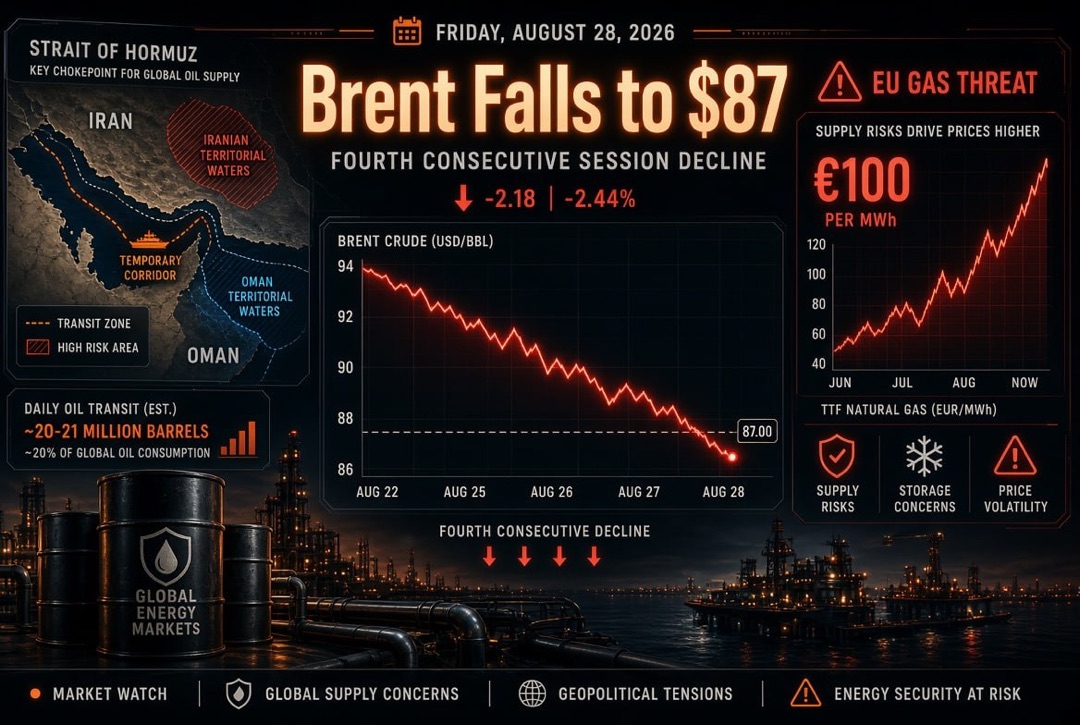
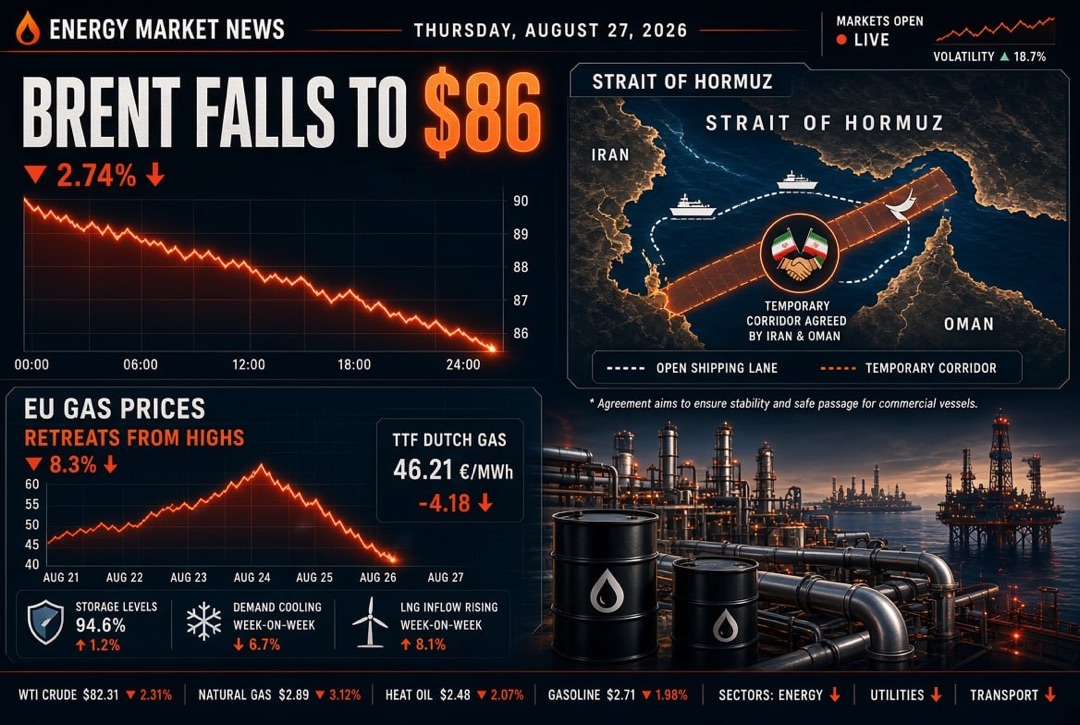
Oil prices are correcting following a two-week rally. Brent was trading near $87 per barrel on Thursday, with WTI around $82. The weekly decline for Brent surpassed 7%; however, year-to-date, the benchmark remains over 40% higher: the premium for geopolitical risk following the closure of the Strait of Hormuz in February has not dissipated. Key price drivers for oil today include:
- Diplomacy in Hormuz: Statements from Tehran and Muscat regarding a temporary shipping corridor and joint demining have emerged as the main bearish factor of the week.
- Mild Sanctions: Washington has refrained from imposing secondary measures against Iran's trading partners, alleviating some concerns about supply reductions.
- Physical Flows: Donald Trump announced the passage of 10 million barrels of oil through the strait on Tuesday, while Kpler recorded only five commercial vessels versus an average of 15 over the past ten days. Data discrepancies are keeping traders from making aggressive sales.
- Russian Risk: Reports of Moscow preparing for escalation in Ukraine briefly pushed the market upwards on Wednesday, before news from Oman brought prices back down.
- Saudi Logistics: Satellite images indicate an increase in shipments by Saudi Aramco from its terminals within the Persian Gulf, as Riyadh restructures its exports amid threats from the Houthis to the Red Sea.
Analysts at MST Marquee characterize the market as being in a "wait-and-see mode": after a series of failed ceasefires, investors are reluctant to play out de-escalation until a deal between Tehran and Washington is confirmed.
Strait of Hormuz: Iran-Oman Agreement and U.S. Position
The key event of the week for the global oil and LNG market is the progress in talks between Iran and Oman. On Tuesday, the foreign ministers of both countries discussed a "preliminary framework" for resuming shipping, and on Wednesday, a representative of the IRGC announced agreements reached. Key elements include:
- Establishment of a temporary joint shipping corridor through the strait.
- Joint project for demining the waters.
- Division of the waters of the strait and revenues from transit between Iran and Oman.
- Negotiations on a permanent route within 30–60 days.
Tehran emphasizes that the agreement with Oman does not automatically mean the reopening of the strait, and the IRGC directly accuses the U.S. of dragging out the process. The parties missed the 60-day window of the June memorandum, the formal ceasefire mechanism is closed, and now the Oman-Iran track is viewed as a prelude to a direct deal with Washington. A positive signal is the reports of the U.S. preparing to return diplomats to evacuated embassies in the Middle East. The negative aspect is the tanker hit by an unknown projectile off the coast of Oman on August 25: shipping safety has not been restored, and insurance rates remain prohibitive.
Sanctions "Economic Outcast": Impact Weaker than Market Fears
The campaign announced by U.S. Treasury Secretary Scott Bessent, termed "economic D-Day," appears more of a signal than a devastating blow by Thursday. The Treasury has focused on Bank Melli, oil smuggling networks, and "zero leakage" of currency revenue, but has not imposed secondary sanctions against China, India, or Turkey. For the oil market, this means that about 340,000 barrels per day of Iranian exports to China remain intact for now. Inside Iran, pressure is mounting: inflation is nearing 90%, and President Masoud Pezeshkian publicly states that the country "cannot fight forever," defending the June memorandum. This combination of economic exhaustion and a diplomatic window is shaping the baseline scenario for investors for the fall — a gradual restoration of flows through Hormuz amid continued high volatility.
U.S. Stocks: Record Low Diesel and Record Refinery Utilization
The EIA's weekly report for the week ending August 21 showed a modest increase in commercial crude stocks of just 0.1 million barrels, up to 428.9 million — 1% above the five-year average. U.S. refinery utilization reached 97.4% capacity with a throughput of 17.4 million barrels per day, gasoline output rose to 9.8 million barrels per day, while distillates fell to 5.1 million. Crude oil imports fell by 435,000 barrels per day to 6.2 million. The major signal for the refined products market is that U.S. diesel stocks have dropped to the lowest seasonal level on record. Europe, facing a shortage of middle distillates, purchased diesel from Mexico for the first time in seven years. For fuel companies and traders, this means that record crack spreads for diesel will be maintained at least until the end of fall.
Gas and LNG: Europe Between €65 and €100 per MWh
The gas market remains the most vulnerable segment of global energy. TTF futures rose above €68/MWh on Tuesday—the highest since early 2023—and retreated below €67 by Thursday on news from Oman. The fundamental picture remains unchanged:
- Storage: EU gas storage is only about 61% full, with a target of 80% by November 1 (revised down from 90%). Wood Mackenzie estimates the "best-case scenario" at 75% with full recovery of Qatari exports by the end of September; if the strait remains closed for another two months, less than 70%.
- Price Forecasts: Goldman Sachs suggests that December TTF may exceed €100/MWh with the gradual normalization of Middle Eastern exports by 2027—double the base case forecast of €50. Morningstar sees a range of €90–120 in the event of a cold winter.
- LNG Supply: New Qatari facilities will not reach full utilization until the second half of 2027; the EU's ban on Russian LNG applies starting January 2027. Europe may require around 64 billion cubic meters of U.S. LNG.
- Asia: Spot JKM is holding around $21–22/MMBtu; Japan, Korea, and Taiwan are hedging risks with coal and the restart of nuclear power plants.
- U.S.: Henry Hub is below $3/MMBtu with record output of approximately 122.5 billion cubic feet per day; planned maintenance at Corpus Christi LNG has temporarily reduced the demand for feedstock.
OPEC+ and Russia: Paper Quotas and Declining Production
OPEC+ will meet on September 6 to discuss October; the baseline scenario suggests a pause in quota increases until the end of the year while maintaining approximately 2 million barrels per day cuts from 2022 and preparing for negotiations on quotas for 2027, where Iraq is pushing for a higher level. The alliance's actual production remains millions of barrels below February levels.
Russia is a clear illustration of the gap between quotas and reality. According to secondary sources tracked by OPEC, production in July fell to 8.89 million barrels per day—a six-year low and nearly 1 million below the permitted level. Throughput in July declined to 3.6 million barrels per day, the worst figure since 2002. Marine oil exports fell to 3.46 million barrels per day for the four weeks ending August 23; strikes in Novorossiysk forced the rerouting of Kazakh barrels to the Black Sea, freeing up Ust-Luga for Russian oil. The volume of Russian oil at sea dropped to 83 million barrels—a one-year low—while export revenue fell to $1.65 billion per week. China and India remain the main buyers with deliveries of around 3.29 million barrels per day. Analysts estimate losses in Russian supply due to infrastructure strikes at 10%, with losses in refined products being substantially higher.
Russian Refined Products Market: Diesel Export Fate to Be Decided Before September 1
The domestic fuel market in Russia remains under manual control. The gasoline export ban is in effect until January 31, 2027, and the ban on jet fuel export is until the end of November. The ban on diesel fuel exports for producers expires on September 1, and according to industry sources, the government is leaning towards an extension at least until the end of September, with discussions also considering a possibility until the end of the year. Vice Prime Minister Alexander Novak stated that there were no logistical issues with diesel and that several refineries are returning from maintenance, however, in August, shortages returned to certain regions after a short hiatus. To fill the market, imports from Belarus and Asia, as well as a temporary reduction of the exchange sales quota to 2%, are being used. For the global refined products market, this means a loss of Russian diesel volumes during a peak European deficit.
Electricity, Renewables, and Coal: Energy Crisis Extends Coal Era
The war in the Middle East has rewritten electricity forecasts. The IEA expects that coal generation in 2026 will account for approximately 10,974 TWh—almost one-third of global output at 33,313 TWh and 77% more than wind and solar combined. Gas generation, which was projected to grow by 1.3%, will remain at last year's levels: expensive LNG has made coal more competitive in Europe and Asia. At the same time, the energy transition is accelerating where there are domestic resources:
- In the U.S., solar generation increased by 21% in the first half of the year, hydro by 9%, and wind by 6%; wind and solar made up 20% of output, surpassing both coal and nuclear for the first time.
- Coal generation in the U.S. fell by 10% to 323 TWh, while coal exports are projected at 102 million short tons due to demand from Asia.
- Texas has halted the approval of new data centers, and the EIA has lowered the forecast for the state's load growth in 2027 from 14% to 6%.
- U.S. tariffs on polysilicon and solar modules increased costs for new renewable projects as of August 6.
What to Watch on Friday, August 28: Calendar for Energy Market Participants
- Washington's response to the Iran-Oman agreement and signals regarding the resumption of direct contacts.
- Kpler data on transit through the Strait of Hormuz and investigation of the tanker attack.
- The Russian government's decision on diesel fuel exports after September 1.
- Injection rates in EU gas storage and the week’s closing for TTF against a backdrop of three-year highs.
- Baker Hughes rig count and U.S. macro statistics affecting demand forecasts.
- Threat from the Houthis to the Red Sea and the restructuring of Saudi export logistics.
- Preparation for the OPEC+ meeting on September 6 and signals regarding a pause in quota increases.
In summary, the week ends with the oil market drifting toward a scenario of de-escalation but remains hostage to physical flows through Hormuz, where data from the White House and tracking companies diverge significantly. Gas and refined products—diesel in the U.S. and Europe, LNG for EU gas storage—have become the main points of deficit in global energy for the fall of 2026, while coal has received an unplanned extension in the energy transition. For daily analysis on oil, gas, renewables, and the energy market, follow our Telegram channel, Open Oil Market.