Key Highlights of the Venture Market as of August 28, 2026: Nvidia's Report Redefines Demand for AI Infrastructure, Anthropic and OpenAI Prepare for the Largest IPOs of the Decade, Chip Contenders Attract Billions, and Global Venture Investments Set Historical Records Amid Unprecedented Capital Concentration
Late August 2026 confirms that the venture market is operating in a supercycle mode. Nvidia's Q2 Financial 2027 report became the week's defining event for startup investors—it demonstrated that demand for computing is not only accelerating but expanding from one lab to dozens of AI companies. Against this backdrop, Anthropic is finalizing its public prospectus, chip startups Etched and Groq are raising capital under contrasting scenarios, and new unicorns are emerging in mere days. Below is a comprehensive review of the key startup and venture investment news for funds and institutional investors.
Key Events of the Day: A Brief for Investors
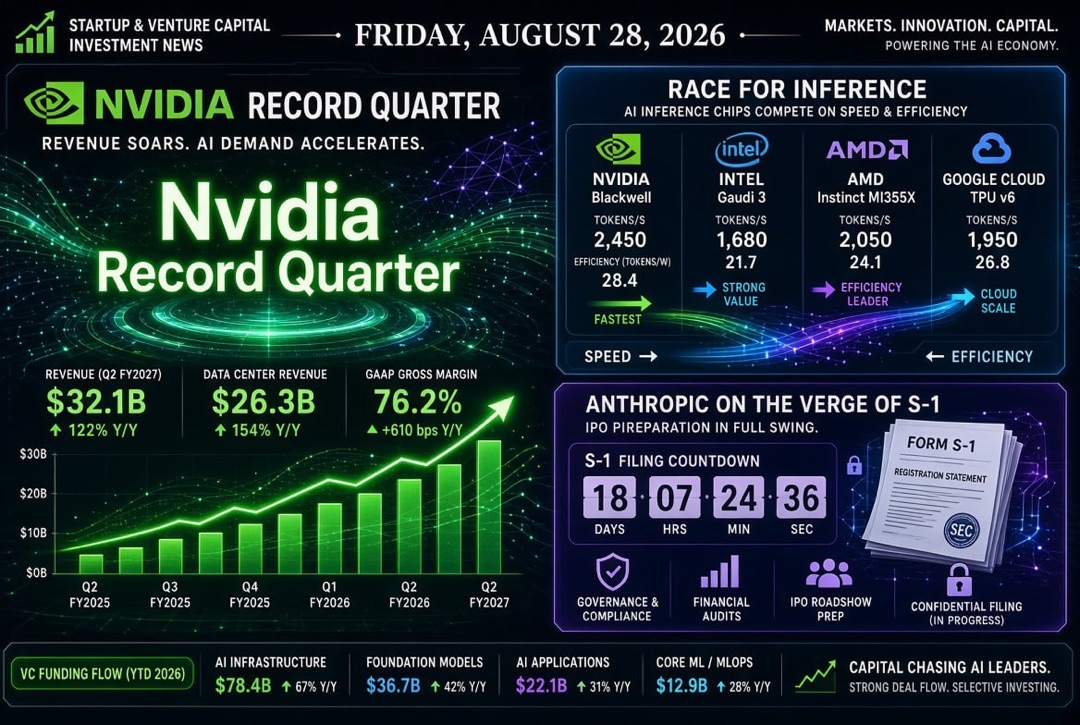
- Nvidia: Revenue of $96.2 billion (+106% YoY), quarterly forecast of $108 billion. The company provided its first preliminary guidance for Financial Year 2028—around 70% growth amid supply constraints.
- Anthropic Prepares Public S-1. The launch of the public version of the prospectus is anticipated by the end of August, with a listing on Nasdaq set for October and an offering volume potentially exceeding $60 billion.
- The Race for Inference. Etched is valued at $21 billion after a $700 million round, while Groq is relaunching with a $3.5 billion valuation and involvement from Nvidia.
- Instinct—New AI Unicorn. The startup, founded by a 23-year-old entrepreneur, raised $250 million at a valuation of $2.5 billion from Index Ventures and Benchmark.
- Record Global Venture Investment. $510 billion in the first half of the year, with 43% attributed to OpenAI and Anthropic.
- Russia: Market Contraction. Venture investment volume for the first half of the year fell by 48%, amounting to 4.6 billion rubles.
Nvidia: "Computing Equals Revenue" as the New Benchmark for the Venture Market
Nvidia's quarterly report, released Wednesday evening, became the de facto barometer for the entire AI ecosystem. Revenue reached $96.2 billion—an 18% increase from the previous quarter and a 106% year-over-year jump; the data center segment generated $89 billion (+117%). Adjusted earnings per share were $2.22 compared to the consensus of $2.10. The forecast for the third quarter—$108 billion ±2%—surpassed analysts' expectations and the stock gained approximately 4–5% in after-hours trading.
For venture investors, the phrasing matters more than the numbers. Jensen Huang stated that AI has crossed a tipping point: tokens have become productive and profitable, and "computing has transformed into revenue." A year ago, infrastructure development was driven by a single lab; today, it involves numerous frontier labs, an open ecosystem of models, and physical AI. A notable signal is the agreement with Amazon Web Services to purchase 2 million GPUs and Vera processors, along with the full launch of the Vera Rubin platform.
Risks to Consider
- Gross margin is expected to decrease to 71–72% by Q4 due to a memory shortage, which the company acknowledges has largely been created by the AI boom itself.
- The 2028 guidance is "supply-constrained": demand exceeds what Nvidia is capable of delivering, which supports valuations of neocloud startups but raises the entry cost for new players.
Anthropic and OpenAI: The Countdown to IPO
The theme defining the autumn for venture funds will be the stock market introductions of the two largest private companies in the AI sector. Anthropic, which filed a confidential S-1 on June 1, is reportedly set to publish the public version of its prospectus by the end of August. Lead underwriters include Goldman Sachs, JPMorgan, and Morgan Stanley; the target venue is Nasdaq, the window is October, and the offering volume exceeds $60 billion. The last private valuation was $965 billion following a $65 billion Series H round, while the secondary market is already pricing the company in the $1.05–1.15 trillion range.
A notable detail: the risk section of the prospectus is expected to mention "negative public sentiment toward AI" and opposition to building data centers—factors that are making their debut at the IPO-documentation level. OpenAI, valued at $852 billion after a $122 billion round, is taking a more cautious trajectory: CFO Sarah Friar informed employees of a target listing in 2027, and the August tender for employees at $7 billion took place at the previous valuation. For LPs, this means that the first wave of liquidity from AI mega-rounds will come through Anthropic, and its scale may reboot the venture fundraising cycle.
The Race for Inference: Etched, Groq, and the Reevaluation of Chip Startups
The week showcased two contrasting scenarios for startups challenging Nvidia in the inference market.
Etched: Valuation Doubles in a Month
Etched, founded by three Harvard graduates, raised $700 million in a Series D round at a $21 billion valuation. The lead investor was not a venture firm, but the quantum trader Jane Street—the company's first client, which has already installed an Etched rack in its own data center. A month earlier, a Series C round led by Sequoia had valued the startup at $10.3 billion; its order book exceeds $1 billion. Other participants in the round included Kleiner Perkins, Andreessen Horowitz, Tiger Global, Bain Capital Ventures, and Blackstone.
Groq: Relaunch at Half-Valuation
Groq closed its Series A at $350 million with a valuation of $3.5 billion—half its peak valuation of $6.9 billion in September 2025. The round was led by Disruptive, and Nvidia's involvement—having previously licensed Groq's technology for $20 billion and poaching its founder—feels significant. The company is transitioning from a chip developer to a neocloud based on Nvidia accelerators and plans to expand its facilities from 54 MW to over 200 MW by 2027.
The takeaway for investors: the market is willing to pay a premium for operational "hardware" with signed clients and to discount projects lacking control over their own technology.
Mega Rounds of the Week: From AI Assistants to Orbital Data Centers
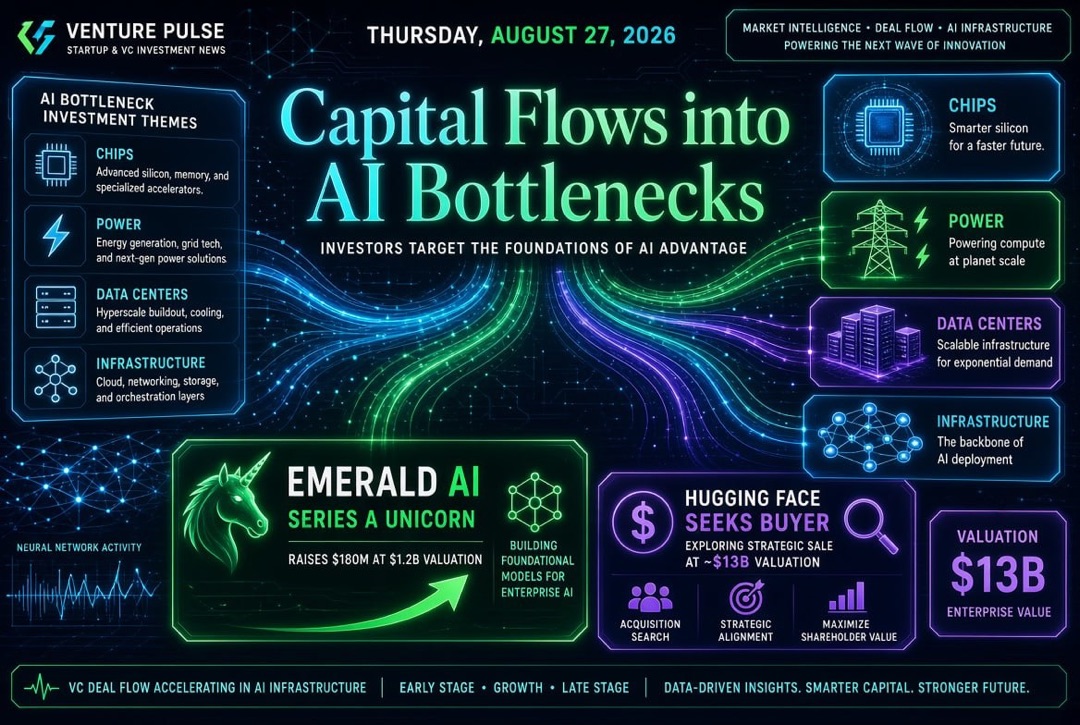
- Instinct — $250 million Series B at a valuation of $2.5 billion (Index Ventures, Benchmark). A personal AI agent, founded less than a year ago, has become the most discussed consumer startup of the summer.
- Muon Space — $250 million Series C at an estimated valuation of around $1.5 billion for satellite constellation manufacturing; the round included Google, Salesforce Ventures, and Wellington.
- Starcloud — Series A extension of $250 million at a valuation of $2.3 billion for orbital data centers for AI inference.
- Wispr — $280 million Series B at a $2 billion valuation from Menlo Ventures; AI dictation enters the meetings segment.
- Rillet — $100 million Series C from Iconiq: AI ERP for finance teams became a unicorn within 48 hours amidst the accountant shortage in the US.
- Velaura AI — $110 million Series A for AI computing infrastructure.
- Stability AI — $76 million Series B from Universal, Sony, Warner, and EA: media holding companies become strategic investors in generative AI.
Europe: Callosum, Sovereign Capital, and Record Seed Round
London-based Callosum raised $100 million in one of the largest seed rounds in European history. The lead investor was Atomico, with participation from Plural, DCVC, and the UK Sovereign AI Fund worth £500 million—marking the first disclosed investment for the sovereign fund. The startup, founded by neurobiologists from Cambridge, is building a software layer that allocates AI tasks among different models and chips, including Cerebras and Rebellions. The deal confirms Europe’s bet on "heterogeneous computing" as a way to reduce dependence on Nvidia. Earlier in August, Swedish Lovable confirmed a valuation of $13.3 billion following a $400 million round, while Crunchbase recorded Europe's strongest venture quarter in four years.
Market Numbers: Record $510 Billion and Capital Concentration
- Global venture investment in the first half of 2026 reached $510 billion, surpassing the total for all of 2025 ($440 billion).
- OpenAI and Anthropic captured $217 billion—43% of all venture investments for the half-year; the share of AI startups in Q2 exceeded 70%.
- July brought in $65 billion (+100% YoY) and a record 14 rounds exceeding $1 billion; AI accounted for 53%, followed by aerospace, defense, and energy.
- Exits are back: in Q2 there were 32 IPOs over $1 billion and a record $113 billion in M&A; July saw the addition of 40 companies to the unicorn list—the highest in four years.
- Physical AI (robotics, autonomous systems) attracted $47.4 billion in 521 deals during the half-year.
Russia and the CIS: Market Contracts, Focus on Industrial Tech
The Russian venture market is moving against the global trend. According to the Moscow Venture Fund, investment volume for the first half of 2026 has decreased by 48% year-on-year, amounting to 4.6 billion rubles, while the number of deals fell by 45% to 54. Over 61% of funded projects relate to IT, with 83% of deals in early stages. The only growing segments are industrial technologies and business software. Market participants anticipate a revival by year-end amid easing monetary conditions: the forecast for 2026 indicates a growth of 10–15%, reaching ~17 billion rubles, with private and state funds remaining the main drivers, while business angel activity is limited.
What This Means for Venture Funds: Conclusions and Forecast
- Infrastructure remains the primary bet. Nvidia's report and the rounds from Etched, Groq, Velaura, and Callosum indicate that capital is flowing into the layer of inference and orchestration of computing.
- Liquidity is approaching. Anthropic's public S-1 could be the biggest event of autumn and return LP funding for a new venture fundraising cycle.
- Concentration presents both risk and opportunity. When two companies absorb 43% of capital, the remaining market competes for a smaller share, yet is less overheated.
- Strategists are changing the structure of rounds. Jane Street, media holdings, and sovereign funds are increasingly leading deals, pushing out classic venture firms.
- Defense, space, and physical AI are solidifying as the second tier of growth following generative AI.
In conclusion, as of August 28, 2026, venture investments are experiencing unprecedented growth, but the quality of this growth is determined not by the number of deals but by access to computing, real revenue-generating clients, and proximity to the IPO window. Investors shaping their strategies for the fourth quarter should anticipate both scenarios of large exits and corrections in valuations for segments without proprietary technology.