Key themes shaping the agenda for venture investors and funds on October 16, 2026:
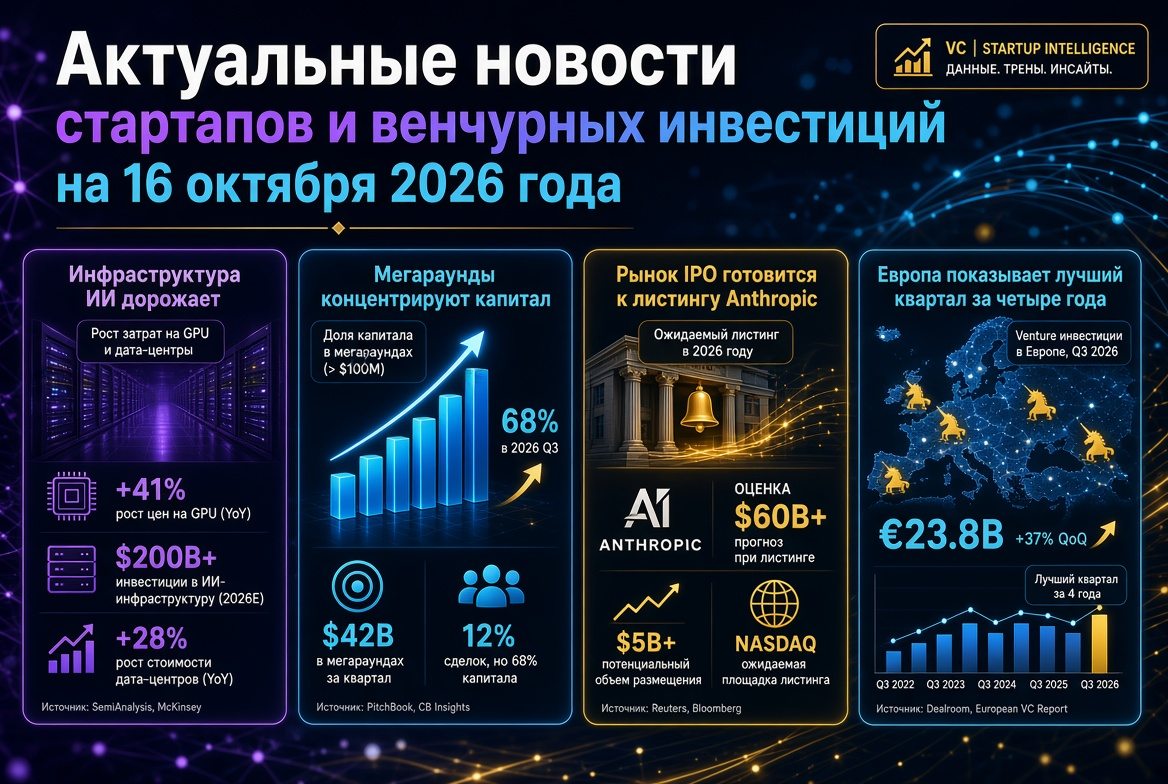
- Q3 Results. Capital is concentrating in mega-rounds, with AI's share of global venture funding approaching two-thirds.
- New decacorns in AI infrastructure. Modal Labs and Applied Intuition are demonstrating multiple growth in valuations within a few months.
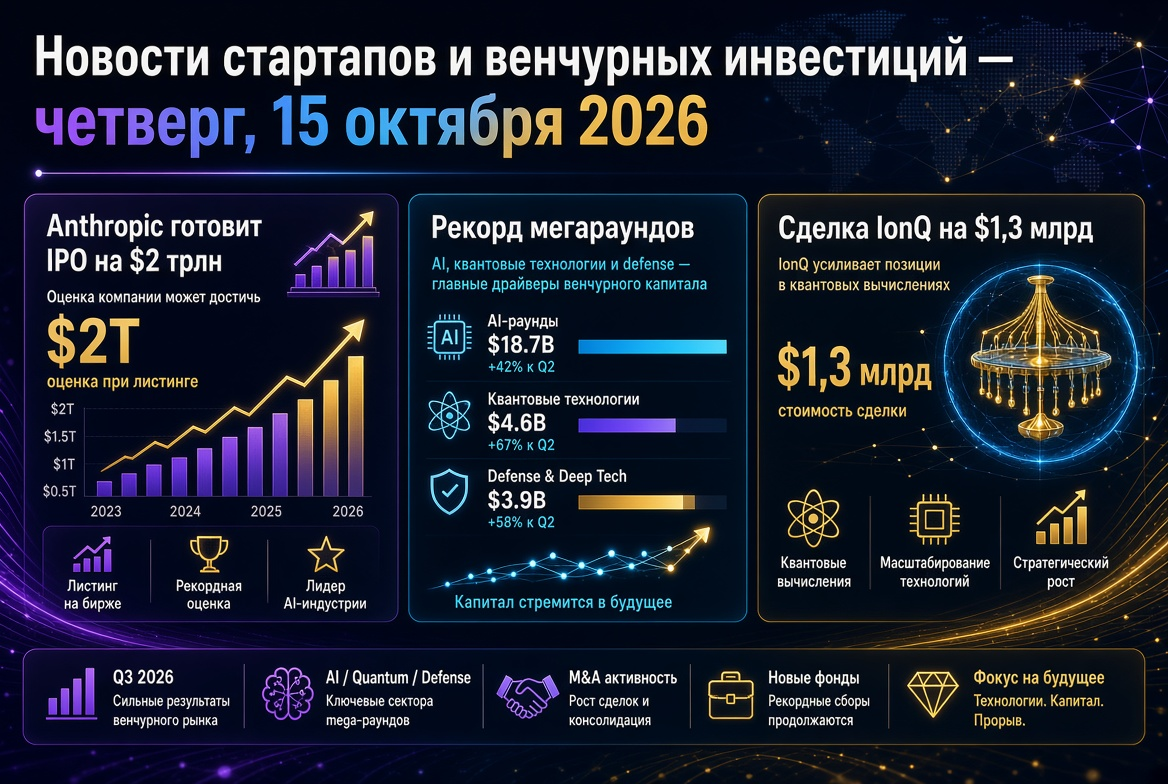
- Preparing for Anthropic’s IPO. The market is awaiting the public S-1 form, the timing of which will determine the November placement window.
- European deep tech. Photonics, energy storage, and government funds are supporting the region's best quarter in four years.
- Early stages. Seed rounds of $50–60 million are becoming the norm for teams with a strong technological foundation.
Venture Market in Q3 2026: Less Money, More Mega-Rounds
According to Crunchbase, global venture funding in Q3 2026 totaled $159 billion. Approximately 6,000 startups received funding. This represents a 25% decrease from the record $212 billion in Q2 but is 53% higher than the previous year. Over nine months, the total volume of venture investments reached $679 billion, the highest level for this period on record.
The structure of the market has changed more significantly than its volume:
- Record Mega-Rounds. 27 companies secured $1 billion or more, compared to 16 in Q2 and 14 in Q1. These deals accounted for roughly one-third of the total quarterly capital.
- AI Dominance. Startups in the field of artificial intelligence received $102 billion, or 64% of global venture funding.
- Quarterly Leaders. Databricks and Safe Superintelligence each raised $5 billion, while six other companies secured at least $3 billion each.
- Early Stage Growth. Funding for early stages rose by 25% year-on-year, reaching $40.6 billion. Seed rounds collectively accounted for $13 billion.
The concentration is also evident on the fund side. According to PitchBook and NVCA, in the first half of the year, Andreessen Horowitz, Thrive Capital, and Founders Fund accounted for 48.1% of all capital raised by U.S. venture funds. The formation of first-time funds is declining to a minimum since 2016.
AI Infrastructure: Modal Labs Triples Valuation and Joins Decacorn Club
The most talked-about deal of the week is the Modal Labs round. The New York-based server infrastructure provider for inference is closing a $750 million round led by Accel at a valuation of $15.75 billion. Just in May, the company was valued at $4.65 billion in a Series C round of $355 million. Thus, its valuation has more than tripled in about four months.
The rationale for investors is clear:
- Modal's annual revenue exceeded $300 million as early as spring;
- The demand is fueled by AI agents and programming tools that require isolated execution environments for code;
- The pay-per-use pricing model fits well for fluctuating inference workloads.
This deal reinforces the thesis increasingly incorporated into investment strategies by funds: in 2026, the fastest re-evaluation is occurring at the “shovels and picks” level of the AI-agent economy.
Autonomous Systems and Defense Technologies: Applied Intuition Valued at $30 Billion
Software developer for autonomous vehicles Applied Intuition has received investment offers valuing it at no less than $30 billion. This is double the $15 billion level recorded in the Series F round. A round exceeding $1 billion may occur in the coming months.
Key parameters for investors:
- The company works with 18 of the 20 largest global automakers;
- The $30 billion valuation corresponds to approximately 36 times the annual revenues from projected recurring revenue of $830 million for 2025;
- The rising multiple is associated with entry into military and off-road autonomy, where Applied Intuition competes with Anduril and Saronic.
In the same segment, Fortastra raised $30 million in a Series A round for maneuverable spacecraft for orbital safety. Delivery drone developer Rino.ai closed its Series C at $100 million.
Anthropic IPO: Market Awaits Public S-1
The primary question for the public offering market is the timeline for Anthropic’s IPO. The company confidentially filed its S-1 draft on June 1, shortly after a Series H round at a $65 billion valuation, capturing a valuation of $965 billion. According to business press, Nasdaq has been chosen as the venue, and the target window has shifted from October to November, allowing investors to see Q3 results.
If the marketing for the offering kicks off during the week of November 9, the public version of the prospectus should emerge by the end of October. Market benchmarks under discussion are reaching $2 trillion. For venture funds, this deal is crucial for three reasons:
- It will set the standard for financial information disclosure for the entire AI sector;
- It will be a test for late-stage valuations in the private market;
- A successful listing may open the window for exits for other major AI companies.
Asia: Manus Raises $500 Million After Deal with Meta Falls Through
AI-agent developer Manus (parent company of Butterfly Effect) has raised over $500 million. This is the first round since Chinese authorities pressured Meta to abandon the acquisition of the startup for approximately $2 billion. The round was led by Boyu Capital and IDG Capital, with participation from Tencent, HSG, and ZhenFund. The valuation is undisclosed, but it was previously reported to be around $4 billion. The company is also considering an IPO in Hong Kong.
This deal demonstrates that regulatory risks surrounding cross-border M&A in AI do not dampen local investors' appetite for agency platforms.
Europe: Deep Tech, Photonics, and Government Funds
European startups raised about $25 billion in Q3. This is the best result for the region in four years, representing a 77% year-on-year increase. October deals confirm the shift towards deep technologies:
- Skeleton Technologies (Estonia) received a nine-digit strategic investment from Siemens and entered the unicorn club. The company will allocate over $200 million for expansion and R&D in Silicon Valley focused on AI data centers.
- Salience Labs (Oxford) raised $125 million for optical switches that connect thousands of GPUs using light.
- Rabot Energy closed a Series B round of $50 million to turn home batteries into a virtual power plant.
- British Business Bank supported Entrepreneurs First, Headline, and Evantic through a £180 million program for AI funds.
Seed and Early Rounds: A New Norm for Check Sizes
Early-stage startups are becoming increasingly capital-intensive. Notable deals in recent days include:
- Hone — a seed round of $60 million from Benchmark and Index Ventures at a valuation of $285 million for autonomous AI agents responsible for business outcomes;
- Sabi — seed funding of $50 million led by Khosla Ventures for a wearable neurointerface;
- Oratomic — Series B of $475 million for fault-tolerant quantum computers;
- Arena — Series B of $200 million at a valuation of $3.1 billion from Lightspeed and Khosla Ventures, nearly doubling its January valuation;
- Multiply Labs — Series B of $75 million from Lux Capital for automating pharmaceutical manufacturing;
- Matchpoint Therapeutics — Series B of $150 million for "molecular glue" drugs.
Fintech also remains active. Valon Technologies raised $150 million at a valuation of $2.3 billion, Capitolis secured $120 million in a Series E round, and Spiko raised $90 million in a Series B round.
Russia: Cautious Market and Focus on Corporate Demand
The Russian venture market is moving against global trends. According to the Moscow Venture Fund, in the first half of 2026, the volume of venture investments decreased by 48% to 4.6 billion rubles, while the number of deals dropped by 45% to 54. High returns from risk-free instruments divert capital away from startups, resulting in funding primarily for B2B projects with transparent revenues and corporate customers.
Support infrastructure is, however, expanding:
- The Moscow Venture Fund will direct 250 million rubles toward technology companies and expects to attract around 1 billion rubles in co-investments;
- FRII launched a fund of 300 million rubles for startups in the information security sector.
What Investors Should Monitor Next Week
- Publication of Anthropic's S-1. The filing timing will serve as a key indicator for the tech IPO market.
- Closure of Applied Intuition's round. Its outcomes will indicate whether the market is ready to pay a premium for dual-use autonomy.
- Money20/20 USA (October 18–21). The conference is expected to unveil new fintech deals and partnerships.
- Oslo Innovation Week (October 19–23). A platform for announcements from Scandinavian climate and deep tech ventures.
The venture market in 2026 operates on the principle of “fewer deals — larger checks.” Capital is rapidly reassessing AI infrastructure, while mega-rounds and preparations for major IPOs are forming a new benchmark system for valuations. For venture investors and funds, discipline is coming to the forefront: revenue, multiples, and a realistic path to exit are more important than the volume of the announced round.