Current Startup and Venture Capital News as of December 1, 2025: Mega Funds, Record AI Rounds, Deals, IPOs, and Global Technology Market Trends.
The venture capital market is experiencing a resurgence, with major funds and strategic investors actively returning, setting the stage for investment formats in 2026. Central to this revival are large rounds in artificial intelligence and a rejuvenation of the IPO market. Meanwhile, capital is being allocated across a wide array of sectors—ranging from traditional fintech and biotech projects to clean energy and space startups—as venture expansion reaches new regions. Below, we summarize the key trends and events shaping the investment landscape as we enter December 2025.
- The Return of Mega Funds and Large Capital. Investment giants are forming record funds and injecting tens of billions into startups, bolstering risk appetite.
- Record AI Rounds and a Wave of New Unicorns. Unprecedented investments in the AI sector are driving startup valuations to unseen heights, resulting in the emergence of hundreds of new unicorn companies.
- Revitalization of the IPO Market. Following a prolonged lull, public offerings have resumed with successful tech company launches attracting billions, paving the way for exits for investors.
- Diversification of Investments Across Sectors. Venture capital is reaching beyond AI: fintech and biotech are seeing a revival, and investments in energy, climate tech, space tech, defense, and other innovative niches are on the rise.
- Consolidation and M&A. Mergers and acquisitions are gaining momentum, with major corporations and funds acquiring promising startups and creating joint ventures, providing new exit pathways.
- Global Expansion. The investment boom is moving into new markets: Asia, the Middle East, Africa, and Latin America are demonstrating record growth rates in startup financing.
- Renewed Interest in Crypto Startups. Following regulatory clarity, blockchain projects are again attracting significant investments: fintech participants in the crypto sector are preparing for IPOs and major funding rounds.
- Local Focus: Russia and the CIS. Despite constraints, new funds and support programs for startups have emerged here. Currently, market volumes are modest, but investments in AI and industrial technologies continue to grow.
Return of Mega Funds: Major Players Ready to Invest Again
The largest investors are re-entering the venture scene with record funds. After a "long pause," Japan's SoftBank has announced the launch of Vision Fund III with approximately $40 billion for advanced technologies (AI, robotics, etc.). Silicon Valley is responding with similar magnitude: Andreessen Horowitz is establishing a new $10 billion fund (with about $6 billion allocated for late-stage investments and $1.5 billion each for AI applications and AI infrastructure), while Sequoia Capital is launching around $950 million in early-stage funds (seed and Series A). Sovereign funds from the Gulf region (Mubadala, PIF, etc.) and major corporations are also actively deploying billions into promising startups worldwide. This influx of "big money" is filling the ecosystem with liquidity, enabling riskier projects to secure massive rounds and instilling confidence in continued growth.
- SoftBank (Vision Fund III) – about $40 billion for AI and robotics.
- Andreessen Horowitz – $10 billion fund (growth and AI sectors).
- Sequoia Capital – ~$750 million (Series A) + $200 million (seed) for the earliest projects.
- Sovereign Funds (PIF, Mubadala) – tens of billions for global VC projects.
Record AI Rounds and New Unicorns
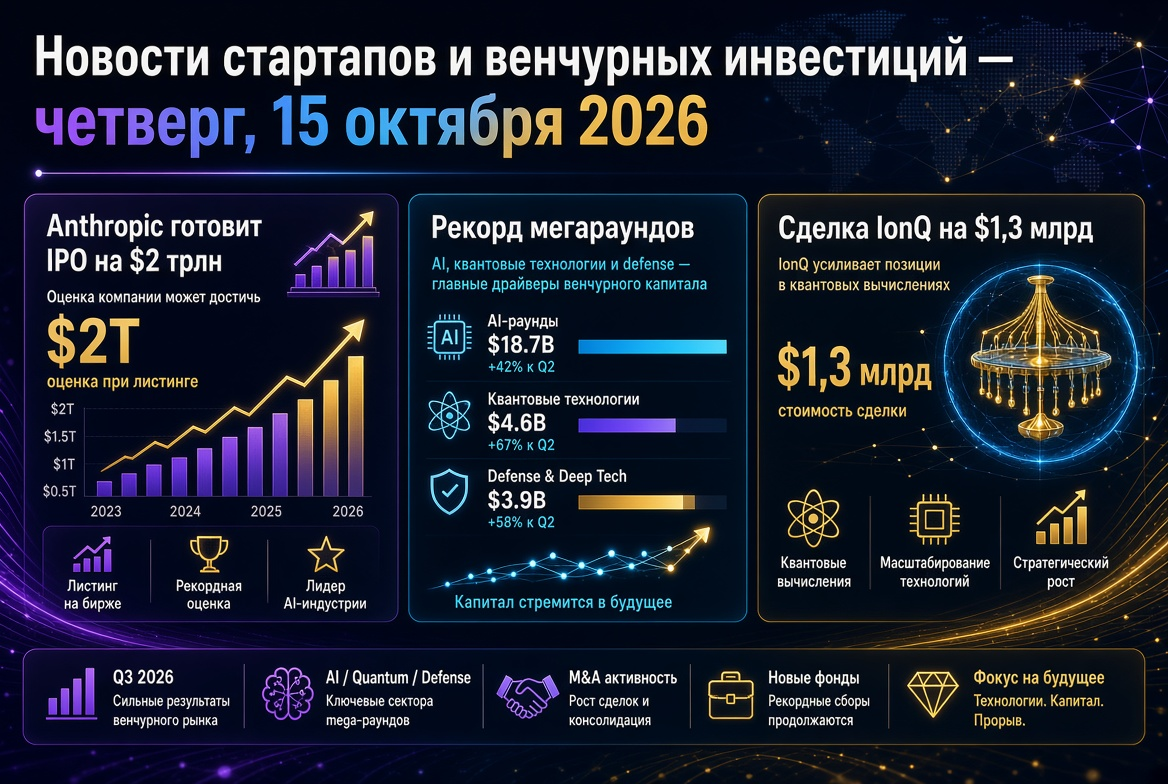
The artificial intelligence sector remains the primary driver of the venture boom. By the end of Q3 2025, global VC funding reached approximately $97 billion (a 38% increase year-on-year), with about 46% ($~45 billion) attributed to AI startups. Leading projects with foundation models, such as American companies Anthropic and xAI, have raised $13 billion and $5.3 billion respectively, bringing their valuations close to hundreds of billions. Major funding rounds continue weekly: in France, Mistral AI secured €1.7 billion (valuation ~$11.7 billion) in September, American service Cursor (Anysphere) raised $2.3 billion at a valuation of ~$29.3 billion in November, and healthcare startup Hippocratic AI obtained $126 million. In total, dozens of projects have surpassed the "unicorn" threshold in recent months. Investors are closely monitoring various AI directions (generative AI, autonomous systems, neural networks), while simultaneously assessing overheating risks by emphasizing team quality and real commercialization.
- Anthropic (USA) – $13 billion (Series F)
- xAI (USA) – $5.3 billion (Series A)
- Mistral AI (France) – €1.7 billion (Series C)
- Cursor / Anysphere (USA) – $2.3 billion (Series B)
- Hippocratic AI (USA) – $126 million (Series C)
- Others: Reflection.ai and Polymarket (about $2 billion each), Crusoe ($1.4 billion), Base Power ($1 billion), Luma AI ($0.9 billion).
Revitalization of the IPO Market: A New Wave of Public Offerings
Following a summer lull, the public offering market has reactivated. In Asia, this wave has affected Hong Kong and Singapore: several large tech companies have gone public, raising billions collectively. For instance, Chinese battery manufacturer CATL raised around $5 billion during its IPO in Hong Kong, confirming investor interest in Asian IPOs. In the United States, momentum is also accelerating: fintech unicorn Chime recently debuted on the stock exchange with its shares rising nearly 30% on the first day. It was followed by design platform Figma, which raised approximately $1.2 billion. The cryptocurrency sector is not lagging behind: payment company Circle launched on Nasdaq with an IPO of ~$1 billion (market cap ~$7 billion), while cryptocurrency exchange Bullish has applied for a listing with a valuation of ~$4 billion. Although some individual offerings (such as travel service Navan in October) faced challenges (shares dropped 20% upon opening), the overall revival of IPOs instills optimism: successful exits allow funds to realize profits and reinvest in the venture capital market.
- CATL (China) – ~$5 billion IPO in Hong Kong.
- Chime (USA, fintech) – successful IPO, up +30% on the first day.
- Figma (USA) – ~$1.2 billion IPO (valuation ~$20 billion).
- Circle (USA, crypto-fintech) – ~$1 billion IPO (stablecoin platform).
- Bullish (USA, crypto exchange) – IPO application with a valuation of ~$4 billion.
- Navan (USA, travel) – $0.9 billion IPO (shares down -20% from the issue price).
Diversification of Investments: Expanding Horizons
Beyond AI, venture capital is increasingly directing funds into other sectors. Fintech projects (new payment systems, blockchain in finance), biotechnologies (medicine, genetics, diagnostics), clean energy, and climate solutions are seeing a revival. For example, startups in renewable energy have received significant investments: AI data centers Crusoe and Base Power raised approximately $1.4 billion and $1 billion, respectively. This has increased demand for biotech and climate tech startups: projects related to sustainable energy, smart cities, and agritech are regularly receiving funding. Additionally, defense and national projects (AI for security, robotics) are becoming part of the portfolios of major funds. Such breadth of focus reduces risks and opens up additional niches for investors.
- Fintech and DeFi – a resurgence of startups in payments, lending, and financial technologies.
- Biotechnology and Health – projects in medicine, genetics, and telemedicine.
- Climate and Clean Energy – startups in renewable sources, energy efficiency, agritech.
- Space and Aerospace Technologies – private space projects, satellite systems.
- Defense and Security – AI systems for military, national infrastructure, "security technologies."
Consolidation and M&A: Companies Joining Forces
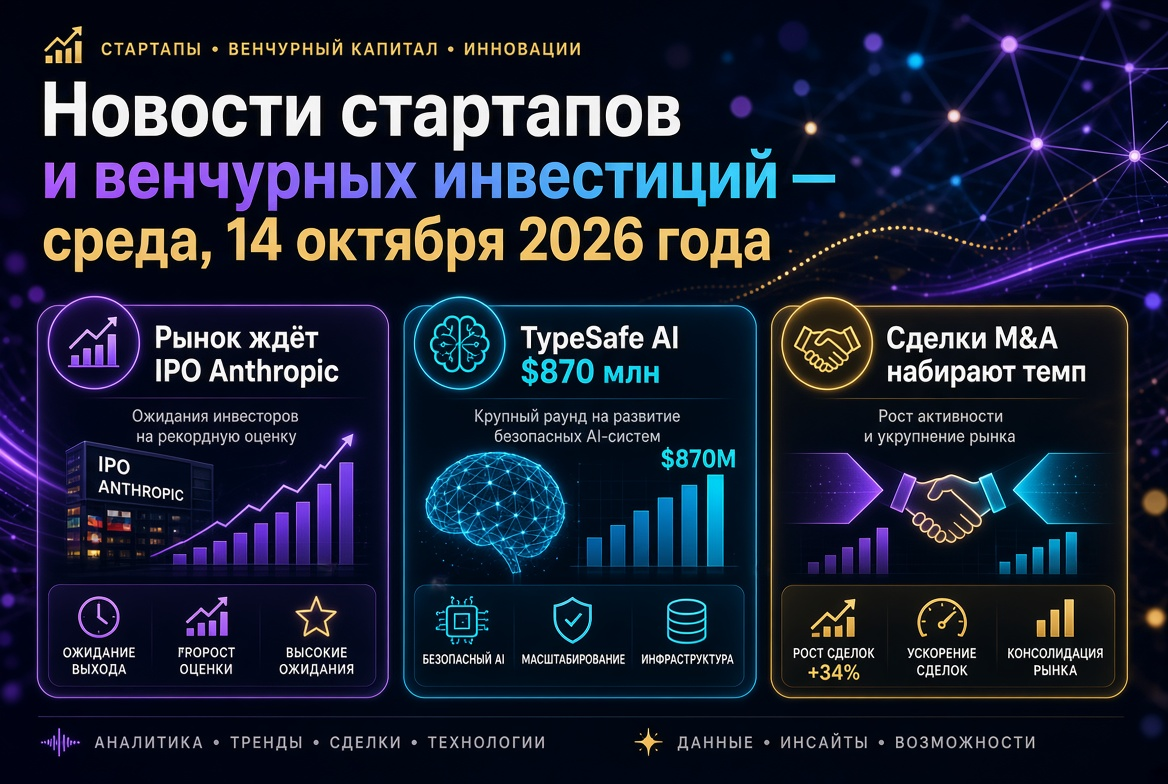
There is a noticeable increase in mergers and acquisitions within the technology sector. Major corporations and funds frequently acquire promising startups to broaden their capabilities (through corporate M&A and venture accelerators). This creates new exit routes for investors: by selling companies to strategic buyers, funds can lock in profits and return liquidity to the ecosystem. Concurrently, major joint projects are emerging between startups and industry leaders (for example, fintech alliances and collaborative AI labs). Consequently, the market is being reshaped not only through new rounds of funding but also through tighter integration of technologies between larger players and startups.
Global Expansion: New Hubs and Regions
The investment boom is finding its way into new markets. The Asian sector is growing steadily: Indian startups attracted about $1.7 billion in investments in November alone (up 3x year-on-year), while Chinese companies raised $3.9 billion in October (+200% YoY). Africa continues to develop rapidly, with $2.65 billion in venture capital secured in the first half of 2025 (+56% year-on-year), primarily in fintech and mobile technologies. Latin America is also gaining momentum: its largest market, Brazil, raised $692 million in Q3 2025 (+47% YoY), driven by active deals in fintech and healthcare. At the same time, interest is rising in Southeast Asia (Singapore, Indonesia) and the Middle East (Dubai, Saudi Arabia), where new technology clusters are being established, attracting global VC funds.
- Asia: India ~$1.7 billion (November, +200% YoY); China ~$3.9 billion (October, +200%).
- Africa: $2.65 billion (January–October 2025, +56%); leaders include Kenya, Nigeria, Ghana.
- Latin America: $692 million in Q3 2025 (+47% YoY); drivers include fintech and healthcare.
- Middle East: Billion-dollar funds (UAE, Saudi Arabia) invest in global VC projects.
- Southeast Asia and the Pacific – rapidly growing startup ecosystems and new accelerators.
Renewed Interest in Crypto Startups
Crypto projects are once again capturing the attention of venture investors. According to Carta, blockchain startups secured $904 million in the first half of 2025—a 47% increase compared to the same period in 2024. This resurgence is linked to regulatory clarity (GENIUS Act and other legislation), which has alleviated many investor concerns. In this context, exits are also becoming more frequent: in the summer, payment company Circle conducted an IPO worth $1 billion, while blockchain lender Figure and cryptocurrency exchange Gemini followed suit with IPOs of $787.5 million and $425 million, respectively. Validators and DeFi projects are also gearing up for new rounds, considering the favorable market sentiment and the requests of financial regulators. All this points to a return of substantial capital to the Web3 ecosystem.
- $904 million – investments in crypto companies in H1 2025 (up +47% YoY).
- Crypto company IPOs: Circle ($1 billion), Figure ($787.5 million), Gemini ($425 million).
- New regulations: The GENIUS Act and other legislative measures aim to support the crypto industry.
- Blockchain startups in adjunct fields (NFTs, Web3 SaaS, DeFi) are preparing for significant funding rounds.
Local Perspective: Russia and the CIS
Against the backdrop of the global boom, the market in Russia and CIS countries remains relatively small and not fully open. According to ComNews, from January to September 2025, Russian tech companies attracted only $125.5 million (up 30% year-on-year). Key niches include IndustrialTech (approximately $29.7 million), Healthcare ($19.2 million), and FinTech ($18.3 million). Notably, AI companies lead in volume: they accounted for $60.4 million in investments (32 transactions). In the CIS, a similar picture emerges: small rounds are being conducted in Kazakhstan, Belarus, and Uzbekistan, often with the participation of local funds. New government programs and accelerators (FRII, RVC, Skolkovo, etc.) are emerging, but large international investors have yet to engage. Overall, the region anticipates an influx of private capital and the easing of barriers—key elements for scaling local startups in the coming years.
- Russia: $125.5 million in 9 months of 2025 (+30% YoY); 103 transactions during the period.
- Main sectors: IndustrialTech ($29.7M), Healthcare ($19.2M), FinTech ($18.3M).
- AI and Machine Learning: $60.4 million in investments (32 transactions)—the leader in transaction volume.
- CIS: Kazakhstan, Uzbekistan, Belarus—all active in "early" deals ($1–5 million), often involving state funds.
- New initiatives: Russian incubators and government funding (FRII, RVC, etc.) are gradually expanding support for startups.