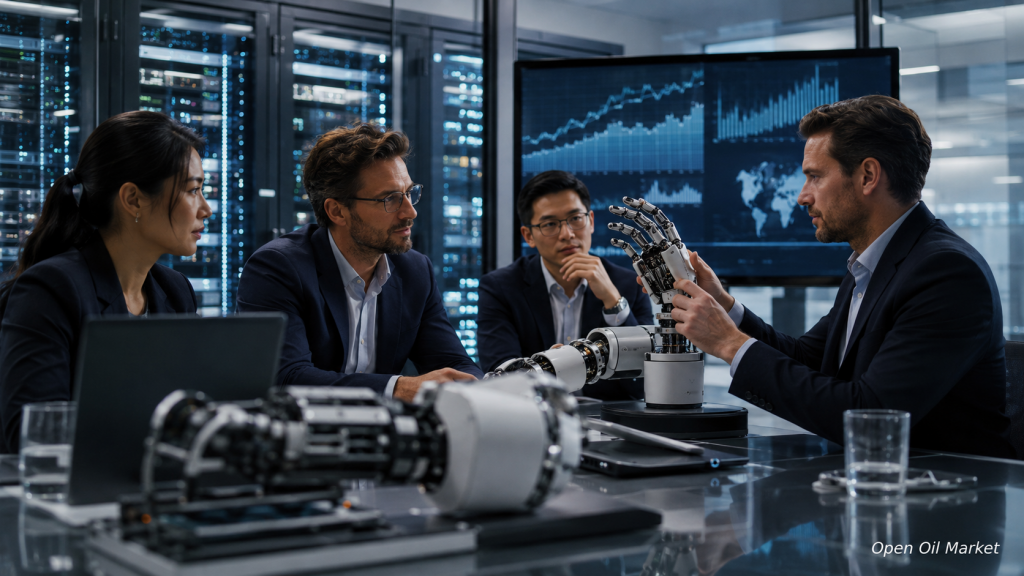
Startup and Venture Investment News as of May 11, 2026: AI Transitions from Model Racing to Implementation, Robotics Attracts Capital, and the Startup IPO Market Revives
The global venture market enters a new week with heightened activity, but with a different focus compared to the beginning of the year. While the primary theme during the first quarter of 2026 was the record funding rounds for major AI startups, by May, investors are increasingly assessing not only the volume of capital raised but also the companies' ability to translate technology into revenue, corporate deployment, and liquid exits.
Following an unprecedented first quarter, where global venture investments reached around $300 billion, the market did not take a break. In April, the volume of global startup funding amounted to approximately $56 billion, with the largest deals still centered on artificial intelligence. The demand structure is maturing: AI infrastructure, robotics, corporate services, data center energy, space technologies, and companies poised for IPO in the coming quarters are now at the forefront.
- AI startups maintain their dominance in venture investment volume.
- Capital is shifting from pure model development to the practical implementation of artificial intelligence in business.
- The startup IPO market is expanding beyond a single sector and becoming a key indicator for funds.
- Robotics and "physical AI" are creating a new wave of unicorns.
- India, China, and Europe are strengthening their roles in the global startup ecosystem.
The AI Market is Changing Phase: Investors Now Pay for Implementation, Not Just Models
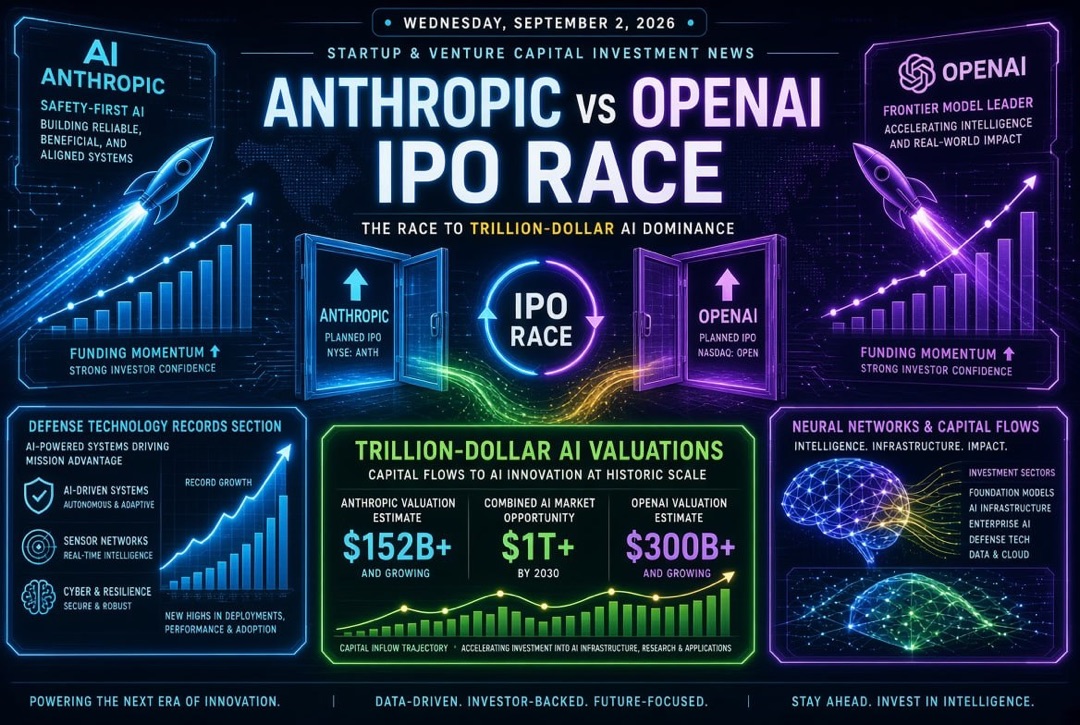
The significant news in the venture market in recent days is the shift of major AI companies to a new growth model. OpenAI and Anthropic, with backing from large investors and private equity funds, have begun to form separate structures for acquiring companies specializing in the implementation of artificial intelligence in corporate processes. OpenAI-backed The Deployment Company received support of about $4 billion, while Anthropic, along with Blackstone, Goldman Sachs, and Hellman & Friedman, is building a similar platform worth around $1.5 billion.
For venture investors, this is an important signal. The next phase of the AI cycle will be determined not only by the quality of the models but also by the speed of their integration into industry, finance, logistics, healthcare, and professional services. A new segment of M&A is forming, where value is not only in algorithms but also in engineering teams, consulting, client access, and the ability to rapidly implement AI in the real economy.
Major Funding Rounds Persist, but the Market Demands Proven Commercialization
Interest in AI startups remains strong. One of the most notable events of the week was a new round for Sierra: the company creating AI agents for customer services raised about $950 million at a valuation exceeding $15 billion. The deal demonstrated that investors are willing to fund not only fundamental models but also applied solutions capable of rapidly scaling within large companies.
However, the quality of growth is becoming increasingly important. For venture funds in 2026, three parameters are critical:
- The presence of paying corporate clients;
- Scalability economics without endless growth in computational costs;
- The ability of the startup to secure a sustainable position in the value chain rather than being a temporary interface on top of someone else's model.
This is why venture investments are increasingly being allocated to AI infrastructure, enterprise software, automation services, and vertical solutions for specific industries.
Robotics Becomes the Second Main Focus After Artificial Intelligence
While in 2025 robotics was perceived as an adjacent trend, in 2026 it has become a full-fledged capital attraction center. In April, 28 companies joined the global unicorn list, with a significant portion of this growth driven by frontier AI laboratories and robotics startups. There is particularly strong demand for companies that integrate large models, sensors, and real industrial scenarios.
French startup Genesis AI has introduced the GENE-26.5 model and a humanoid robotic hand capable of performing delicate operations—from working with products to manipulating small objects. The company is already negotiating with industrial clients in Europe. Simultaneously, Chinese Linkerbot, after a round valuing it at about $3 billion, is considering further increasing its valuation to $6 billion.
For the venture market, this indicates the emergence of a new asset category—physical AI, where software models have a direct outlet to industries, logistics, pharmaceuticals, and manufacturing. The potential here is assessed to be higher than that of many classic SaaS models, as it involves not just replacing individual functions but restructuring entire production processes.
The IPO Market is Reviving: Startups are Seeing a Path to Liquidity Again
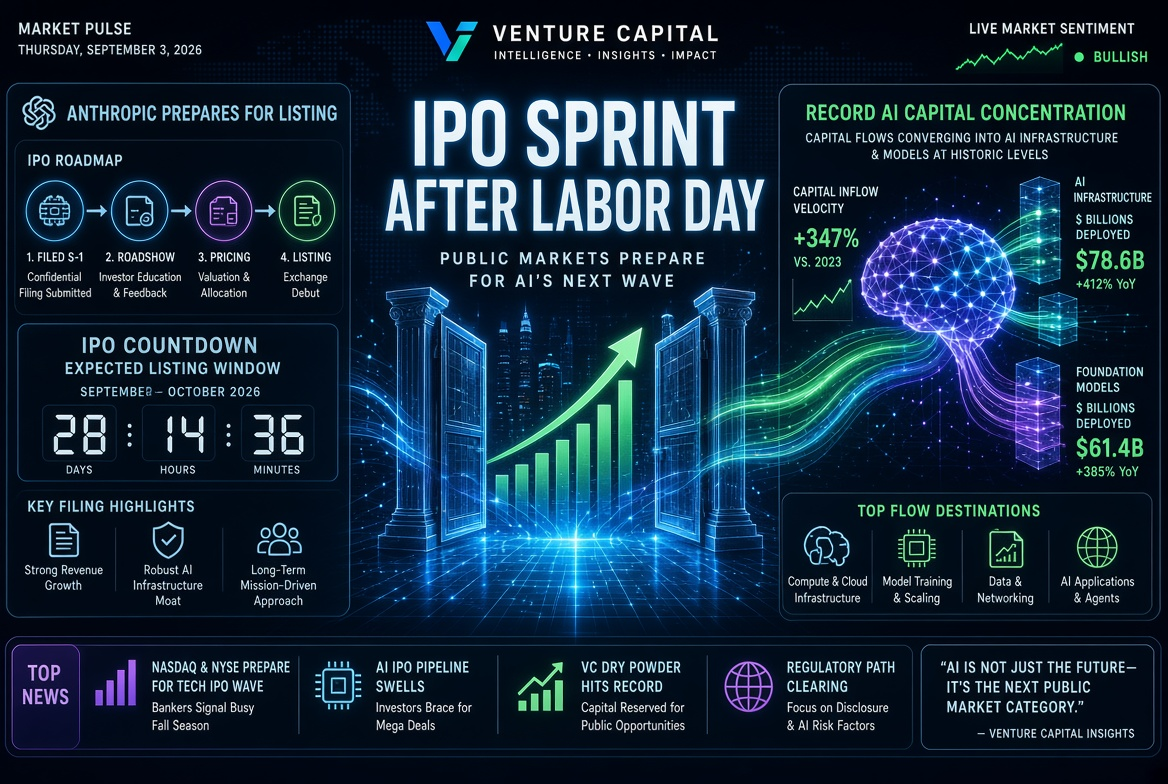
After a long period where funds had to rely primarily on secondary sales and private deals, the startup IPO market has begun to show significant signs of revival. AI chipmaker Cerebras aims for a valuation of approximately $26.6 billion for its IPO, Fervo Energy is planning to list at a valuation of up to $6.5 billion, and space analytics company HawkEye 360 has already raised $416 million during its IPO. Additionally, Lime and quantum company Quantinuum have announced plans to go public.
For venture funds, this is fundamentally more important than just the rise in stock prices of individual companies. Successful listings restore the exit mechanism, improve internal rate of return calculations, and enable investors to return capital to LPs in new funds. If the current wave of IPOs continues, the second half of 2026 could become the first full liquidity window after several years of restrained activity.
Capital Becomes More Global: India and China Strengthen Their Positions
The startup ecosystem is becoming increasingly less confined to Silicon Valley. In India, Skyroot Aerospace became the country's first space-tech unicorn after raising $60 million from GIC, Sherpalo Ventures, and BlackRock at a valuation of around $1.1 billion. Likewise, the service startup Pronto quickly doubled its valuation to $200 million, demonstrating that demand for consumer models in fast-growing economies remains strong, even amidst the global shift towards deep tech.
In China, the new focal point is DeepSeek, which is considering its first external funding round with a potential valuation of up to $50 billion. This move is significant not only for the startup itself but for the entire Asian venture scene: state and corporate investors are increasingly forming their own infrastructure for AI, robotics, and semiconductors.
Funds Transition from Passive Funding to Operational Strategies
The behavior of investors is also noticeably changing. Venture funds, growth investors, and private equity are increasingly acting as operators rather than just capital providers. The Long Lake deal to acquire American Express Global Business Travel for $6.3 billion, backed by General Catalyst and Alpha Wave, exemplifies a strategy where a traditional business is purchased, and then AI tools are implemented to enhance margins and growth.
This creates new competition for classic startups. Now they compete not only against each other but with capitalized platforms that can acquire existing assets and quickly transform them into technology companies. For venture investors, not only the product but also the team's ability to build a secure market position before their niche becomes a target for consolidation becomes increasingly significant.
Signals for Venture Investors to Watch This Week
- AI M&A Activity. If OpenAI and Anthropic swiftly close their first acquisitions, it could trigger a new wave of consolidation among service and consulting companies.
- Demand for IPOs. Results from Cerebras, Fervo Energy, and upcoming tech listings will indicate how ready investors are to fund growth stories after record private valuations.
- Robotics. New rounds in physical AI will be a crucial indicator of whether the sector is emerging as a standalone investment class.
- Capital Geography. China, India, and Europe are increasingly forming their own clusters, reducing the U.S. monopoly on the most promising deals.
- Revenue Quality. Amidst an overheated AI market, funds' focus will shift to retention, unit economics, and actual returns on implementations.
As of May 11, 2026, the venture market remains robust, yet it is becoming more demanding. The period when mere affiliation with the AI sector was enough for a premium valuation is gradually giving way to a selection phase. The best startups now need to demonstrate not only technological breakthroughs but also a pathway to scalable revenue, industrial application, and a potential exit through IPO or M&A.
For venture investors, this means expanded opportunities but also increased complexity in analysis. The most promising companies appear to be at the intersection of artificial intelligence, robotics, computing infrastructure, energy, and industry automation. It is here that the next group of leaders in the global startup ecosystem may emerge in the coming months.