Current News in Startups and Venture Investments as of March 28, 2026: Growth of the AI Sector, Investments in Defense Tech, Development of AI Infrastructure, and IPO Prospects
The startup and venture investment market is entering the end of the first quarter of 2026 with a crystal-clear focus: capital continues to concentrate around artificial intelligence, AI infrastructure, defense technologies, and companies that have already proven their ability to swiftly monetize demand. For venture funds, this means heightened competition for top assets, an increase in the value of secondary deals, and a growing interest in projects where technological leadership is backed by tangible revenue and a scalable business model.
Main Theme of the Week: Capital Flows Where There is Scale and Computation
A new hierarchy is forming distinctly in the startup market. At the top level are companies that either build foundational AI infrastructure, sell AI in industries with high error costs, or operate in segments with government demand. This narrative extends beyond just generative AI. It encompasses computational power, corporate integration, defense, semiconductors, and cloud infrastructure.
From a venture investment perspective, this market resembles nothing like the classical cycle of 2021. Back then, investors often paid for growth; today, they pay for growth plus proven demand. This is why the following areas are in focus:
- AI startups with large corporate contracts;
- Companies that save money or accelerate client processes;
- Projects related to chips, data centers, and computational infrastructure;
- Startups working at the intersection of defense, autonomy, and software.
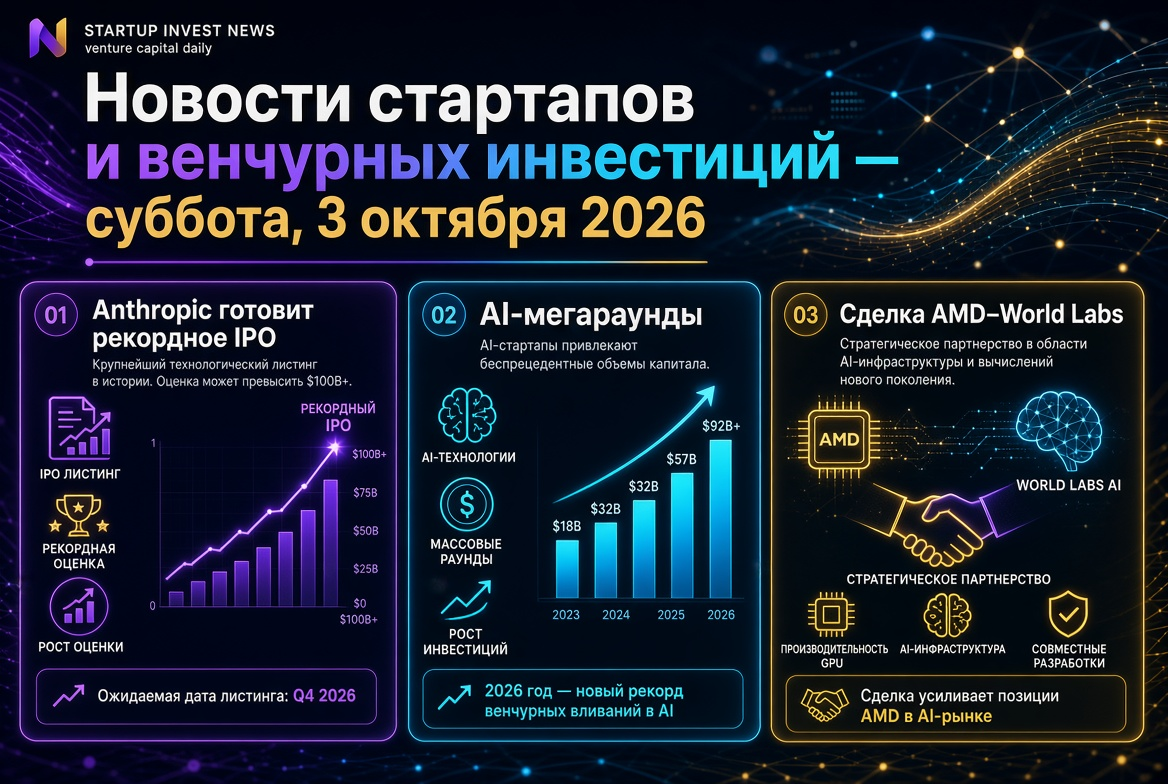
AI Funding Remains the Primary Magnet for Venture Capital
One of the most prominent deals of the day is a new $40 billion credit from SoftBank for further investments in OpenAI. This is yet another signal that the largest strategic players are no longer limited to conventional venture checks. They are constructing financial frameworks that allow them to scale their exposure to AI to levels unattainable for most funds.
Concurrently, OpenAI and Anthropic are actively competing for the corporate market and partnerships with private equity to accelerate the deployment of their models within large businesses. For venture investors, this is a critical marker: the market is shifting from a simple “model as a product” to a “model as a platform for deployment.”
What This Means for Funds
- Late-stage AI rounds will remain substantial and costly.
- Investors will demand clearer revenue streams and shorter paths to profitability.
- Success will not come from the loudest pitches but from the fastest deployments.
Legal AI Secures Its Position as One of the Hottest Segments
One of the strongest signals of the week was the new funding for Harvey: the company raised $200 million at an $11 billion valuation. This is a telling deal for the startup market. Legal AI has ceased to be an experiment and has evolved into a full-fledged investment narrative with a premium for quality teams, client bases, and speed of deployment.
Why is legal AI so appealing to venture investors? Because it combines three key factors:
- High cost of manual labor;
- Huge volume of repetitive tasks;
- Willingness of corporate clients to pay for reduced time and risk.
Harvey exemplifies the type of future leader: not just a tool, but a working environment for professionals. This is particularly important for funds that seek companies with clear revenue expansion and strong product-market fit.
Defense Tech Emerges as a Distinct Class of Venture Assets
Another major deal of the week was Shield AI, which secured $2 billion at a $12.7 billion valuation. The magnitude of this round suggests that defense technologies have definitively transitioned from a niche interest to a strategic venture direction.
For investors, this marks a significant turning point. Previously, defense tech was often viewed as a long, capital-intensive, and bureaucratic segment. Now, it encompasses autonomy, combat system software, simulation, drone management, and solutions for GPS-denied environments as part of the global technological mainstream.
Within this segment, the following areas stand out:
- Autonomous control systems;
- Software for simulation and training;
- Solutions capable of operating in critical environments;
- Products where government demand bolsters the private market.
AI Infrastructure is Attracting Not Just Equity, But Debt as Well
The story of Nebius well illustrates how the funding structure for startups is evolving in 2026. The company closed $4.34 billion in convertible debt and outlined capital expenditure plans ranging from $16 to $20 billion in 2026. For the venture market, this is a fundamentally important signal: AI infrastructure is increasingly funded through hybrid means, combining equity, debt, and customer prepayments.
This suggests that traditional venture logic is giving way to a more complex capital architecture. Companies that excel are those capable of:
- Securing debt on acceptable terms;
- Utilizing commercial contracts as a source of growth financing;
- Minimizing equity dilution;
- Building assets attractive to both strategic and financial investors.
For funds, this presents two conclusions. First: Capital in AI infrastructure remains available, but it increasingly does not resemble “pure venture.” Second: The demand is growing for companies that can be integrated into the supply chain of large clients today.
Asia and Europe Strengthen Positions in Niche Technology Segments
Startup Rebellions, specializing in AI chips, received $166 million in government backing from South Korea. This is not just a local story. It confirms that governments are increasingly acting as venture catalysts in strategic sectors, particularly in semiconductors and the computational base for AI.
For the global investor audience, this indicates that the startup landscape is becoming more multipolar. Previously, the center of gravity was undoubtedly in the U.S. Now, it is notably bolstered by:
- Europe — in enterprise AI, legal tech, and infrastructure solutions;
- Asia — in chips, manufacturing, and deep tech;
- The U.S. — in foundational AI, defense tech, and IPO preparation.
The IPO Window is Reopening, Changing Late-Stage Behavior
The market is increasingly discussing the potential IPO of SpaceX. According to Reuters, the company is considering an unusually large share allocation for retail investors, and the deal could become one of the largest in history. Even before the actual IPO, such signals are already influencing the behavior of venture funds: a strong IPO window makes it easier to explain to LPs why late-stage investments deserve attention once again.
For startups, this means the following:
- The public market is once again a viable option for the largest private companies;
- Pressure on financial discipline is increasing;
- Revaluation of quality late-stage assets becomes more probable.
What is Important for Venture Investors and Funds Right Now
If we collect the current market picture into a single investment framework, it appears quite stringent yet constructive. Capital is available, but it is becoming concentrated. Technological risk has not disappeared, but it is becoming more selective. The best deals are shifting to areas with either huge TAM, strategic importance, or a quick path to economies of scale.
In the coming months, funds should pay particularly close attention to:
- Startups in AI infrastructure and model deployment;
- Applied AI for lawyers, finance, and corporate functions;
- Defense technologies and autonomous systems;
- Semiconductors and computational infrastructure;
- Companies with real prospects for IPO or strategic M&A.
The news from startups and venture investments on Saturday, March 28, 2026, reveals one main shift: the market no longer rewards mere ambition. It rewards scalable infrastructure, commercial discipline, and technology that is already embedded in customer cash flows. AI startups, defense tech, legal AI, and companies building the foundation for the next cycle of the digital economy remain at the forefront. For venture investors, this is not an era of broad bets but an era of precision selection and high error costs.