Current Startup and Venture Capital News as of February 21, 2026: Mega-Rounds in AI, Capital Concentration, Venture Market Trends, and Key Signals for Funds and Investors
Venture Capital Market: Capital is Concentrating, Competition for Deals is Rising
By mid-February 2026, the venture market increasingly operates under a "winner takes almost all" model: the largest checks and highest valuations are once again flowing to a limited number of AI companies and infrastructure players, while a broad array of early-stage opportunities is being selected more rigorously. Investors are willing to pay a premium for proven revenues, access to data and computational power, and the ability to quickly scale products in the corporate sector. For funds, this means growing competition for a limited number of “obvious” deals and the need to delve deeper into unit economics, training/inference costs, and demand sustainability.
Top Story of the Day: OpenAI Round as an Indicator of a New Private Capital "Supercycle"
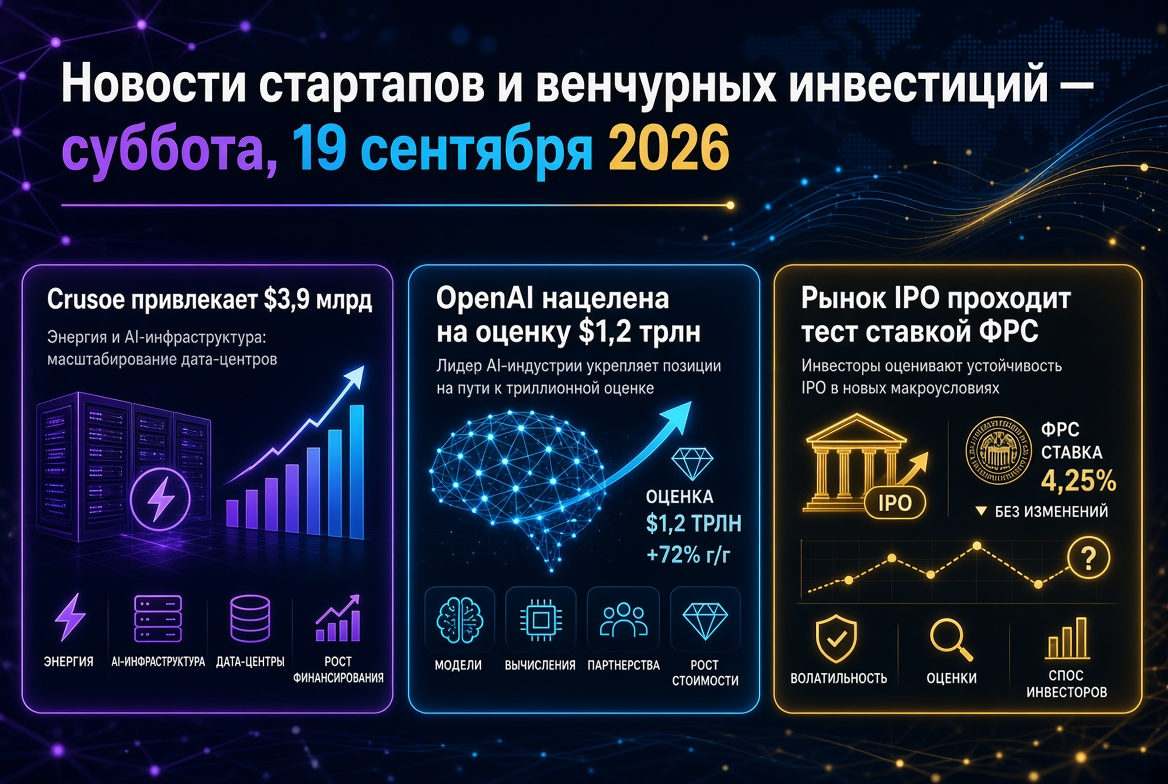
A key marker of the week has been the preparations for the largest round in recent years surrounding OpenAI, with discussions pointing to raising around $100 billion or more, with reports suggesting that multiple strategic investors and major tech groups are considering participation. More important than the size is the logic of such funding: the money is essentially being converted into accelerated access to computations, chips, cloud infrastructure, and engineering talent. This reinforces the trend where "capital expenditures on intelligence" are becoming the new norm, and the boundaries between venture capital, private equity, and strategic investments are becoming blurred.
For the startup market, this has a dual effect. On one hand, there is a displacement effect: part of the capital that could have flowed into a wide array of B2B/SaaS, biotech, or fintech is being directed to a few mega-success stories. On the other hand, a powerful wave of secondary benefits emerges: demand is growing for application models, observability and security tools, inference optimization, specialized data, and vertical solutions for industries.
Major Deals and Signals of the Week: AI Sets New Valuation Benchmarks
The focus is on mega-rounds in generative AI and everything related to "delivering intelligence" on an industrial scale. Record-high deals are being discussed in the market, raising reference valuations for late-stage investments and widening the gap between leaders and the rest.
- Generative AI: Mega-rounds among segment leaders are setting a new benchmark for valuations and the amount of capital needed to compete at the frontier.
- AI Infrastructure: Demand for alternatives and diversification of supply chains is heightening interest in developers of accelerators, specialized computing platforms, and "AI-cloud" solutions.
- Vertical AI Products: Companies demonstrating ROI through time/risk savings (compliance, financial control, cybersecurity, software development) and having a clear go-to-market strategy are receiving the best financing.
Infrastructure and "Hardware": Betting on Computation as a Strategic Asset
The shifting phase of the market is evident in how investors evaluate infrastructure startups: “GPU access,” stack efficiency, cost optimization of computations, and the ability to ensure predictable performance are now regarded with equal importance to product differentiation. At late stages, this leads to deals where the economic logic resembles that of infrastructure projects: long payback horizons, significant capital investments, but with potentially high barriers to entry.
For venture funds, this means that due diligence is increasingly incorporating technical metrics (training costs, latency, query costs, load profiles), as well as contractual details with cloud providers and chip suppliers. Winning teams are those that can turn computation into a predictable business process and maintain margins at scale.
What's Happening at Early Stages: The Market is Becoming More Pragmatic
In seed and Series A rounds, there is a noticeable pivot towards "applied efficiency." Founders are given less leeway for unclear monetization, while those demonstrating clear ROI for clients, a short implementation cycle, and a solid sales economy find more support. In the AI segment, there has been increased filtering of "wrappers" lacking unique data, integrations, or industry advantages: investors are expecting either proprietary data, deep process integration, or hard-to-replicate infrastructure competence.
A practical checklist that is more frequently heard in negotiations includes:
- Unit Economics: Gross margins accounting for inference, support, and training costs.
- Proven Impact: Measurable KPI for the client (speed, accuracy, reduction of losses, compliance risks).
- Defensibility: Data, distribution channels, partnerships, regulatory/process barriers.
- Scaling Speed: Repeatability of sales and ability to service growth without explosive increases in COGS.
M&A and Exits: Strategists are Returning, but Choosing Selectively
Against the backdrop of capital concentration in AI, the role of strategic buyers is increasing—especially in sectors where AI has a direct impact on R&D, risk management, or operational efficiency. In biotech and pharma, there is a visible readiness to acquire technologies that accelerate drug development and clinical processes; in the enterprise sector, interest is growing in development tools, security, and compliance. However, the overall exit market remains selective: buyers are either looking for “must-have” assets or teams/technologies that can be rapidly integrated into existing products.
Venture Geography: The US and Major Hubs Solidify Dominance, but Niche Ecosystems Persist
The majority of the largest deals still concentrate in the US and a few global tech hubs, where access to talent, capital, and corporate buyers is available. However, for funds, "second markets" are becoming attractive—where regional AI platforms, infrastructure for local languages and industries, as well as fintech and industrial solutions tied to specific regulatory regimes are being created. In 2026, the differentiation of regions is increasingly based not on the “presence of startups,” but on access to data, infrastructure, and corporate demand.
Risks: Discussions of an "AI Bubble" are Returning—and This is a Useful Stress Test
Ultra-high valuations and rounds inevitably raise the issue of overheating. For investors, this is less a reason to "exit AI," but rather a caution to differentiate more precisely:
- Frontier Models (expensive, capital-intensive, relying on scale and infrastructure);
- Infrastructure (high barriers to entry, cyclical capex risks for clients);
- Vertical Applications (dependence on data quality and sales, but with more immediate visibility of economics).
The primary practical risk in 2026 is the mismatch between revenue growth rates and computational cost growth. Thus, the market needs a new standard of transparency: metrics for model efficiency, service costs, retention, and actual added value for clients.
What Investors Should Watch for in the Coming Weeks
Leading up to the end of the quarter, the market is keenly focused on three sets of signals: (1) the completion and terms of the largest AI rounds, (2) the dynamics of corporate budgets for AI infrastructure and implementation, and (3) the activity of strategists in M&A, especially in biotech, cybersecurity, and development tools. On the tactical front, venture funds should maintain focus on companies that deliver measurable efficiency and can scale without proportional increases in computational costs.