Billions in Venture Investments in AI Infrastructure, Cybersecurity, Energy, and Aerospace on July 13, 2026
The global startup and venture investment market is experiencing a high concentration of capital around artificial intelligence, computing infrastructure, cybersecurity, energy, and defense technologies as of Monday, July 13, 2026. For venture investors and funds, this is not merely another wave of interest in AI startups; it signifies the formation of a new investment architecture where computational power, trusted digital identity, corporate data protection, autonomous systems, and access to affordable energy play key roles.
Following a record first half of 2026, venture capital remains active but increasingly selective. Major funds and strategic investors are ready to write checks in the hundreds of millions and billions of dollars; however, a distinct advantage is being held by startups with an infrastructural role. These companies serve entire markets, including AI, fintech, defense, industrial automation, energy, and corporate security, rather than just catering to isolated consumer scenarios.
Overview of the Day: The Venture Market is Growing Again, but Capital is Concentrating
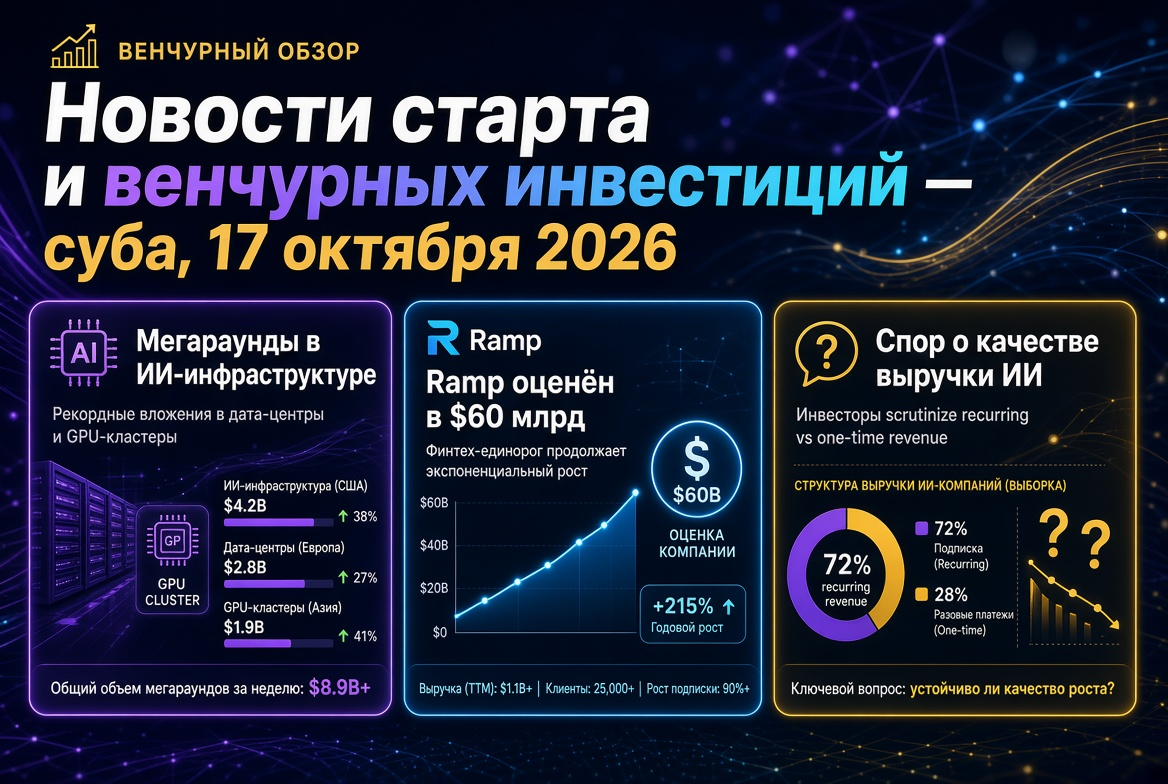
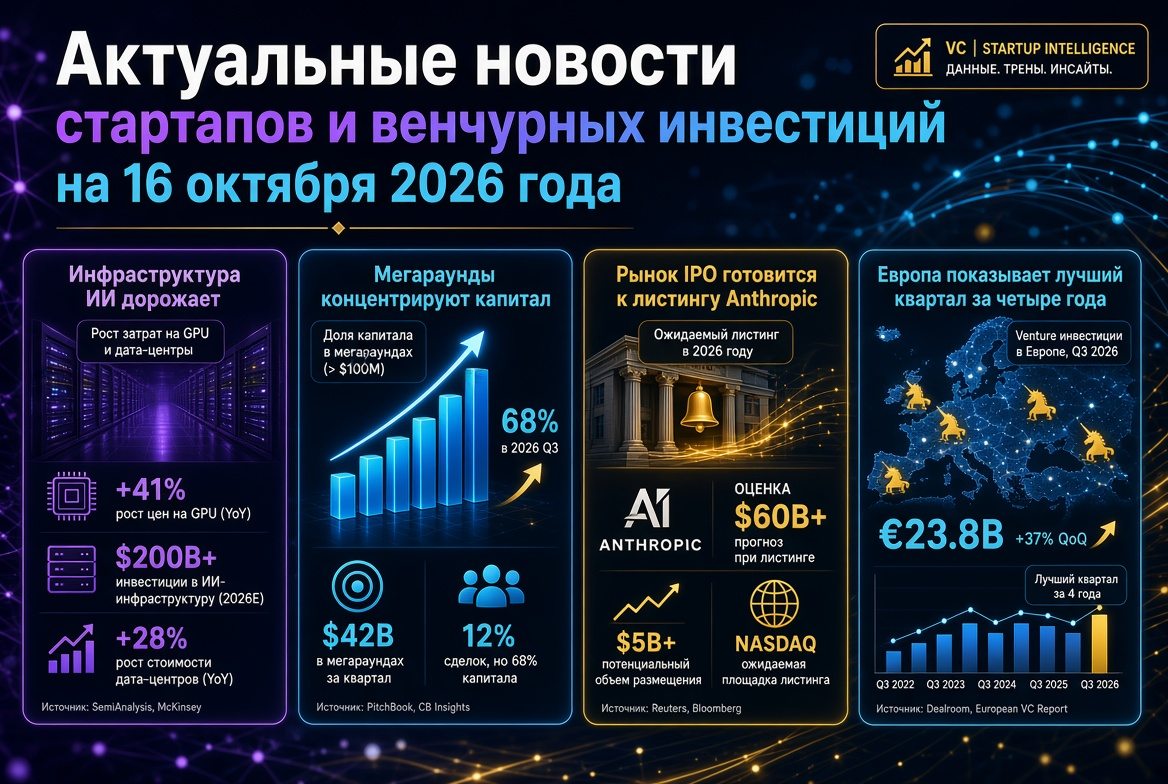
The key theme of the day is the further concentration of venture investments in the largest technology segments. Global startups are attracting record amounts of capital, yet a substantial portion of funds is directed toward a limited number of companies related to artificial intelligence, AI infrastructure, semiconductors, cybersecurity, and deeptech.
For venture funds, this signifies a shift in the deal selection logic. Investors are increasingly evaluating not just revenue growth rates but also the strategic position of startups within the technology chain. Companies addressing critical bottlenecks have become particularly sought after:
- Computing infrastructure for AI models and corporate AI agents;
- Cybersecurity, digital identity, and post-quantum cryptography;
- Energy solutions for data centers and high-load computing;
- Robotics, aerospace, defense tech, and physical AI;
- Tools for automating legal, financial, and regulatory processes.
Thus, news surrounding startups and venture investments today increasingly resembles a technological infrastructure market for the coming decade rather than a classic application marketplace.
AI Infrastructure: SambaNova Solidifies the Trend Towards Specialized Computing
One of the recent notable events was SambaNova's $1 billion funding round at a valuation of approximately $11 billion. The company is developing specialized AI chips, hardware systems, and cloud solutions for inference—the stage at which artificial intelligence models respond to user queries and operate within real corporate processes.
For the venture investment market, this serves as an important signal: capital is shifting from abstract interest in "large models" to the infrastructure that enables these models to operate more cheaply, quickly, and at scale. While in 2023–2025, investors were vying for stakes in developers of foundation models, 2026 has seen increased demand for companies that provide:
- Reduction in inference costs;
- Corporate deployment of AI systems;
- Localization of computing and data control;
- Compatibility of hardware and software infrastructure;
- Resilience of chip and server supply chains.
This opens up a distinct investment vertical for funds: AI infrastructure is evolving from a supportive sector to a standalone asset class within the venture market.
Cybersecurity and Post-Quantum: Keyfactor Secures Billion-Dollar Capital
Cybersecurity has emerged as the second center of capital attraction. Keyfactor raised over $1 billion in strategic investments led by Summit Partners. The company operates in the machine identity segment, managing cryptographic keys, certificates, and digital trust for corporate environments.
For venture investors, this deal is significant for two reasons. First, the cybersecurity market is becoming deeply infrastructural: protection is no longer limited to antivirus programs, cloud gateways, and threat monitoring. Corporations need to manage millions of machine identities, APIs, devices, models, and automated agents. Second, post-quantum cryptography is looming on the horizon, increasing demand for solutions to upgrade the cryptographic framework of large enterprises.
Venture funds will closely monitor startups that converge cybersecurity, AI governance, access management, and regulatory compliance. This is where the next layer of corporate infrastructure is taking shape.
Legal AI and Agentic AI: Norm AI and Prime Intellect Highlight Demand for Applied Artificial Intelligence
In the applied artificial intelligence segment, two key events stand out. Norm AI secured $120 million in a Series C round at an estimated valuation of around $1.2 billion. The startup is developing AI tools for legal and regulatory work, aiding companies in automating compliance, analyzing regulations, and managing legal risks.
Similarly, Prime Intellect raised $130 million in a Series A for the development of an open superintelligence stack and tools that enable companies to train and deploy AI agents on distributed computing infrastructure. This reflects a broader trend: corporate clients want not just external chatbots but to build their own AI systems with control over data, models, costs, and security.
For investors, this suggests that the AI startup market is dividing into two directions:
- Horizontal platforms — infrastructure, computing, development tools, security;
- Vertical applications — legal tech, fintech, healthtech, industry, logistics, education, and corporate governance.
The most resilient startups will be those capable of combining deep industry expertise with scalable AI architecture.
Deeptech, Energy, and Fusion: Proxima Fusion and Quaise Energy Increase Interest in Energy Infrastructure
European deeptech has also come into focus. Munich-based Proxima Fusion raised €411 million for developing nuclear fusion energy, establishing itself as one of the most noticeable European fusion startups. Among its investors are strategic and technological players keen on gaining long-term access to a clean and powerful energy base.
Concurrently, American Quaise Energy raised $134 million in Series B funding to develop deep geothermal drilling technology. For the venture market, these are not incidental deals: the growth of AI infrastructure demands colossal energy amounts, and data centers are increasingly being viewed not only as technological but also as energy assets.
The clean energy, fusion, geothermal, and energy infrastructure segment is becoming a logical continuation of the AI boom. If computation is the "brain" of the new economy, energy is its fundamental fuel. Therefore, venture investments in energy will increasingly be regarded as part of AI and industrial tech strategies.
Quantum, Aerospace, and Defense Tech: Capital Flows into Strategic Technologies
Among significant deals, Oratomic raised $300 million in Series A funding for the development of neutral-atom quantum computing and fault-tolerant architectures. This confirms the interest of venture funds in quantum technologies despite the extended investment horizon and high technological risks.
In aerospace and defense tech, Venus Aerospace made headlines with a $91 million Series B funding round. The company is advancing hypersonic and rocket propulsion technologies, including a rotating detonation rocket engine. Interest in such startups is supported by several factors: increasing defense budgets, demand for technological sovereignty, competition in space infrastructure, and the development of dual-use solutions.
For venture funds, defense tech is no longer a niche category. It represents one of the fastest-growing segments of deeptech, with potential buyers including governments, defense corporations, aerospace companies, and operators of critical infrastructure.
Fintech, Crypto Infrastructure, and Institutional Demand
Fintech and crypto infrastructure are also regaining attention. Gauntlet raised $125 million from SBI Holdings to develop risk management and digital asset optimization tools. EDX Markets secured $76 million amid growing interest from institutional investors in digital asset trading infrastructure.
Unlike the speculative wave of past years, the current interest from investors is shifting towards infrastructural models: custody, risk management, compliance, exchange liquidity, protocol monitoring, and corporate access to on-chain tools. For funds, this means that crypto startups can once again fall under investment mandates but only if they possess clear revenue streams, regulatory resilience, and institutional clients.
Geography of the Venture Market: The US Leads, Europe Strengthens Deeptech, India Returns to Growth
Geographically, the venture market remains heterogeneous. The US maintains its leadership in AI infrastructure, chips, cybersecurity, and late-stage investments. Europe is bolstering its position in deeptech, energy, climate technologies, and industrial startups. The UK is showing strong dynamics due to its AI companies, while Germany is becoming increasingly prominent in fusion, robotics, and industrial tech.
India is also re-entering the focus of investors. The growth of funding for tech companies, IPO plans for consumer and wellness platforms, and demand for cloud infrastructure indicate that the market is becoming appealing once again for funds focused on developing ecosystems.
This creates several strategic approaches for global venture funds:
- The US — late-stage ventures, AI infrastructure, cybersecurity, enterprise software.
- Europe — deeptech, energy, climate tech, defense tech, industrial AI.
- India — consumer tech, fintech, cloud infrastructure, B2B SaaS.
- Asia — semiconductors, robotics, AI models, digital infrastructure.
What Matters to Venture Investors and Funds
As of Monday, July 13, 2026, the venture market appears strong but is more demanding regarding asset quality. Funds are available, but they are concentrating in companies addressing systemic challenges and those that can become part of the critical infrastructure of the new economy.
Investors should take note of three key conclusions:
- AI remains the primary driver of venture investments, but the most promising prospects are not only models but the infrastructure surrounding them: chips, inference, agents, security, data, and energy.
- Deeptech and defense tech are becoming mainstream directions for large funds, particularly in the US and Europe.
- The exit market is reviving: IPOs, M&A, and strategic deals are returning liquidity, increasing the likelihood of a new investment cycle.
The primary risk is overheating valuations in AI and infrastructure startups. However, unlike previous venture cycles, the current growth is supported not just by narrative but by genuine demand from corporations, governments, cloud providers, and industrial customers. Therefore, the key task for funds is to differentiate between technological fads and companies that truly control the critical nodes of the future market.