Startup and Venture Investment News – Monday, November 24, 2025: Record AI Rounds, the Return of Mega Funds, IPO Market Revival, M&A Consolidation, Global Venture Market Expansion, Renaissance of Crypto Startups, and a Wave of New Unicorns
By the end of November 2025, the global venture capital market is showing consistent growth after a period of decline. Investors worldwide are once again actively investing in tech startups: record deals are being made, companies' IPO plans are back in focus, and major funds are triumphantly returning to the market with significant investments. Governments in various countries are increasing support for innovation and encouraging private capital attraction, stimulating venture activity alongside the revival of stock markets. As a result, substantial financial resources are flowing into the startup ecosystem, although investors remain cautious and selective, favoring startups with sustainable business models and proven economics.
Growth is being observed in nearly all regions. According to the latest data, global venture capital investment reached approximately $97 billion in the third quarter of 2025—an increase of 38% compared to the previous year and slightly higher than the previous quarter's results. This figure marks the highest quarterly total since 2021 and the fourth consecutive quarter of growth following the "venture winter" of 2022–2023. The main driver of this surge has been mega rounds in the artificial intelligence (AI) sector, although funding increases are noted across all stages. Venture activity is rising almost everywhere: the US maintains its leading position (particularly in the rapidly developing AI segment), investment volumes in the Middle East have grown exponentially, and Germany has, for the first time in a decade, surpassed the UK in cumulative venture financing. In Asia, the dynamics are uneven: India, Southeast Asia, and Gulf countries are attracting record capital flows amid a relative decline in activity in China. The startup scenes in Russia and CIS countries are also striving to keep pace despite external constraints, with new funds and programs launched to develop local ecosystems. A new global venture boom is forming, although market participants continue to act cautiously and selectively.
Below is a list of key events and trends shaping the venture market landscape as of November 24, 2025:
- The return of mega funds and large investors. Leading venture players are forming record-sized funds and increasing their investments, once again filling the market with capital and reigniting risk appetite.
- Record investment rounds in AI and a new wave of unicorns. Unprecedented capital injections into AI startups are skyrocketing company valuations to unseen heights, fostering the emergence of numerous new unicorns.
- Revival of the IPO market. Successful public offerings of tech companies and new listings indicate that the long-awaited "window" for public placements has reopened.
- Diversification of sector focus. Venture capital is being directed not only to AI but also to fintech, biotech, climate technologies, space, defense projects, and other sectors of the economy.
- A wave of consolidation and major M&A deals. Large mergers, acquisitions, and strategic partnerships are reshaping the industry landscape, creating new exit opportunities and accelerated growth for startups.
- Global expansion of venture capital. The investment boom is spreading to new regions—from the Middle East and South Asia to Africa and Latin America—forming their own technological clusters.
- A renaissance of interest in crypto startups. After a prolonged "crypto winter," the blockchain sector is reviving, once again attracting significant venture investment amid a recovery in the crypto market.
- Local focus: Russia and CIS countries. New funds and initiatives are emerging in the region to develop local startup ecosystems, drawing investor attention despite geopolitical constraints.
The Return of Mega Funds: Big Money Back in the Market
Major investment funds and institutional players are confidently returning to the venture scene, signaling a new surge in risk appetite. After a decline in VC fundraising during 2022–2024, leading firms are renewing capital attraction and announcing mega-sized funds. The Japanese conglomerate SoftBank, overcoming recent challenges, has announced the launch of Vision Fund III, with an approximate volume of $40 billion, focusing on advanced technologies (AI, robotics, and more). In the US, venture firm Andreessen Horowitz plans to raise a record fund of approximately $20 billion, betting on investments in late-stage AI startups. Simultaneously, sovereign funds from Gulf countries are significantly expanding their presence in the tech sector; Middle Eastern investors are pouring billions into promising startups worldwide while launching large-scale programs for developing their tech hubs. In key regions, dozens of new venture funds are appearing, attracting substantial institutional capital for investment in high-tech projects. The influx of this "big money" is flooding the market with liquidity and enhancing competition for the most promising deals while instilling confidence in the industry regarding further capital inflows.
Record Investments in AI and New Wave of Unicorns
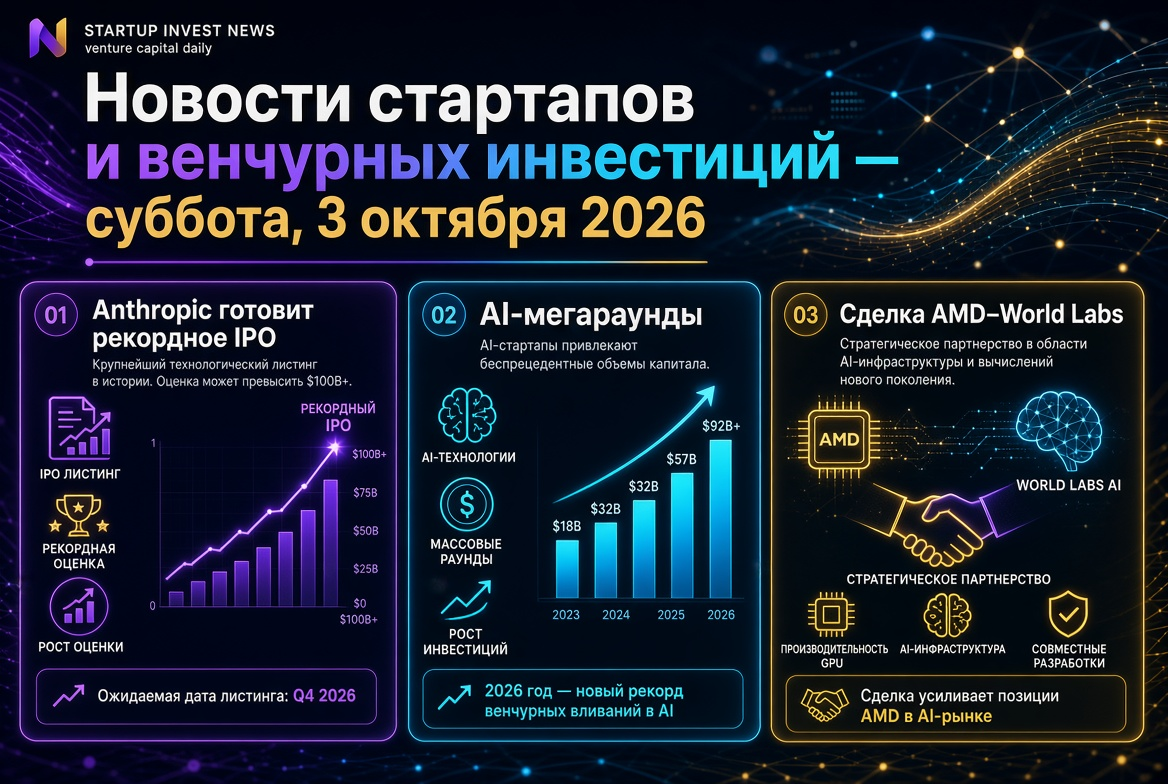
The artificial intelligence sector remains the primary driver of the current venture boom, showcasing unprecedented levels of funding. Since the beginning of 2025, AI startups have collectively raised over $160 billion just in the US (approximately two-thirds of all venture investments in the country), and by year-end, global investments in AI companies are projected to exceed $200 billion—a never-before-seen figure for the sector. The combined valuation of the ten largest AI startups (including leaders such as OpenAI, Anthropic, xAI, and others) has approached an astronomical $1 trillion. This influx of capital into AI is accompanied by the emergence of numerous new unicorns. In October 2025 alone, about 20 new startups with valuations exceeding $1 billion were born, marking a record monthly addition to the unicorn club in recent years. Investors are eagerly supporting projects in generative AI, AI infrastructure, autonomous systems, and other cutting-edge fields. Almost weekly, news of new mega rounds of financing is reported: for instance, in November, the American company Lambda (providing cloud infrastructure for AI) raised around $1.5 billion, the market prediction platform Kalshi raised $1 billion, and the multimodal AI systems developer Luma AI closed a round at $900 million. Such levels of venture financing haven't been seen since the peak of 2021. While this rapid growth instills optimism regarding the potential of these technologies, some experts warn of signs of overheating in certain niches. This prompts investors to be more discerning about valuations and to choose genuinely quality projects.
IPO Market Revives: A New Wave of Public Offerings
The global IPO market is beginning to emerge from a prolonged lull and gain momentum. After nearly two years of inactivity, the IPO mechanism is reemerging as a desirable exit strategy for venture investors. Hong Kong has catalyzed a new wave of IPOs in Asia: in recent months, several major tech companies have gone public, collectively raising billions of dollars. For instance, the Chinese battery maker CATL successfully conducted its offering, raising around $5 billion and proving that investors in the region are again willing to actively participate in IPOs. In the US and Europe, conditions are also improving: the American fintech unicorn Chime recently made its debut on the stock market, with its shares rising approximately 30% on the first day of trading. Shortly thereafter, the designer platform Figma conducted an IPO, raising about $1.2 billion at an estimated valuation of around $20 billion; its shares also rose confidently in the first days of trading. In the second half of 2025, other well-known startups—among them payment giant Stripe and several highly valued tech companies—are preparing for their public market exits.
Even the crypto industry is looking to capitalize on the revival: fintech company Circle successfully went public last summer (its valuation at the IPO was around $7 billion, and subsequently, its shares saw significant growth), while crypto exchange Bullish has filed for a listing in the US with a target valuation of approximately $4 billion. The returning activity in the public offering market is crucial for the entire venture ecosystem: successful exits through IPOs enable funds to realize profits and redirect freed-up capital into new projects, supporting the continued growth of the sector.
Diversifying Investments: Beyond AI
In 2025, venture investments are covering an increasingly broad range of sectors, moving beyond mere artificial intelligence. After the declines of recent years, related sectors are noticeably reviving, making the startup ecosystem more balanced and reducing the risk of overheating in specific niches. Venture capital is confidently broadening its horizons, investing in diverse areas:
- Fintech: After a pause in 2022–2023, financial technologies are once again attracting large funding rounds not only in the US but in Europe and emerging markets, fueling the growth of new digital services.
- Climate Technologies: Projects in clean energy, climate tech, and agtech are receiving record investment amid a global trend towards sustainability and decarbonization.
- Biotech and Healthcare: New developments in pharmaceuticals, genetics, and digital health are again attracting capital as industry valuations recover from recent downturns.
- Defense and Space Projects: With heightened attention to security, investors are increasingly funding defense technologies and cybersecurity, while interest in space startups—from satellite services to projects for space exploration—is growing.
The expansion of sector focus signifies the maturity of the venture market: investors are diversifying their portfolios, and funds are being directed towards various innovative fields, reducing the ecosystem's reliance on a single dominant direction.
Consolidation Wave and M&A: Consolidating Players
High valuations for startups and intense competition for markets are stimulating a new wave of consolidation. Major mergers and acquisitions are once again taking center stage, reshaping the balance of power in the industry. Tech giants are eager to acquire key innovations and talent, embarking on active acquisition campaigns. A notable example is Google’s agreement to acquire the Israeli cybersecurity startup Wiz for about $32 billion, a record amount for Israel's tech sector. Such mega-deals demonstrate the willingness of corporations to invest in advanced developments to strengthen their positions. Overall, the current activity in M&A and major venture deals indicates market maturation. Mature startups are either merging with one another or becoming acquisition targets for corporations, while venture funds have the opportunity for long-awaited profitable exits. Consolidation accelerates the growth of the most promising companies while simultaneously "cleansing" the ecosystem of weaker players, leading to a healthier market.
Global Expansion of Venture Capital: New Technological Hubs
The investment boom is spreading to new geographic regions, establishing its own centers of technological development worldwide. The Middle East, particularly the UAE and Saudi Arabia, stands out: countries in the region are investing unprecedented sums into creating local tech hubs of global standards. In recent years, venture investments in the Middle East have increased several-fold, leading to the creation of new major funds and mega-projects (such as the futuristic technology megacity NEOM in Saudi Arabia). Active capital influx is also observed in South Asia: India and Southeast Asian countries are setting new records in attracting venture investments, partially compensating for the relative cooling of the Chinese market. At the same time, startup ecosystems in Africa and Latin America are gaining strength, where financing growth is forming new technological clusters. Thus, venture capital is becoming increasingly global: beyond traditional centers like Silicon Valley, New York, or London, new growth points for startups are solidifying on the world map.
Local Market: Russia and CIS Countries
Despite external constraints, there has been a revival of startup activity in Russia and neighboring countries in 2025. In the past year, several new venture funds have emerged (with a combined capital of around 10–15 billion rubles), and government structures and corporations have launched support programs for tech startups. While the total volume of venture investments in the region remains modest on a global scale, and serious barriers (high rates, sanctions, etc.) persist, the most promising local projects continue to attract funding. The gradual formation of its own venture infrastructure is already creating a foundation for the future—by the time external conditions improve and global investors can more actively return to the market. The local focus on developing the startup ecosystem in Russia and the CIS aims to ensure technological sovereignty and prepare the ground for the next generation of entrepreneurs to thrive.
Renaissance of Interest in Crypto Startups
After a prolonged "crypto winter," the market for blockchain startups is noticeably reviving. As of autumn 2025, funding for crypto projects has reached its highest level in recent years. New large rounds are occurring in the Web3 infrastructure and decentralized finance (DeFi) segments, while venture capital is returning to promising blockchain platforms. The recovery in the crypto market has played its part: the flagship cryptocurrency Bitcoin surpassed the psychological milestone of $100,000, boosting investor enthusiasm in the sector. Venture funds that were previously very cautious with crypto assets are gradually resuming investments in projects at the intersection of technology and finance, with new specialized funds and incubators for Web3 startups emerging. Naturally, the lessons of previous years have taught investors caution—the volatility and regulatory risks remain ever-present. However, a restrained optimism is beginning to develop in the market: participants are increasing their presence in the crypto sector, trying not to miss the potential growth of a new wave of blockchain technologies.
Conclusion: Cautious Optimism and Quality Growth
By the end of 2025, moderately optimistic sentiments have consolidated within the venture capital industry. Successful IPOs and multi-billion dollar funding rounds indicate that the long period of downturn is behind us, and the startup ecosystem is experiencing a new upswing. However, investors remain vigilant: funding is increasingly concentrating on startups with sustainable business models, proven economics, and genuine profitability prospects. Major capital inflows into AI and other promising areas instill confidence in further market growth, yet players are keen to avoid the mistakes of past bubbles, adopting a more stringent approach to assessing quality projects.
Thus, the startup ecosystem is entering a new cycle of development that is more mature and balanced. The return of major investors, the emergence of new unicorns, and successful exits through IPOs form the foundation for a new wave of innovation. However, the discipline and calculative nature of investors will dictate the character of this growth. Despite the heightened appetite for risk investments, the focus remains on quality startup growth and the long-term sustainability of the market.