Current Startup and Venture Market News as of November 6, 2025: Multi-Billion Dollar Deals in Artificial Intelligence, a Resurgence of Interest in Crypto Startups, Rejuvenated IPO Activity, and Other Global Trends for Investors.
As of early November 2025, the global venture capital market is showing steady growth after a prolonged "winter." Investors worldwide are once again actively funding technology startups—transactions are occurring at unprecedented amounts, and companies' plans to go public are back in the spotlight. Major venture funds and corporations are returning with substantial investment programs, and governments across various countries are expanding their support for innovative businesses. Preliminary estimates indicate that 2025 could become the most successful year for venture investments since the record-breaking 2021, signaling a resurgence of private capital in the startup market and the beginning of a new growth cycle.
Venture activity is now encompassing all regions. The United States continues to lead the way (especially driven by significant investments in the artificial intelligence sector), while investment volumes in the Middle East have multiplied compared to last year, and Europe is witnessing a reshuffling of leaders—Germany has overtaken the United Kingdom in total venture deals for the first time. India, Southeast Asia, and Gulf countries are attracting record capital amid relatively subdued investor activity in China (where stringent regulatory measures are stifling the industry). The startup ecosystems in Russia and the CIS countries are also striving to keep pace, despite external constraints. A new global venture boom is forming, although investors are still acting selectively and cautiously, betting only on the most promising projects.
Let's delve deeper into the key events and trends shaping the agenda as of November 6, 2025:
- The Return of Mega Funds and Large Investors. Leading players are raising record venture funds and increasing investments, saturating the market with capital and enhancing their risk appetite.
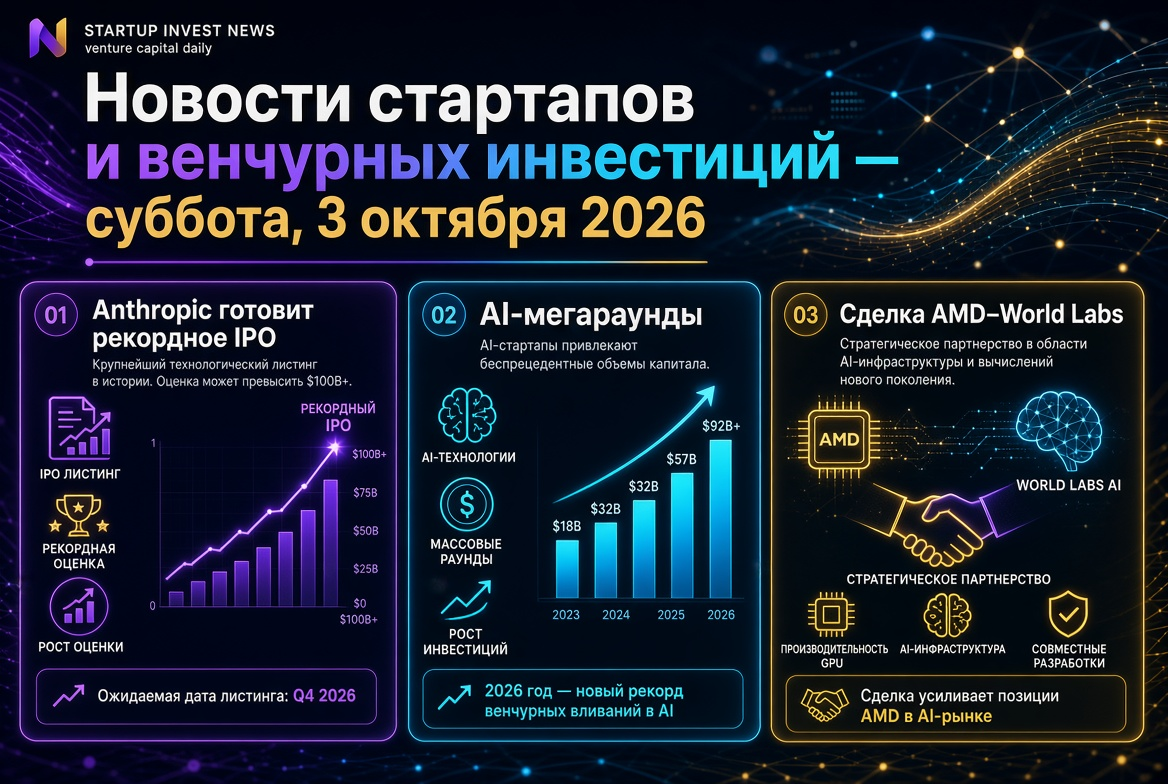
- Mega Funding Rounds and New AI "Unicorns." Unprecedented investment volumes are elevating startup valuations to unseen heights, particularly in the artificial intelligence segment.
- Revival of the IPO Market. Successful public offerings of technology companies and new applications are confirming that the long-awaited "window of opportunity" for exits remains open.
- Renaissance of Crypto Startups. The rise of the digital asset market has rekindled interest in blockchain projects, intensifying capital inflow into the crypto industry.
- Consolidation Wave: Rise in M&A Deals. Major mergers, acquisitions, and strategic alliances are reshaping the industry landscape, creating new opportunities for exits and accelerated growth of companies.
- Global Expansion of Venture Capital. The investment boom is extending to new regions—from the Middle East and South Asia to Africa and Latin America—forming tech hubs of their own.
- Local Focus: Russia and CIS Countries. Despite restrictions, new funds and projects are emerging in the region, signaling a gradual recovery of the venture ecosystem.
The Return of Mega Funds: Big Money Back in the Market
The largest venture players are triumphantly returning to the market, indicating a new surge in risk appetite. SoftBank has launched the Vision Fund with a volume of approximately $40 billion, while top Silicon Valley funds are raising unprecedented capital pools (for example, a16z is securing around $20 billion for investments in late-stage AI startups). Sovereign investors are also becoming active: funds from Gulf countries are pouring billions into technologies and launching national mega-projects, creating their own tech hubs in the Middle East. New venture funds are emerging globally, attracting institutional capital into innovative sectors. All of this signals that large capital is once again ready to invest boldly for prospective growth.
Mega Rounds and New "Unicorns": Investments Hit Records
Massive funding rounds are now being announced almost weekly—artificial intelligence has firmly established itself as the main "magnet" for venture capital in 2025. Investors are directing colossal sums toward AI leaders; for instance, the US-based model developer Anthropic raised around $13 billion, marking one of the largest deals of the year, while industry flagship OpenAI was valued at approximately $500 billion in its latest secondary share offering.
Unprecedented investments are flowing not only directly into AI startups but also into related infrastructure—from chips and cloud platforms to business applications—with rounds reaching hundreds of millions of dollars. The wave of mega deals has spawned numerous new "unicorns" and even "decacorns," pushing the number of private companies with valuations exceeding $1 billion to record levels. While the excitement around AI fuels capital inflow, experts warn of the risk of market overheating; it is essential for investors to remain selective.
IPO Market Rejuvenates: The Window for Exits is Open
After a period of quiet, activity in the initial public offering (IPO) market has resumed, giving venture funds the long-awaited opportunity for profitable exits. In Asia, Hong Kong has led the wave of new offerings, where several tech firms have collectively raised billions of dollars in recent months.
In the U.S., fintech giant Chime had a successful listing—its shares saw significant growth on the first day of trading. Following this, a number of "unicorns" have filed applications or are preparing to go public (including Stripe, Reddit, and others), indicating that the "window" for IPOs remains open. These exits enable funds to reinvest freed-up capital into new projects and bolster optimism in the market.
Renaissance of Crypto Startups: New Capital Inflow
In 2025, venture interest in the crypto industry has returned: since the start of the year, over $20 billion has been invested in blockchain startups (nearly double the total for all of 2024). In October alone, crypto startups attracted around $3.9 billion. A landmark event was the $2 billion round for the Polymarket platform involving the NYSE owner—signifying traditional financiers' willingness to invest in blockchain technologies. Major venture funds (Sequoia, a16z, etc.) are also ramping up activities: together with Stripe, they invested $500 million in launching the payment network Tempo. Positive shifts in regulation (such as the stablecoin law in the U.S.) are stimulating institutional capital inflow into the sector. Despite recent volatility, investors continue to fund promising Web3 projects, and crypto startups have once again become a noticeable part of the venture landscape.
Consolidation and M&A: Player Expansion
High company valuations and a rejuvenated market have spurred a new wave of mergers and acquisitions in the technology sector. Major corporations and "unicorns" are eager to accelerate growth by acquiring promising startups. Although antitrust scrutiny is curbing mega deals among Big Tech, targeted strategic acquisitions are actively taking place—for example, cloud giants are acquiring AI companies to enhance their products.
Startups themselves often opt for merging or selling instead of pursuing another risky funding round. For investors, such deals are a desirable exit strategy: for instance, when OpenAI acquired one of the startups, it provided an exit for its investors. The total value of announced tech M&A deals in 2025 is rapidly increasing, indicating a return of trust. Consolidation is reshaping the industry landscape and may lay the foundation for new leaders that bring together the best innovations on a single platform.
Global Expansion of Venture Capital: New Regions
The current venture boom has a global scope. Middle Eastern countries have significantly increased investments (in the MENA region, deal volumes surged in the third quarter of 2025 to approximately $4.5 billion). India and Southeast Asia have solidified their position as critical hubs: Indian unicorns regularly close significant funding rounds, while Singapore and Indonesia are attracting a growing stream of investments. African and Latin American markets are also returning to growth after a decline in previous years, drawing substantial investments. China—formerly a leader—displays subdued dynamics in 2025 due to domestic restrictions, but other emerging markets are filling the void. The geography of venture capital is expanding, opening up new growth opportunities for investors worldwide.
Russia and CIS: Adapting to New Conditions
The Russian venture market, after experiencing a few challenging years, is gradually emerging from a prolonged "hibernation" and adapting to sanction-related limitations. Despite reduced access to foreign capital, new funds and initiatives aimed at supporting startups are being launched domestically. At the Eastern Economic Forum 2025, a venture fund was announced with participation from the state bank PSB, targeting approximately 12 billion rubles for investments in technology companies—a sign of both the state and business readiness to develop innovations locally.
The startup ecosystems in Russia and neighboring countries are reorienting toward the domestic market and friendly jurisdictions. Major corporations are launching corporate accelerators to support promising teams, and the number of deals involving business angels and family offices is growing. These trends indicate a gradual recovery of venture activity in Russia and the CIS—even if in a changed format, with a focus on local resources and markets.
Conclusion: Cautious Optimism Among Investors
As of early November 2025, sentiments in the venture industry remain cautiously optimistic. A series of major funding rounds and successful IPOs has shown that the most challenging period of decline is behind us, and capital is actively working towards the development of technologies once again. At the same time, market participants are striving to avoid the mistakes of the past: the focus has shifted to achieving operational efficiency and sustainable growth among startups, instead of racing for scale at any cost. This pragmatic approach helps prevent overheating—even with an abundance of funds, they are being directed selectively, only toward well-justified projects. Venture investors are concluding 2025 with cautious optimism regarding the prospects of the startup market.