Startup and Venture Capital Updates for December 3, 2025: Record AI Rounds, Global Fund Activity, M&A Deals, Technology Market Trends. Insights for Investors and Venture Funds.
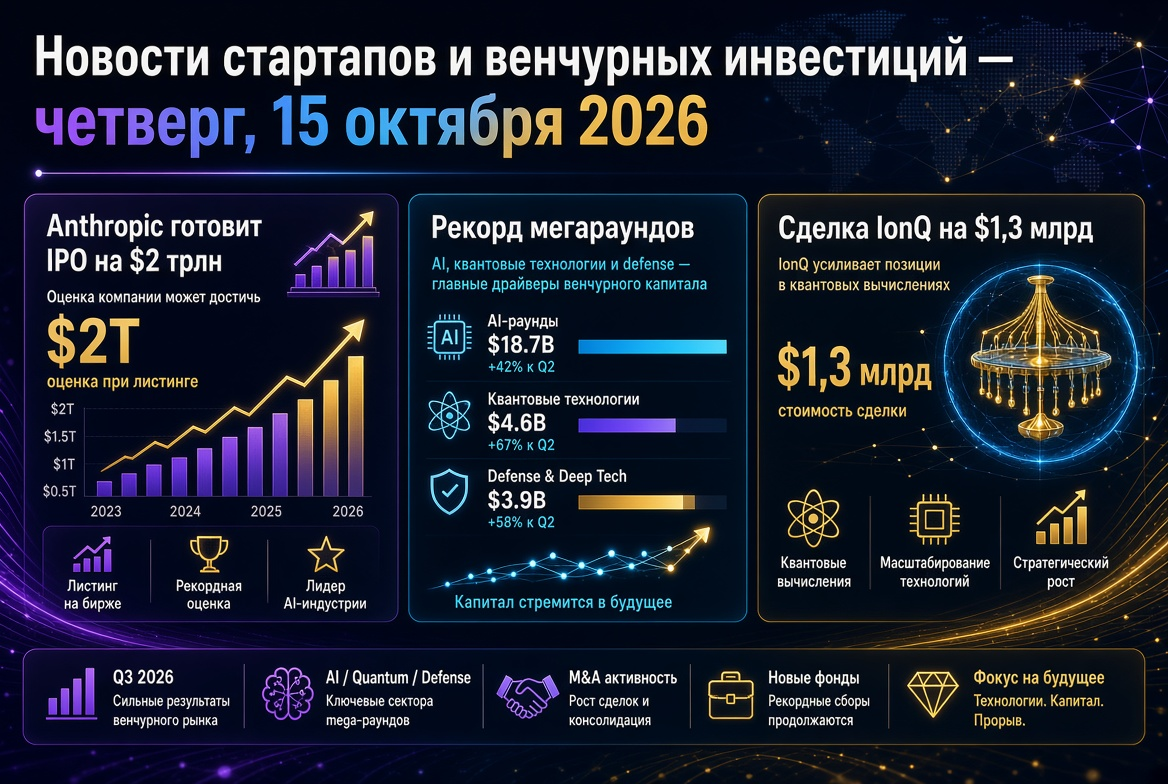
By the end of 2025, the startup and venture capital market is demonstrating strong growth. As of the third quarter, global venture investments have surpassed $100–120 billion, reflecting significant year-on-year growth. Major funds and corporations are returning to large-scale financing of innovations, particularly in the fields of artificial intelligence and deep tech. New large unicorns are emerging, while promising tech companies are going public. Meanwhile, investors are diversifying their portfolios: in addition to IT and AI, there is increased funding for fintech, biotech, climate technologies, and defense startups. Below are the key themes and examples of recent funding rounds.
- The Return of Major Investors and Mega Funds
- Record Investments in AI and Emergence of New Unicorns
- Revival of the IPO Market and Startup Debuts
- Industry Diversification: Fintech, Biotech, Climate, and Defense
- Consolidation and M&A Deals
- Investment Geography: Asia, the Middle East, and Africa
- Interest in Crypto and Blockchain Startups
- Local Context: Russia and the CIS
The Return of Major Investors and Mega Funds
Major venture and corporate investors are once again actively entering the market. SoftBank is forming Vision Fund III with approximately $40 billion earmarked for investments in AI and robotics, while Andreessen Horowitz has closed a record fund of about $10 billion (focused on AI infrastructure and rapidly growing companies). Sequoia Capital is preparing new seed and Series A funds totaling nearly $1 billion. Sovereign funds from the Gulf region (Mubadala, PIF) plan to direct multi-billion dollar investments into promising technologies. Major tech corporations (Google, NVIDIA, Samsung, Microsoft, etc.) are expanding their venture arms, attracting startups in fields like artificial intelligence, quantum computing, and semiconductors.
- SoftBank – Vision Fund III (~$40 billion for AI and robotics)
- Andreessen Horowitz – new $10 billion fund (AI infrastructure and scalable growth)
- Sequoia Capital – ~$750 million for Series A + $200 million for seed funds
- Sovereign funds (Mubadala, PIF, etc.) – multi-billion dollar investment programs
- Corporate VCs (Google, Microsoft, Samsung, etc.) – increased venture activity
Record Investments in Artificial Intelligence and New Unicorns
The artificial intelligence sector continues to set the tone for venture investments. According to PitchBook/FT estimates, approximately two-thirds of all VC investments in 2025, around $160–200 billion, are directed toward AI projects. Generative AI and machine learning platforms consistently attract unprecedented funding rounds. For instance, AI platform developers have secured the following amounts:
- Anysphere (Cursor platform) – $2.3 billion (Series D), valuation over $29 billion
- Lila Sciences (AI for scientific research) – $350 million (Series A)
- Sesame (voice AI) – $250 million (Series B)
- Hippocratic AI (AI for medicine) – $126 million (Series C)
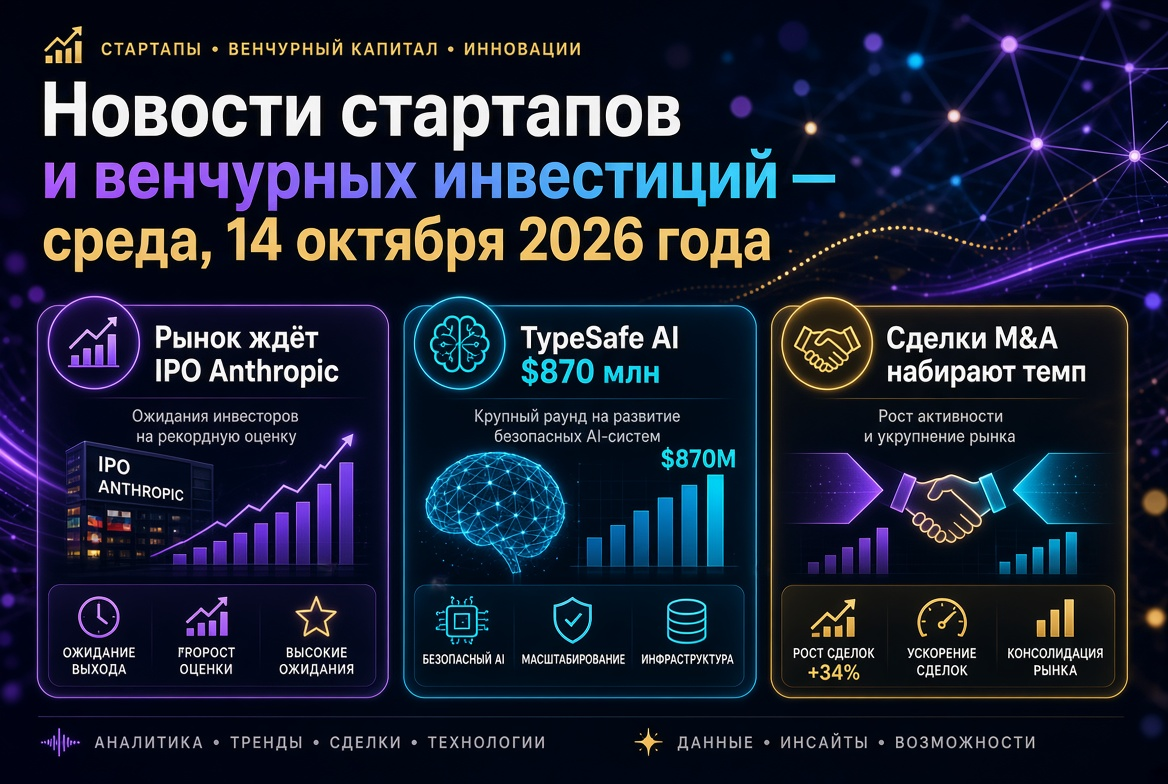
Other notable deals include American companies Anthropic ($13 billion) and xAI ($10 billion) in Q3, while European firms Mistral and British startup Nscale each raised $1.5 billion, indicating a global race for AI unicorns. As rounds become larger, the number of unicorns (valued at $1 billion or more) continues to rise. Venture analysts note that the market for AI platforms and tools will remain dominant, attracting a significant portion of investor capital even after the release of GPT-4.
Revival of the IPO Market and Prospects for Exits
After a period of quiet, a wave of IPOs and major exits for tech startups is re-emerging. Funds expect that several global unicorns (particularly in fintech and biotech) will debut on exchanges in the US, Europe, or Asia by 2026. In 2025, fintech companies and biotech startups successfully launched on NASDAQ and LSE, returning capital to venture investors. M&A deals are also picking up as strategic players acquire mature projects or merge with them to monetize technology. Together, these trends allow investors to anticipate exits and a partial recovery of market liquidity, further fuelling interest in new funding rounds.
Industry Diversification: Fintech, Biotech, Climate, and Defense
Investors are expanding their focus beyond "pure" AI to other sectors. In fintech, investments are actively flowing into solutions for automating banking services and payments. For instance, AI platforms Model ML (Australia) and Nevis (UK) raised $75 million and $35 million, respectively, for investment banking and wealth management automation. The European payment platform Sokin secured €42.9 million for global transactions. In biotech, One-Carbon Therapeutics (Sweden) raised SEK 153 million (~$16.2 million) for oncology research. Climate and sustainable technologies are becoming priorities: investors are examining projects aimed at reducing emissions, clean energy, and agri-tech. In the defense tech sector, German company Quantum Systems raised €180 million to develop AI-powered drones. Thus, venture funds’ portfolios today are balanced between AI and related industries – from fintech and biomedicine to eco-technologies and defense.
- FinTech: Nevis ($35M, wealth management platforms), Model ML ($75M, generative AI for investment banking), Sokin (€42.9M, payment infrastructure).
- Biotech & Health: One-Carbon Therapeutics (Sweden, SEK153M for oncology); startups in therapeutics and genomics.
- ClimateTech: clean energy, e-mobility, and carbon footprint reduction projects are securing funding and venture rounds.
- DefenseTech: Quantum Systems (€180M) – autonomous combat drones with AI, as well as cybersecurity and drone projects.
- IndustrialTech: robotics, IoT, and manufacturing innovations are popular among industrial funds.
Consolidation and M&A Deals
There is a noticeable resurgence in merger and acquisition activities in the market. Venture funds are merging, and large companies are acquiring tech startups to expand their portfolios. A notable example of consolidation is the merger of American funds CerraCap Ventures and Impact VC into a new global fund, CerraCap Impact VC, creating a unified ecosystem for startups in AI, cybersecurity, and IT transformation. Analysts note that many M&A deals in AI and Web3 are taking place at significant discounts to previous valuations: in recent months, dozens of startups have been acquired for a total of around $2.3 billion, with prior round valuations nearly four times higher. This indicates a wave of market rebalancing: strategic buyers are focusing more on actual profitability and technological compatibility rather than the previous hype surrounding "yet-to-be-realized" technologies.
- Merger of CerraCap Ventures + Impact VC → CerraCap Impact VC (new global VC platform).
- OpenAI acquired a stake in Thrive Holdings (Thrive Capital) to integrate its technologies into the accounting and IT services of large companies.
- Many AI and Web3 startups are currently exiting through M&A at a discount (~70%) compared to their last valuations, reflecting the realization of overly optimistic assumptions.
- Funds and corporations are also forming joint CVC programs, aiming to scale innovations more rapidly by acquiring talented teams.
Investment Geography: Asia, the Middle East, and Africa
Venture capital is actively entering new markets. In Asia, the increase in investments is especially evident in China and Southeast Asia, where major tech startups are raising rounds in the hundreds of millions of yuan and dollars. For example, Chinese company Robot Era raised approximately ¥1 billion (~$140 million) for robot development. In Southeast Asia, investors are financing fintech and insurance services – Thai online insurer Roojai raised $60 million, while Indian real estate platform SquareYards secured $35 million. In Singapore and the Philippines, deep tech projects are attracting funding rounds of $10–50 million.
In the Middle East, Saudi Arabia and the UAE are becoming hubs for venture capital: fintech startup Erad secured a $125 million credit line, while the platform Revibe ($17 million) and housing construction service Mnzil ($11.7 million) received funding from international investors. Infrastructure projects (residential complexes, energy, logistics) are also receiving funding. In Africa, there is increasing activity in fintech and renewable energy, with startups in Nigeria, Kenya, and South Africa attracting capital from global funds. Thus, global venture capital is spreading far beyond traditional capitals, focusing on regional technology leaders.
- Asian Market: Robot Era (China) raised ¥1 billion ($140M), Roojai (Thailand) – $60M (digital insurance), SquareYards (India) – $35M.
- Middle East: Saudi fintech Erad – $125M credit line, Revibe – $17M, startup Mnzil – $11.7M (Series A); regional infrastructure startups (Zinit, Strataphy, Buildroid AI) attracted up to $8M.
- Africa: startups in fintech, e-commerce, and clean energy are drawing foreign capital; the largest deals are in South Africa and Nigeria.
Interest in Crypto and Blockchain Startups
After a prolonged correction, the crypto market is showing signs of revival, which is also reflected in venture investments in Web3. Bitcoin prices are holding near record highs (~$85–90K), and in the US, regulators are approving new products related to crypto-assets: the launch of Bitcoin and Ethereum ETFs is expected by the end of the year. A significant update called Fusaka is planned for the Ethereum network on December 3, 2025, to enhance scalability and security. The success of public offerings from crypto companies (ETFs, exchanges) is restoring investor confidence in the sector. Currently, DeFi, NFT infrastructure, and enterprise blockchain projects are securing funding rounds at high valuations. Experts caution that startups need to prepare for increased regulation, but overall interest in crypto technologies is growing.
Local Context: Russia and the CIS
The Russian startup market remains relatively small but is showing growth. According to Venture Guide and ComNews, in the first nine months of 2025, Russian tech companies attracted approximately $125.5 million in venture investments—a 30% increase from the previous year. However, the number of deals has declined (103 vs. 120 in 2024), and there is a shortage of large rounds. The leading sectors for investment in Russia continue to be Industrial Tech ($29.7 million), followed by Healthcare ($19.1 million) and FinTech ($18.3 million). Startups in AI and machine learning secured around $60.4 million, maintaining their lead among technologies. Amid the outflow of foreign capital, state institutions are attempting to support the ecosystem: "RUSNANO" and the Russian Direct Investment Fund plan to increase financing—with RUSNANO expected to invest around 2.3 billion rubles in startups by the end of the year. However, major international investors have yet to appear in the Russian sector. In neighboring CIS countries (Kazakhstan, Uzbekistan, Belarus), state initiatives and small rounds ($1–5 million) in exchange for equity are ongoing.
- Investment volume in Russia (9 months 2025) – $125.5 million (+30% year-on-year); number of deals – 103 (−14%).
- Leading sectors for investment: IndustrialTech ($29.7M), Healthcare ($19.1M), FinTech ($18.3M).
- AI/ML leads among technologies: startups in this area received ~$60.4 million (over 30% of all investments).
- Government support: "RUSNANO" will invest ~2.3 billion rubles in domestic innovations by the end of 2025; similar programs are being implemented by the RDIF and regional funds.