Current Startup and Venture Capital News for Friday, May 15, 2026: AI Infrastructure, Defense Technologies, Robotics, and New Directions for Venture Funds
Friday, May 15, 2026, marks a significant shift in the global startup and venture capital market, characterized by a surge in interest towards AI infrastructure, defense technologies, industrial robotics, and applied artificial intelligence solutions. For venture investors and funds, the critical theme is not merely the increase in transactions but a reallocation of capital towards companies positioned to become the foundational infrastructure of the new tech economy.
The startup landscape is increasingly bifurcating. On one side, larger AI companies and infrastructure projects are achieving multi-billion dollar valuations, gaining access to strategic capital, and enjoying extended periods as private entities. Conversely, traditional SaaS startups, fintech companies, and consumer-facing projects are compelled to demonstrate efficiency, profitability, and rapid pathways to sustainable revenue.
Cerebras and the Return of a Major IPO Window for AI Companies
One of the most notable events for the venture market has been Cerebras Systems' entry into the public market. The AI chip manufacturer raised approximately $5.55 billion during its IPO, making it one of the largest tech events of 2026. For the startup market, this serves as an important signal: investors are once again willing to value infrastructure AI companies at premium multiples if they occupy a strategic position within the computing chain.
Cerebras is competing with Nvidia and other computing infrastructure providers, focusing on specialized solutions for accelerating artificial intelligence. For venture funds, this confirms that the most attractive investment opportunities are emerging not only within software but also in hardware: chips, data centers, energy-efficient computing, and AI inference systems.
- AI chips are becoming a distinct investment class within the venture market.
- Public investors are again willing to pay for growth in strategic tech segments.
- A successful IPO could stimulate interest in other mature AI startups.
Anduril: Defense Technologies Become Mainstream in Venture Investments
Another key development was Anduril Industries raising around $5 billion at a valuation of $61 billion. The company operates in defense technologies, autonomous systems, sensors, and drones. This funding round illustrates that defense tech has officially transitioned from a niche market to one of the central segments of venture capital.
For funds, this represents a reevaluation of their stance towards startups operating at the intersection of software, autonomy, industrial production, and government demand. Whereas defense startups were once seen as complex due to regulatory and sales hurdles, they are now regarded as potential pathways to securing long-term contracts, large budgets, and strategic markets.
The key takeaway for investors: the venture capital market is increasingly financing companies that address not only consumer needs but also infrastructural, industrial, and geopolitical challenges.
Mind Robotics and the New Wave of Industrial Automation
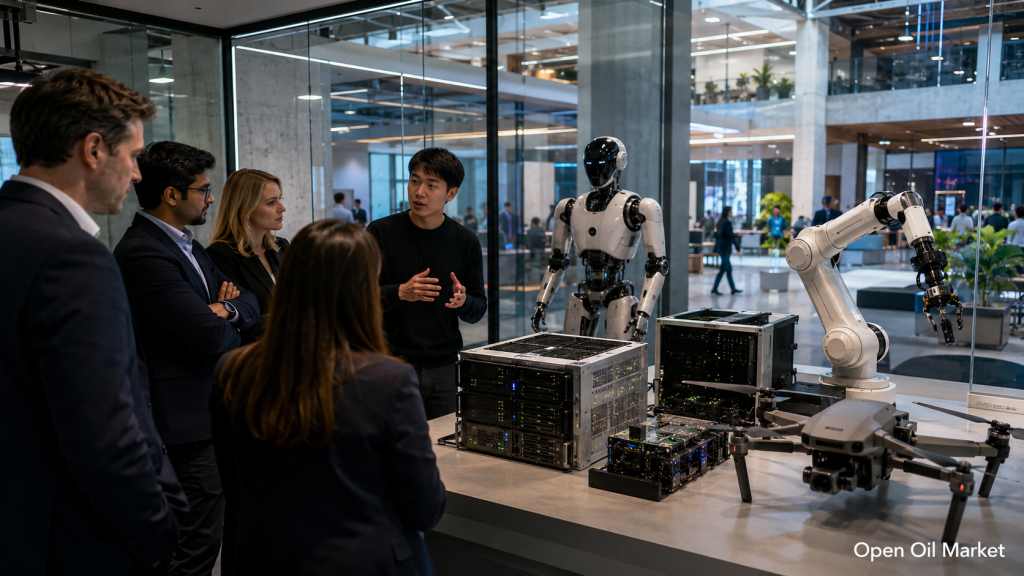
Industrial robotics also remains in the spotlight. Mind Robotics, spun out from the Rivian ecosystem, has raised $400 million and achieved a valuation of approximately $3.4 billion. The startup is developing AI models, robots, and infrastructure aimed at automating manufacturing processes.
For venture investors, this deal is significant for two reasons. First, it validates the growing interest in physical AI—artificial intelligence that extends beyond screens and begins managing real objects, machinery, production lines, and logistics operations. Second, Mind Robotics has access to Rivian's actual manufacturing environment, which may accelerate the testing and implementation of technologies.
- Robotics is receiving backing from major funds and strategic investors.
- Manufacturing companies are becoming platforms for training and scaling AI models.
- Labor automation is evolving from a long-term idea into an investment thesis for the current cycle.
Recursive and Fractile Strengthen the European AI Agenda
The European startup market is also witnessing increased activity in the field of artificial intelligence. Recursive raised over $650 million in a Series A round at a valuation of approximately $4.65 billion. The company works on recursive self-improving AI systems, attracting significant venture and strategic players among its investors.
Meanwhile, the British company Fractile secured $220 million to develop a new generation of AI inference hardware. This area is becoming critically important as the cost and speed of processing requests increasingly dictate the economics of AI products. As corporations and users transition from experimentation to mass adoption of models, the demand for specialized computing rises.
For funds, Europe is evolving into not only a market for applied software but also a hub for foundational AI companies: laboratories, chip startups, robotics, defense solutions, and data infrastructure.
Anthropic and Gates Foundation: AI Moves into Social Infrastructure
The partnership between Anthropic and the Gates Foundation for $200 million highlights another significant trend: artificial intelligence is becoming a tool not only for commercial automation but also for social infrastructure. The project focuses on healthcare, education, language accessibility, and applying AI in regions with limited access to advanced technologies.
For the venture market, this creates a new layer of opportunities. Startups working in healthtech, edtech, data infrastructure, and AI for public good may gain additional interest from funds, philanthropic organizations, and strategic partners. Solutions that combine commercial scalability with social impact are becoming particularly promising.
Early-stage Market: Capital Available, but Demands Have Become Stricter
The early-stage startup market remains active; however, investors are now more selective. A notable example is the new fund, Silicon Road Ventures, led by Ajay Mahajan, which has raised 150 crore rupees targeting Indian startups in the agentic AI sector for B2B commerce, logistics, fintech, and retail operations.
This reflects a global shift: funds are seeking not abstract AI products but solutions that integrate into specific business processes. Startups must demonstrate clear economics, measurable customer impact, and potential for international scaling.
- AI agents for business and operational automation remain a priority.
- Investors are closely observing B2B models with recurring revenue.
- Markets in India, Europe, and the U.S. are competing for the status of AI entrepreneurship hubs.
Physical AI Expands Beyond Factories
Interest in physical AI is evident not only in industry but also in construction. Xpanner raised $18 million in a Series B round, developing an Automation-as-a-Service model for construction machinery. The company offers ways to automate existing equipment without full replacement, making the technology implementation less capital-intensive for clients.
For venture investments, this signals an important opportunity: substantial gains may emerge in traditional, capital-intensive industries where digitization has been slow. Construction, manufacturing, logistics, energy, and agriculture are becoming markets where AI startups can create significant value through increased productivity.
What This Means for Venture Investors and Funds
The current agenda indicates that the venture market in 2026 is becoming more capital-intensive and increasingly polarized. Large investments are concentrating around companies capable of becoming systemic infrastructure for the AI economy. At the same time, funds are increasingly evaluating not just revenue growth but also the strategic significance of the technology.
Key focus areas for investors in the coming months are:
- AI Infrastructure: chips, data centers, computing, inference, and cost optimization of models.
- Defense Tech: autonomous systems, sensors, drones, and software for the defense sector.
- Industrial Robotics: physical AI, factory automation, and production AI models.
- Agentic AI: autonomous software agents for B2B tasks, commerce, logistics, and finance.
- AI in Healthcare and Education: applied solutions with social and commercial value.
Market Takeaway for May 15, 2026
The startup and venture investment news for Friday, May 15, 2026, reaffirms a central trend: the market is no longer financing artificial intelligence as a trendy category. Capital is moving towards companies capable of controlling infrastructure, reducing computing costs, automating the physical world, and creating new platforms for industry, defense, healthcare, and business.
For venture funds, this necessitates a deeper technical analysis of deals. Mere user growth is no longer sufficient. Startups that combine robust technology, access to large markets, operational efficiency, and strategic significance will prevail. In 2026, venture investments are increasingly a bet on infrastructure for the next technological cycle rather than just on applications.