Key takeaways for venture investors:
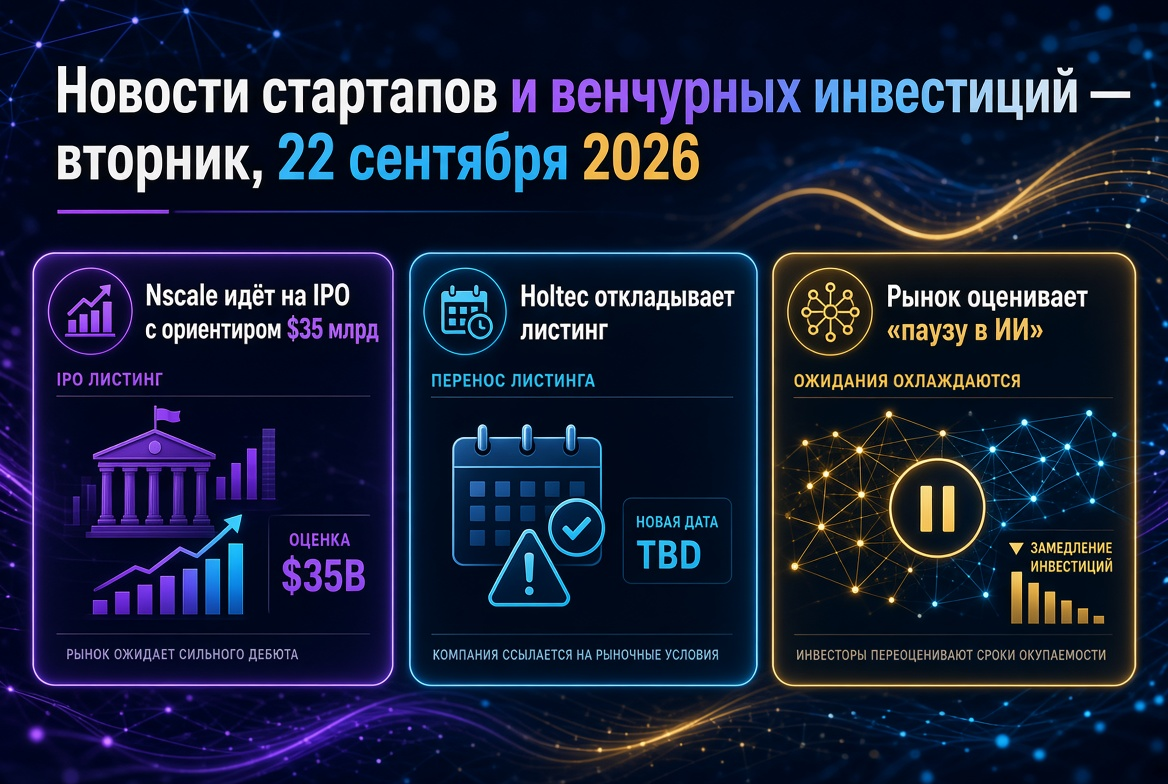
- Nscale has filed an IPO prospectus with the NYSE; valuation target – up to $35 billion.
- Holtec Nuclear postponed its offering of up to $900 million due to market conditions.
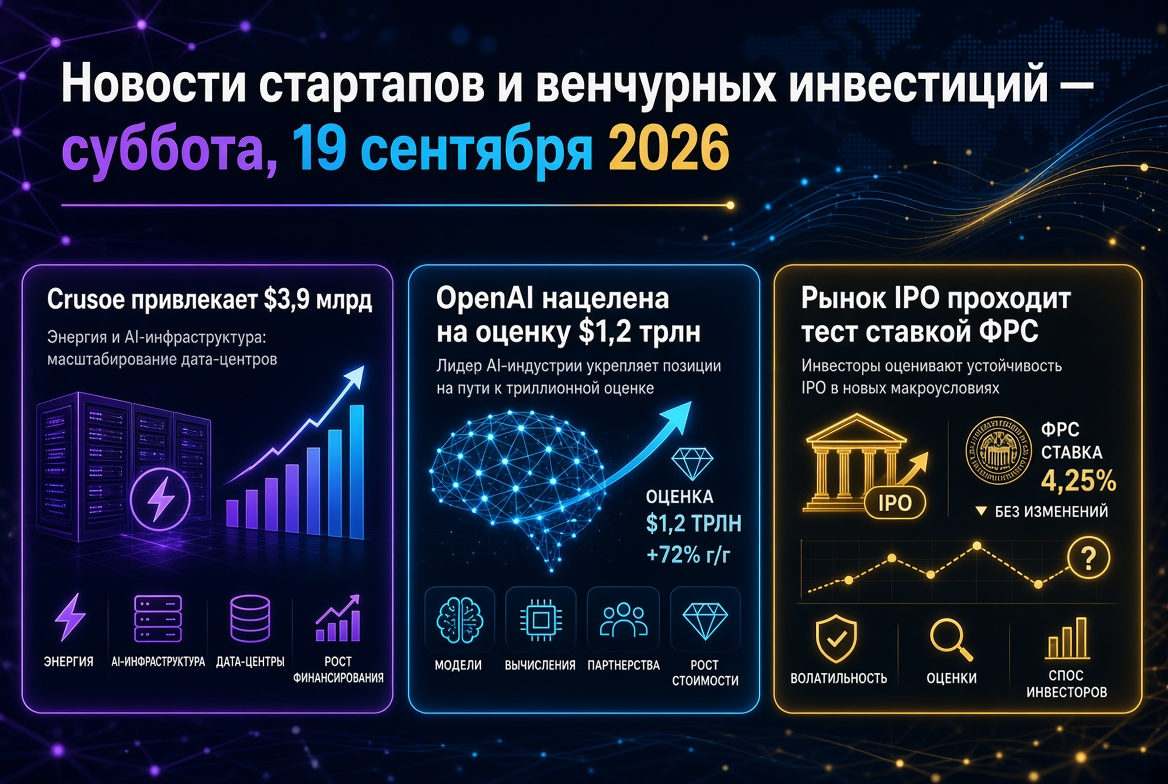
- OpenAI has delayed its IPO to 2027, with investors proposing a round at a valuation of $1.2 trillion; Anthropic remains focused on Nasdaq.
- Emulate is preparing a seed round of up to $700 million, Euclyd raised €200 million in its Series A round.
- Crux AI is securing a $22 billion loan backed by chips, while Bloom Energy is pursuing $25 billion in project financing.
- An Indian alliance of deep tech investors has committed to invest $3 billion, and CATL is launching a venture fund worth $860 million.
Nscale: A pivotal IPO test for AI infrastructure
The British neo-cloud provider Nscale filed an IPO prospectus with the SEC on Friday and intends to trade on the NYSE under the ticker NSCL. The underwriters include Goldman Sachs, J.P. Morgan, and Morgan Stanley. Revenue for the first half of 2026 grew to $140.6 million from $10.4 million a year earlier, while net loss widened to $1.02 billion. Remaining contractual obligations reach $56.4 billion, yet over half of the revenue was generated by a single client. Reports indicate that the company hopes to raise up to $3 billion at a valuation of up to $35 billion—compared to $14.6 billion in the March Series C round. Simultaneously, Nscale secured a convertible loan from Nvidia.
For venture funds, this serves as the first autumn indicator of how public investors will assess a capital-intensive model characterized by contracted demand, high customer concentration, and reliance on a single GPU supplier.
Holtec and the IPO window: selectivity over euphoria
Holtec Nuclear, once considered the key IPO of September, has postponed its offering. The backdrop is unfavorable: X-energy is trading about 37% below its April offering price, and Standard Nuclear is down 21%. The IPO window has not closed but has narrowed:
- This week, Bamboo Insurance is expected to raise $665 million at a valuation of $3.3 billion, along with defense materials maker Amaero seeking $53 million;
- Biotech firm Electra Therapeutics, which raised $350 million, is trading roughly 12% below its offering price;
- Motive withdrew its IPO application and secured over $1.3 billion in growth funding from General Catalyst—private equity is replacing the public market;
- Revolut is considering a dual listing in New York and London with a valuation of up to $200 billion.
A "pause in AI" and the Fed's rate: a dual filter for valuations
Anthropic's CEO, Dario Amodei, published an essay urging a coordinated slowdown in enhancing model capabilities. This was supported by Sam Altman and executives from other major tech firms. The market reacted with a sell-off of semiconductors, but by the end of the week, the Nasdaq gained 0.7%, while the Dow lost 1.7%.
Industry analysts note implications for venture investments: longer model release cycles, potential shifts in data center commitments, extended exit timelines, and additional pressure on limited partners. Competition is shifting from "raw" performance to distribution, reliability, and cost—favoring larger players. At the same time, there have been calls for regulations governing owners of more than 5% of computing power, akin to systemically important banks.
OpenAI and Anthropic: trillion-dollar valuations, different paths
Investors have offered OpenAI a round at a valuation of around $1.2 trillion—41% above March's $852 billion, when the company raised $122 billion. According to reports, there are no formal negotiations; some offers involve the sale of shares by employees. Annual revenue has exceeded $40 billion, with an IPO expected in 2027. Anthropic, valued at $965 billion in May, continues to prepare for its Nasdaq initial offering in mid-October. Its listing will set the public multiple for the entire AI sector.
Megarounds and new unicorns: capital concentrates
- Temporal raised $550 million in a Series E round at a valuation of $12.55 billion; a platform for AI agents.
- Fab2 secured $500 million in a Series A round for the mass production of compact chip factories.
- Suniva raised $835 million in debt and equity to produce solar cells in the U.S.
- Ridgeline raised $250 million at a valuation of $1.45 billion; Cornelis Networks secured $205 million for AI networking solutions.
- Penelope Health raised $100 million to automate physicians' administrative processes.
A week prior, Cognition raised $2 billion at a valuation of $48 billion, while Boring Company raised $3 billion at $23 billion. Median Series A and B rounds remain moderate: the gap between category leaders and other startups is widening.
Debt over equity: chips and energy as collateral
Funding for AI infrastructure is increasingly moving to the credit market. A consortium of ten banks is providing $22 billion collateralized by TPU and customer contracts from Crux AI—a cloud project by Blackstone and Alphabet with $5 billion in equity. Bloom Energy has secured $25 billion in project financing for data center energy supply with Brookfield. Nvidia will invest $2 billion into Brookfield's $10 billion infrastructure AI fund. For venture funds, this means less equity dilution in portfolio companies but greater sensitivity to interest rates.
M&A: Signed does not mean closed
Deals remain a secondary liquidity channel, but closing timelines are extending. Nvidia's acquisition of Hugging Face for $12.9 billion is expected to close only in the first half of 2027. Several signed but unclosed deals include Visa – BioCatch ($2.4 billion), Analog Devices – Alif Semiconductor ($1.35 billion), Bending Spoons – Miro ($1.36 billion), and Dynatrace – Arize AI ($915 million). SoftBank has agreed to acquire Robotics and AI Institute, with the deal undergoing scrutiny in the U.S. SPACs are making a comeback: nuclear technology developer HGP is merging with Meshflow at a valuation of $1.2 billion.
Europe, Asia, and emerging markets
- United Kingdom: Emulate, founded in August by alumni from Google DeepMind, is discussing a seed round of up to $700 million at an approximate valuation of $3.7 billion; leaders include Index Ventures and Lightspeed. ElevenLabs is preparing for a Series E of over $500 million with potential participation from Scaleup Europe Fund.
- Netherlands: Euclyd raised €200 million in a Series A for inference chips; among the round's leaders is Samsung.
- India: The India Deep Tech Alliance committed to investing $3 billion, with $250 million allocated in the first year.
- China: CATL is establishing a venture fund worth $860 million for AI and robotics; its robo-taxi unit Hello raised around $100 million.
- Latin America: Brazilian VOLL secured $140 million from Warburg Pincus.
What this means for venture investors and funds
- Exits are shifting. The delay of OpenAI's IPO and Holtec's pause extend the liquidity horizon—DPI planning needs reassessment.
- Nscale and Anthropic will set multiples. Their reception by the public market will determine late-stage valuations by 2027.
- Regulatory risk has become an investment factor. Security audits and potential computational restrictions need to be factored into due diligence.
- The capital structure is changing. Debt collateralized by chips and contracts decreases dilution but requires sustainable unit economics at a 4% rate.
- The premium for teams has reached its limit. Seed rounds of hundreds of millions without a product raise the bar for the next round and increase the risk of down rounds.
The venture market remains liquid but pays for proven demand, control over scarce resources, and capital discipline. These criteria will define the news from startups and venture investments through the end of the third quarter.