Current Overview of Startup and Venture Investment News as of May 1, 2026, Regarding the Growth of Agent AI, Mega Rounds, Enterprise AI, Deeptech, and Capital Concentration in the Global Venture Market
Friday, May 1, 2026, marks a significant point for the startup and venture investment market: following a record first quarter, investors enter the new month with a clear signal — capital is once again available, but it is being allocated much more selectively. The global venture market formally appears strong: mega rounds in artificial intelligence, data infrastructure, autonomous systems, and enterprise software are pushing statistics to historical highs. However, beneath the surface, there remains a rigorous filtration; venture investors and funds are increasingly financing not just growth, but companies with proven revenue, a strategic infrastructure role, and the capability to become an industry standard.
The prevailing theme of the day is the transition from a general excitement surrounding generative AI to the applied phase of agent AI. Investors are assessing not only the models but also how startups are embedding AI into real business processes: marketing, finance, customer service, engineering design, supply chain, and analytics for institutional clients.
Record Quarter: Venture Capital is Growing Again, but the Market Has Become More Concentrated
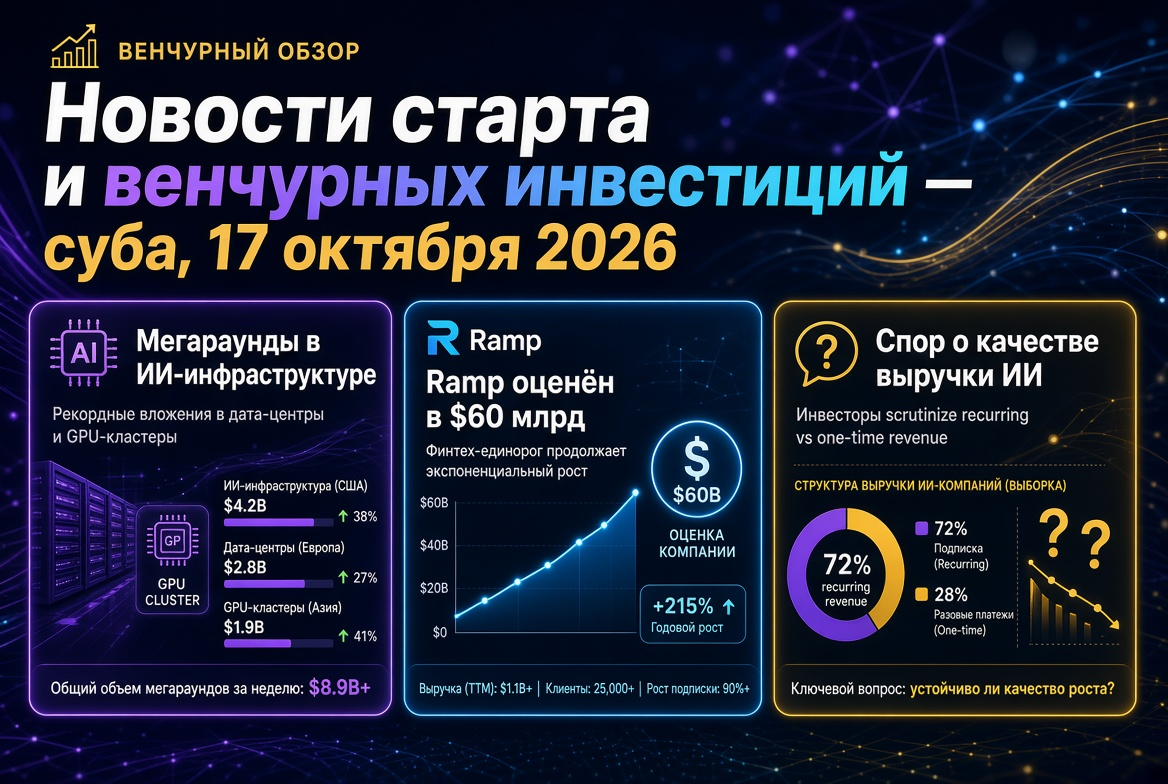
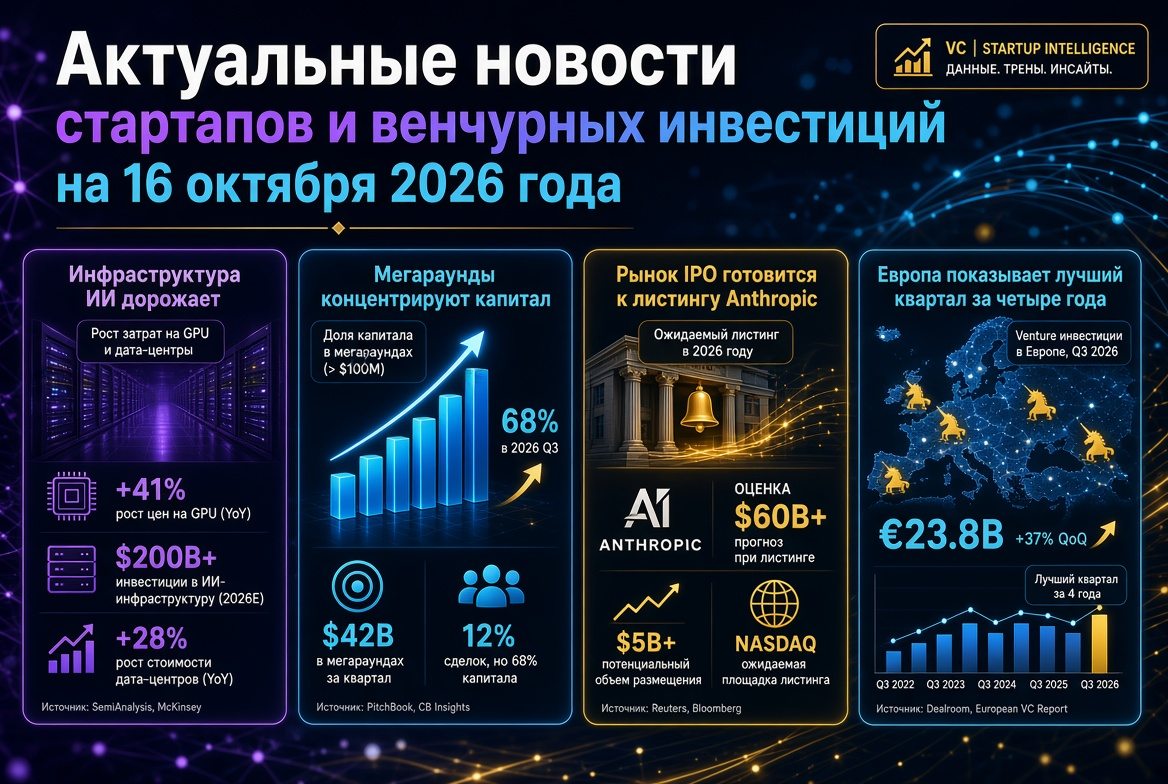
As of the end of the first quarter of 2026, global venture investments reached historical highs. A key feature of this growth is not a mass revival across all stages but the dominance of large deals in artificial intelligence. Startups related to AI infrastructure, frontier models, computational power, autonomous agents, and enterprise software have garnered an disproportionate share of capital.
For venture funds, this indicates a shift in investment logic. The market no longer rewards abstract promises of "AI for everything." Projects that address specific economic pains are coming to the forefront: reducing operational costs, accelerating analytics, automating sales, enhancing marketing efficiency, improving customer experience, or optimizing engineering processes.
Agent AI Becomes the Primary Investment Narrative
If 2023–2024 was the era of "co-pilots," then 2026 increasingly appears to be the year of autonomous AI agents. Venture investments are shifting from helper tools to systems capable of independently executing multi-step processes, working with corporate data, making interim decisions, and integrating into the operational contours of companies.
Key Areas of Demand from Funds
- Agent AI for financial institutions and investment banking;
- AI platforms for marketing and personalizing customer communications;
- Automation of customer service in complex corporate environments;
- Tools for AI development, engineering modeling, and industrial digital twins;
- Data infrastructure and APIs for AI agents.
For investors, this marks a significant pivot: the value of a startup is increasingly defined not just by the quality of its model, but by the depth of integration into the customer's workflows. The closer the product is to revenue, margin, and operational leverage for the client, the higher the likelihood of securing a substantial round even amid intense competition for capital.
Parallel Web Systems: The Infrastructure for AI Agents Takes Center Stage
One of the most notable deals in recent days has been the round for Parallel Web Systems—a startup founded by former Twitter CEO Parag Agrawal. The company raised $100 million in a Series B round at a valuation of around $2 billion. The round was led by Sequoia, with participation from investors including Kleiner Perkins, Index Ventures, Khosla Ventures, First Round Capital, and others.
Parallel is developing APIs for search and research specifically targeted at AI agents. This is an important signal for the venture market: if agents are becoming the new interface for working with information, then infrastructure layers for their search, data verification, and integration could transform into one of the most valuable segments of enterprise software.
Rogo: Financial AI Agents Become the New Operating System for Banks
Rogo has secured $160 million in a Series D round to scale its agent AI platform in the financial sector. The company works with investment banks, private equity funds, and asset managers, helping to automate research, material preparation, deal analysis, data handling, and portfolio analytics.
For venture investors, this deal is particularly illustrative. Financial institutions traditionally demand high levels of security, accuracy, legal resilience, and integration with internal systems. If a startup can pass this filter, its product gains a strong investment profile: high check size, long customer lifetime, significant switching costs, and the potential to become an industry platform.
Hightouch and Netomi: Enterprise AI Moves into Marketing and Customer Service
Hightouch raised $150 million at a valuation of $2.75 billion, reinforcing its positioning as an AI platform for marketing. The company is betting on agent tools that work with customer data, helping to create personalized content, plan campaigns, and accelerate marketing operations.
Simultaneously, Netomi secured $110 million in a Series C round to develop AI solutions in customer service. The startup employs models from OpenAI, Anthropic, and Google, with notable clients spanning aviation, media, and digital services. The involvement of Accenture Ventures and Adobe Ventures highlights a trend: large technology and consulting ecosystems are increasingly investing in startups that can be rapidly scaled through corporate sales channels.
Ineffable Intelligence and JuliaHub: Deep Technologies Back in Focus
The venture market is also paying close attention to deeptech. The British AI laboratory Ineffable Intelligence, founded by former DeepMind researcher David Silver, raised $1.1 billion at a valuation of $5.1 billion. The project is betting on systems that can learn through reinforcement learning and uncover new knowledge without directly relying on vast amounts of human data.
JuliaHub, meanwhile, raised $65 million in a Series B round and is developing software for modeling complex systems, including cars, airplanes, and industrial digital twins. For funds, this represents a distinct category of interest: AI is beginning to penetrate not only office processes but also the engineering design of the physical world, where accuracy requirements are significantly higher than in typical SaaS products.
What’s Going on with Early Stages
Despite the noise surrounding mega rounds, the early stage remains more challenging. Seed and Series A funding are still accessible for strong teams, but the quality requirements have increased. Funds are looking at the speed of hypothesis validation, the depth of technical advantage, the capability to attract enterprise clients, and discipline in capital expenditure.
What Investors Are Focusing on in 2026
- A real product presence, not just a demonstration;
- A clear economic value for the customer;
- Access to unique data or industry expertise;
- The ability to protect margins in the face of rising computing costs;
- Potential for international scaling.
Venture funds are becoming more pragmatic. Companies without AI differentiation, strong distribution, or a clear path to revenue are facing stricter conditions for capital acquisition.
Geography of Venture Investments: The U.S. Dominates, Europe and Asia Strengthen Deeptech
The U.S. remains the primary hub for venture capital due to the concentration of AI companies, hyperscale infrastructure, substantial funds, and corporate buyers. However, Europe is strengthening its position in deeptech, engineering software, industrial AI, and scientific startups. Asia continues to stay active in robotics, semiconductors, fintech, and applied AI solutions.
For global venture investors, this creates a more complex map of opportunities. The top deals increasingly occur at the intersection of technology, industry expertise, and geopolitical significance: computing, data, energy, defense, industrials, finance, and healthcare.
For Venture Investors and Funds
The startup and venture investment news as of May 1, 2026, indicates that the market has not only recovered from a cautious period but has transitioned into a new phase of selection. Funding is available, but it is directed toward companies that can become the infrastructure for the next technological cycle.
Key takeaways for funds include:
- Agent AI is emerging as one of the primary focus areas for venture investments;
- Enterprise AI is receiving a premium for proven revenue and integration into complex processes;
- Deeptech is once again attracting large checks, particularly in engineering, modeling, and AI research;
- The market remains concentrated: the best startups are securing capital faster and at a higher valuation, while weaker projects face a demand shortage;
- For investors, it is critically important to distinguish a genuine technological platform from a product built on someone else’s model without sustainable advantages.
The main intrigue of May is whether the venture market can maintain its record momentum without reliance on a few mega AI deals. For the funds, this is a moment of discipline: those who can identify not only the loudest startups but also future infrastructure companies in niche, capital-intensive, and rapidly growing segments of the global economy will win.