Startup and Venture Capital News as of September 17, 2026: Temporal's Mega Round in AI Infrastructure, New Unicorns Exein and Open Cosmos, EUCLYD's Semiconductor Deal, a Wave of Rounds in "Physical AI" in China, Federal Reserve Meeting, Holtec IPO, and Anthropic's Listing Preparation
As of mid-September 2026, the global venture market is experiencing a notable shift: capital is flowing away from "wrappers" around language models towards infrastructure that makes artificial intelligence reliable, cost-effective, and applicable in the physical world. In the past 48 hours, venture funds have closed a series of significant funding rounds—from $550 million in Temporal to €300 million in Open Cosmos—while Europe gained two new unicorns in a single day. Simultaneously, investors are revising their cost of capital models, as the Federal Reserve's meeting on September 16, in which markets priced over 90% probability of the first interest rate hike since 2023, sets a new framework for late-stage startup valuations.
Key venture topics for Thursday, September 17, 2026:
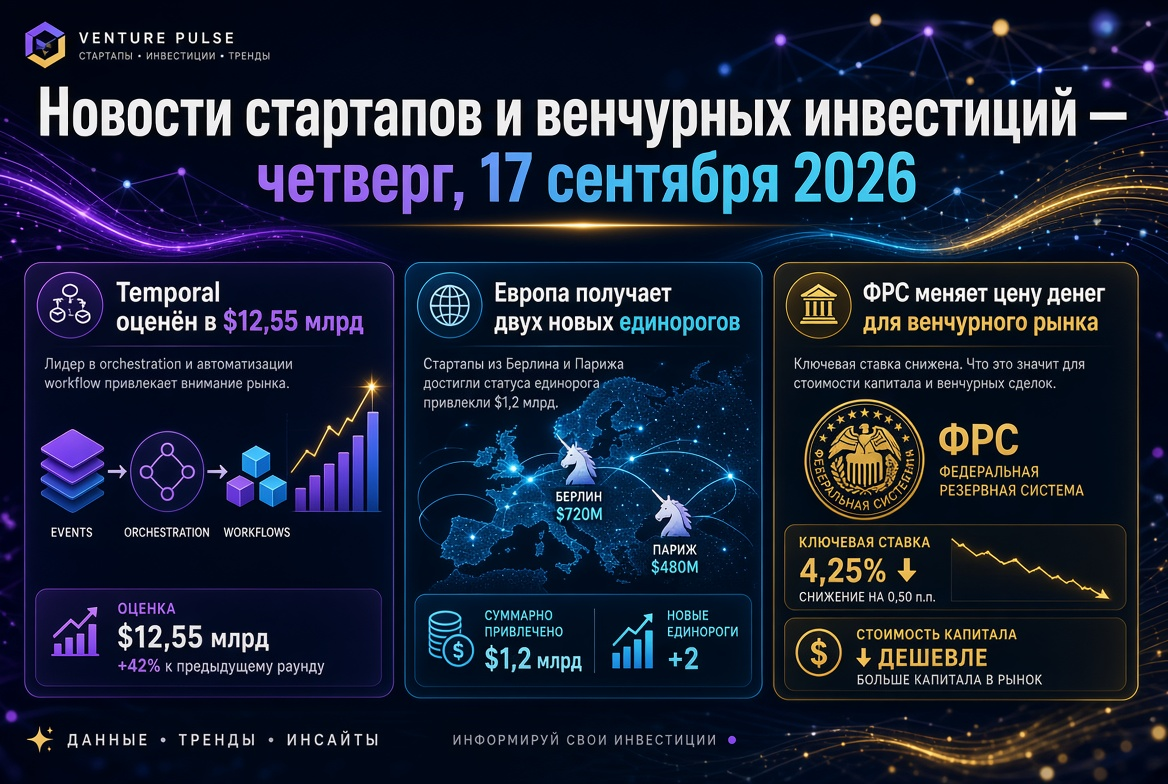
- Temporal's Mega Round. $550 million at a valuation of $12.55 billion—AI agent infrastructure is becoming an asset class in its own right.
- New Unicorns in Europe. Italy's Exein ($1.7 billion) and the UK's Open Cosmos (over $1 billion) confirm the demand for cybersecurity and space.
- Semiconductors and "Physical AI". EUCLYD raises over €200 million, while China funds robotics and chip inspection.
- Macro Factors. The Federal Reserve and expensive venture debt are changing the mathematics of late-stage rounds.
- IPO Window. Pricing of Holtec and Orion180, anticipation for Anthropic's prospectus and Oura's listing.
- Russia and CIS. The market has contracted almost by half, with capital concentrated in the five largest deals.
Deal of the Day: Temporal Raises $550 Million for "Reliability" of AI Agents
The platform Temporal, which is developing durable execution infrastructure for distributed applications and AI agents, has closed its Series E round with $550 million at a valuation of $12.55 billion. The round was led by Lightspeed, with co-investors including Wellington Management, Growth Equity at Goldman Sachs Alternatives, and Tiger Global; participating were T. Rowe Price and SV Angel, with returning investors such as a16z, Sequoia, Index, and GIC.
The dynamics are striking: back in February 2026, the company was valued at $5 billion during Series D, meaning the valuation has more than doubled in seven months. The justification lies in operational metrics that are rarely seen in startups of this size:
- Annual revenue exceeded $250 million, with growth over 200% year-on-year;
- Net revenue retention (NDR) remains above 200% since February;
- In August, the platform processed 1.9 trillion billable actions, a growth of over 350%;
- The number of paying customers reached 4,300 (+139%), including OpenAI, Netflix, Snap, NVIDIA, and JPMorgan Chase.
For venture investors, Temporal serves as a marker of a new thesis: the winner is not the one who trains the best model, but the one who controls how models execute complex processes in production.
Europe: Two New Unicorns in One Day
Exein — Europe's Most Expensive Cybersecurity Startup
Rome's Exein raised $270 million at a $1.7 billion valuation in an oversubscribed round led by Headline. The deal included Sofina, Goldman Sachs, the European Investment Bank group, KfW Capital, and T.Capital, alongside previous investors Balderton, HV, and Lakestar. The total capital raised exceeded $600 million, with the valuation increasing 30-fold over two years, and ARR quadrupling in the first half of 2026.
The company secures "physical AI"—robots, drones, autonomous transport, and industrial devices—at the operating system level. Its technology covers over 2 billion connected devices, with nearly half of its revenue generated from the Asia-Pacific region. The funds will go towards expansion in the U.S., M&A, and developing its own fundamental model for machine security.
Open Cosmos — A Profitable Space Unicorn
The British satellite manufacturer Open Cosmos closed its Series C round with €300 million (approximately $348 million) at a valuation exceeding $1 billion. The round was led by Lightrock and ETF Partners; participants included the BCI pension fund, Institut Català de Finances, Entrepreneurs First, Phoenix Court, and the UK's NSSIF, while Claret Capital provided venture debt. The company manufactures up to one satellite per day across four factories, has demonstrated five consecutive years of profitable growth, and signed contracts worth over $370 million in three and a half years. The round was oversubscribed and intentionally targeted European investors—a signal that sovereign space infrastructure is becoming a priority for continental capital.
Semiconductors: EUCLYD Targets Inference Costs
Eindhoven-based startup EUCLYD raised over €200 million in its Series A round, co-led by Samsung, Somerset Capital Partners, Scaleup Europe Fund managed by EQT, and Innovation Industries. Former ASML CEO Peter Wenningk has become the chairman of the board. The company develops specialized ASICs and data center-level systems that reduce energy consumption and memory bandwidth requirements while servicing large models. The thesis is straightforward: if inference becomes the largest computing load, the economics of "per token" transforms into a standalone semiconductor opportunity, regardless of whose model comes out on top.
Asia: China Dominates "Physical AI" Rounds
The Asian trading day brought a cluster of deals unified by one logic—funding components and operating systems for robots, not demo prototypes:
- ENCOS (Nanjing) — over 300 million yuan Series B led by CITIC Goldstone for the production of integrated robotic joints and manipulators;
- Yincheng Intelligence (Shanghai) — about 100 million yuan Series A simultaneously with a comparably sized order from SF Express for sorting robots;
- Kangwei Vision (Shenzhen) — about 100 million yuan for optical inspection of PCBs for AI servers;
- Nutshell Therapeutics — C1 round in the tens of millions of dollars from Trustbridge and Decheng with a candidate already in clinical phase I.
This picture is complemented by Hong Kong's Qupital with $300 million in capital commitments in trade finance, Stockholm's Tandem Health with $100 million Series B from EQT, and Tokyo's Yoom with its first external round of ¥700 million for orchestrating AI agents in corporate processes.
Macro: The Federal Reserve, Venture Debt, and the New Cost of Capital
The Federal Reserve's rate has been held in the range of 3.50–3.75% since December 2025; however, inflation in the U.S. remained at 3.4% as of August amid an energy shock due to conflicts in the Middle East. Ahead of the September 16 meeting, futures priced in about a 93% probability of a 25 basis point hike—the first since 2023. For the venture market, this indicates a "expensive money for a long time" scenario: floating credit lines linked to SOFR are being re-priced every 90 days, with every 25 basis points adding approximately $25,000 in annual costs for every $10 million of debt. Late-stage funds are already adjusting their multiples, while companies with growing metrics like Temporal continue to attract capital at premium valuations.
IPO: The Window is Open, but Selectively
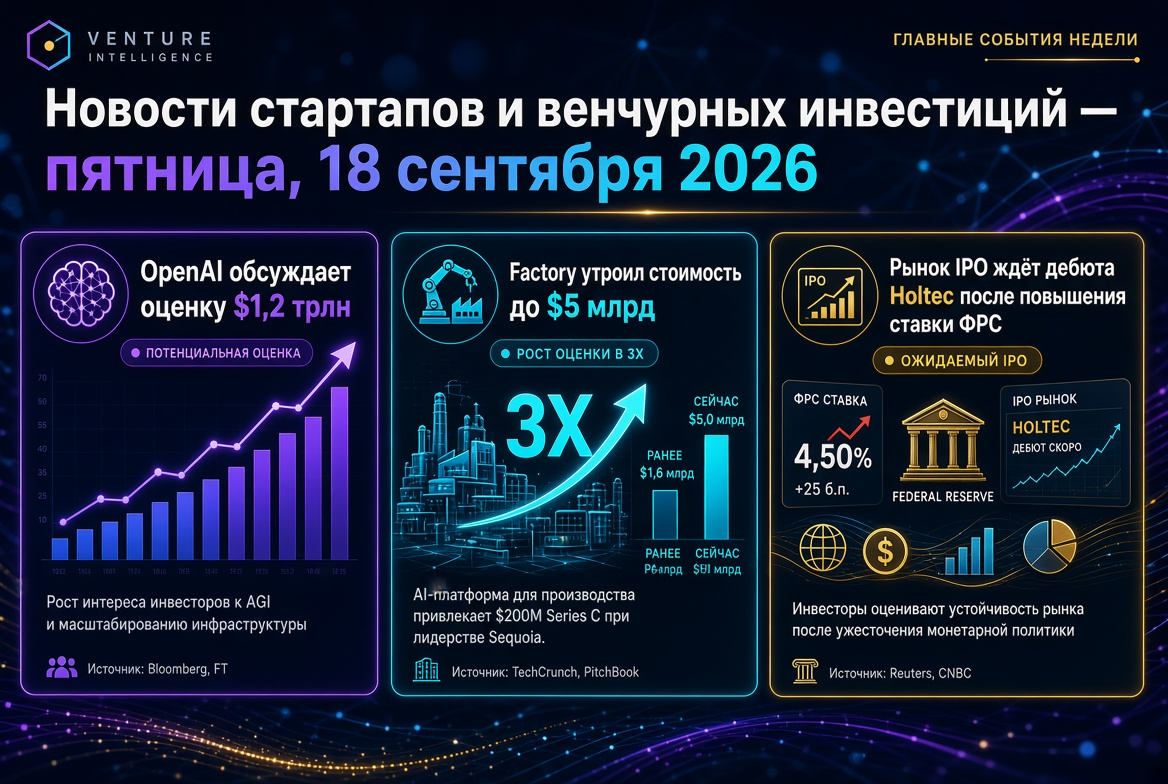
2026 is on track to achieve the strongest performance in the IPO market since 2021: 331 applications have been submitted and 280 deals completed year-to-date. For Thursday, September 17, the pricing of two Nasdaq listings has been set: nuclear company Holtec is offering 50 million shares at $15–18 (around $850 million), while insurer Orion180 aims to raise up to $340 million at a valuation of approximately $1.7 billion. Smart ring manufacturer Oura, which filed on September 3, anticipates a listing late in the month.
The season's main event is Anthropic. Following a confidential S-1 filing in June and a Series H round at a $65 billion valuation, with a market valuation of $965 billion, the company is reportedly preparing its public prospectus for the end of September and a roadshow by mid-October with a target valuation of up to $2 trillion. Annual revenue as of the end of July exceeded $65 billion. Public financial data from this AI market leader will serve as a benchmark for re-evaluating the entire private AI ecosystem.
Russia and CIS: Concentration Instead of Growth
The Russian venture market shrank by 48% year-on-year in the first half of 2026, reaching 4.6 billion rubles, while the number of active investors fell from 50 to 33. Private funds accounted for 67% of the volume (3.1 billion rubles in 21 deals), while corporate investments dropped by 54% to 0.4 billion rubles. The five largest deals accounted for about 60% of the market, with the "Architect of AI" round at 1.1 billion rubles making up almost a quarter of the half-year total. No foreign deals were recorded—creating a fully domestic market, with capital directed towards mature B2B companies with clear revenue streams.
What This Means for Venture Investors
- The infrastructure layer is more valuable than the model layer. Temporal, EUCLYD, and DeepKernel demonstrate that premiums are earned by those who control execution, computation, and data.
- "Physical AI" demands proof. SF Express's order for Yincheng and clinical phases for Nutshell are valued higher than demonstrations.
- Sovereignty is becoming a budget line item. European rounds at Open Cosmos and EUCLYD were raised with a focus on regional capital.
- Expensive debt changes the structure of rounds. It is advisable to reconsider floating credit lines and incorporate higher rates into models before year-end.
- The IPO window is open for quality. The prospectus for Anthropic will serve as a benchmark for valuations of private AI companies.
In Summary
The venture market as of September 17, 2026, appears simultaneously generous and demanding: record-breaking rounds and new unicorns coexist with stricter criteria and growing capital costs. Investors are willing to pay for scarce assets—efficient chips, real operational data, deeply integrated workflows, and secure infrastructure. Intelligence is becoming cheaper, while the systems that convert it into reliable economic outcomes are becoming pricier. This is where capital is heading.