Venture Market on July 18, 2026: Record $510 Billion in First Half, Fireworks Mega Round at $1.5 Billion with $17.5 Billion Valuation, Germany’s Largest Seed at microagi, Deals from Wonder, Fora, Whale, and Bunkerhill. Analysis of Capital Concentration and Exit Market for Venture Investors
By mid-July 2026, the venture industry finds itself in a state that is difficult to describe with a single term. Formally, it is a boom: global startup investments reached a record $510 billion in the first half of the year, according to Crunchbase, the exit market has shown the best dynamics since 2021, and individual rounds are once again measured in billions of dollars. In reality, this is a market of conviction, not breadth — funds are flowing to a narrow circle of companies capable of demonstrating scale, revenue, and structural positioning within the value chain.
Deals from the last few days illustrate this thesis better than any statistics. The five largest rounds in daily summaries consistently account for over 80% of disclosed capital. The rest of the market remains tight: venture funds are not paying for "AI as a feature," they are paying for control over bottlenecks.
Main Event: Fireworks Raises $1.505 Billion at $17.5 Billion Valuation
The dominant financial event was the Series D round of Fireworks, amounting to $1.505 billion with a valuation of $17.5 billion. The round was led by Atreides Management, Index Ventures, and TCV, with participation from Evantic, Lightspeed Venture Partners, and NVIDIA. The total disclosed amount of capital raised by the company has exceeded $1.832 billion.
Why are venture investors willing to pay such a price?
- Revenue Density. The company reports surpassing $1 billion in annualized revenue (ARR) — a rare figure for an infrastructure AI startup at the Series D stage.
- Operational Scale. The daily token volume on the platform has grown from 15 trillion to over 40 trillion year-over-year.
- Specialization over Universality. Approximately 95% of serviced tokens relate to specialized models rather than "off-the-shelf" solutions.
The strategic significance of the deal extends beyond its size. Fireworks is building a thesis that corporate spending on AI will shift toward customized stacks on open models, rather than concentrating around a few closed labs. The company directly competes with Together AI and Baseten, making this round both a financial event and a market positioning statement. The capital raised will be directed towards expanding the engineering team and global computing capabilities — a sign that winning in AI infrastructure requires not just software, but also significant capital intensity.
Paradigm Shift: From Models to Operating Systems
The primary trend in venture investments in mid-2026 is capital moving away from the abstract notion of "artificial intelligence" to operational layers. Investors are financing software that not only describes work but also executes it.
- Infrastructure for Model Specialization — Fireworks enables corporations to train and maintain highly specialized models.
- AI in Physical Operations — Whale sells an "AI operating system" for stores, facilities, and frontline processes.
- Trust Layer for Agents — Beacon Security builds a contextual data level for agent-based cybersecurity.
- Deployment in Regulated Environments — Bunkerhill Health transforms internal hospital ideas into operational AI agents.
- Client Executive Layer — Sable offers an "AI employee" working in live sessions with customers.
For startup founders, the takeaway is uncomfortable but clear: if the product does not parallel a budget line item that is already significant to the buyer, the bar for capital attraction rises sharply.
Largest Venture Funding Rounds: Deal Overview
Late Stages: Capital of Conviction
- Fireworks — $1.505 Billion, Series D (San Mateo, USA). AI Infrastructure. Leads: Atreides Management, Index Ventures, TCV.
- Wonder — $650 Million, Series D (New York, USA) with a pre-money valuation of $9 Billion. Participants included Accel, GV, NEA, funds managed by AllianceBernstein, ARK Invest, and Kayne Anderson Rudnick. The company expanded its presence from 46 to 140 locations since May 2025 and has raised over $3 billion since 2021. Investors are not financing a chain of restaurants but rather a vertically integrated food infrastructure: kitchen technology, delivery, marketplace, and automated production.
- Fora — $60 Million, Series D (New York, USA) at a post-money valuation of $1 billion — a new "unicorn." Leads: Forerunner and Tactile Ventures, supported by Thrive Capital, Insight Partners, and Heartcore Capital. Total financing has reached $138.5 million.
Middle and Early Stages: A Focus on Bottlenecks
- Xenter — $58.25 Million, Series B (Draper, Utah, USA). Medtech and healthcare data infrastructure.
- microagi — $55 Million, Seed (Munich, Germany). The largest seed round in the history of German startups. Lead: Hummingbird, with participation from Northzone, LocalGlobe, Village Global, and redalpine.
- Sable — $45 Million (San Francisco, USA). Leads: Sequoia Capital and 8VC. The company was founded less than a year ago.
- Whale — $40 Million, Series C3 Extension (Singapore), bringing Series C to $100 million. Leads: CMB International and SMBC Asia Rising Fund with participation from Krungsri Finnovate, Singtel Innov8, Hyundai Motor Group.
- Bunkerhill Health — $25 Million, Series B (San Francisco, USA). Lead: Khosla Ventures, with participation from Sequoia Capital, Felicis, Optum Ventures, and Y Combinator.
- Beacon Security — $13 Million, Seed (New York, USA). Lead: Notable Capital.
- Kind Designs — $10 Million, Pre-Series A (Miami, USA) at a valuation of $70 million. Among the investors are Mark Cuban, NY Angels, Adrian Fenty, and Kyle Kuzma.
Physical AI: Robotics as a Venture Category
The seed round for microagi at $55 million is a strong indicator that "physical AI" is transitioning from a catchphrase to a stand-alone investment class. The Munich-based company positions itself not as a robot manufacturer, but as a deployment company that builds layers of data and operational management, teaching robots to perform useful tasks in the real world.
The limitation in real robotics is not the presence of manipulators or a basic model, but rather the scarcity of specific physical data and reliable deployment tools. The data-collection subsidiary shift operates in 15 countries and pays over 20,000 individuals for recording physical tasks using cameras and sensor gloves. This directly points to where investors see value creation: not in the "body" of the robot, but in the data and management stack.
There is also a geopolitical subtext. Europe is seeking ways to compete in AI without replicating the foundational economic models of Silicon Valley. The focus on deploying robotics, industrial data, and manufacturing automation appears to be a more convincing regional strategy.
Industry Diversification: Healthcare, Cybersecurity, Climate Adaptation
Despite the dominance of AI, venture investments in 2026 span a wide range of sectors — provided that AI is tied to tangible operational outcomes.
Healthcare
The Carebricks platform from Bunkerhill Health enables hospitals to transform their own clinical and operational ideas into AI agents for image analysis, registry management, prior authorizations, and triaging. The platform has already been deployed in systems such as Cleveland Clinic, UTMB, and Intermountain Health. Healthcare expenditures reached $5.3 trillion in 2024, and labor shortages remain a persistent constraint — hospital AI becomes investable when it stops being a dashboard and starts functioning as labor infrastructure.
Cybersecurity
Beacon Security has increased its annual recurring revenue (ARR) by 300% in the first half of 2026 — clients from the financial, insurance, and technology sectors are replacing outdated security architectures. The round was supported by over 60 founders and information security directors. The logic is simple: if corporations want automated cyber operations, agents need a trusted data layer providing sufficient context for action without management failures.
Climate Adaptation
The round for Kind Designs reflects a shift within climate technologies — from a narrative of mitigation to a purchasing logic of adaptation. The company prints "living breakwaters" using 3D printers to protect coastlines and restore marine ecosystems. Key metrics: $1 million in revenue in 2025, $10 million in contracted revenue, an active pipeline worth $175 million, and a $2 million contract with the U.S. Navy. This is the profile of an infrastructure firm selling to municipalities and federal clients, rather than a climate startup waiting for demand for carbon credits.
Geography of Capital: US Dominance, but Asia and Europe Are Reclaiming Ground
The story of venture capital concentration is real, but it is no longer just a tale of Silicon Valley.
- The US remains the leader in deal value — it accounts for the majority of the largest rounds.
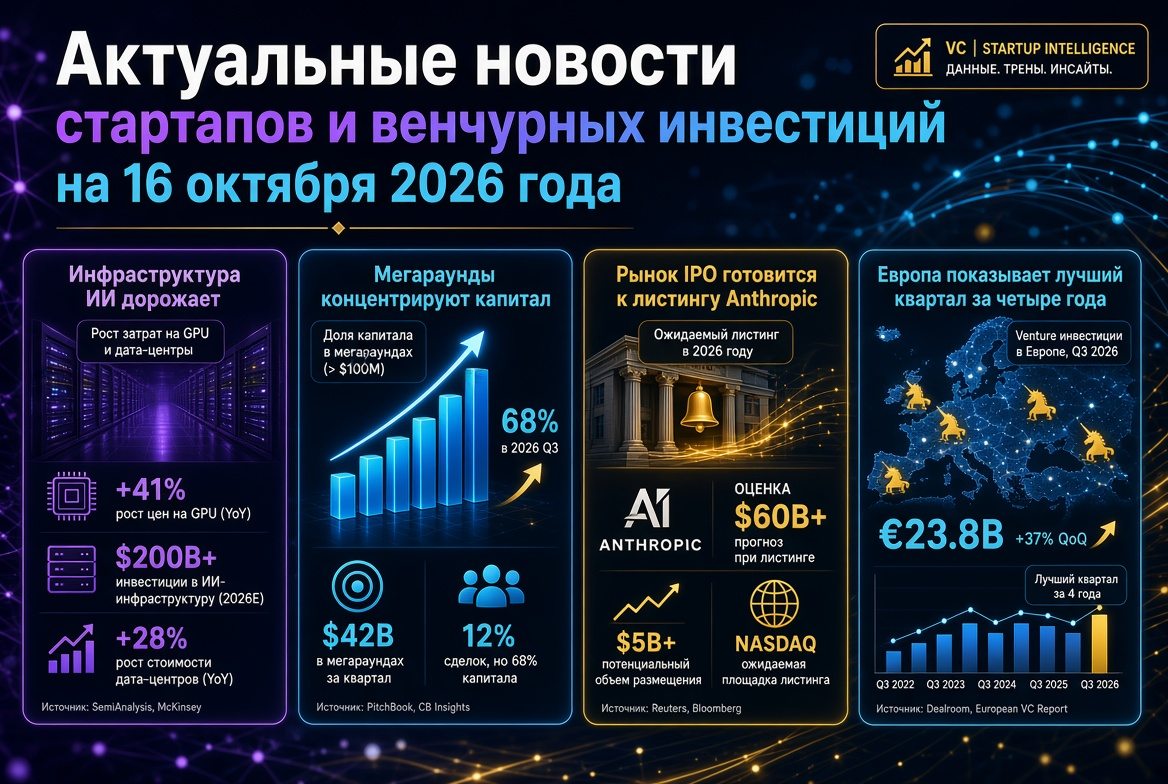
- Asia reached a multi-year high: startup funding in the second quarter of 2026 reached $42.8 billion, with more than 60% allocated to AI.
- Europe is asserting itself through industrial specialization — the record German seed round at microagi is proof of this.
- Singapore serves as a hub for corporate capital: Whale serves over 1,600 enterprises across 45+ countries and manages over 600,000 edge AI nodes.
Winning geographies are those that can connect AI with infrastructure, industrial systems, or corporate implementations.
IPO and Exit Market: Liquidity Window Opens
For venture funds and LPs, the key question remains exits. According to Crunchbase, IPOs and acquisitions of startups accelerated in the second quarter of 2026, forming the strongest exit market since 2021. This fundamentally alters the calculations for late-stage investors: they are more willing to fund expensive businesses when the pathway from private revaluations to public liquidity appears plausible.
Wonder is already being discussed in terms of an IPO, and the Fireworks round resembles private financing built on public market expectations — scale, revenue, sustainable leadership in the category. Nevertheless, the exit market is just beginning to normalize, and several blockbuster rounds should not be interpreted as a universal abundance of capital.
Stage Bifurcation: Seed Becomes Extreme
One of the main structural features of the venture market in 2026 is the stratification by stages:
- Late stages are reserved for companies with visible revenue scale or a clearly defensible systemic role (Fireworks, Wonder).
- Seed and early rounds have not quieted — instead, they have become more selective and extreme. Seed funding in 2026 remains high largely because some rounds have seen significant increases in size, while the rest of the market remains constrained.
- The middle segment is experiencing the most pressure: it is the most challenging to demonstrate both scale and structural positioning.
In the first quarter of 2026, AI companies accounted for 80% of global venture funding, while $12 billion in seed capital increasingly shifted towards larger launches. The rounds for microagi ($55 million seed) and Sable ($45 million) serve as a direct illustration: investors are willing to write large early checks if they believe the startup occupies a structural bottleneck.
The Human in the Loop: Why Investors Pay for Labor Amplification
The Fora model, which has attained "unicorn" status, deserves special attention. The company is not building the thesis that "AI replaces travel agents" — rather, it builds the opposite. Advisors on the platform have booked travel totaling over $3 billion, with 97% of more than 15,000 active advisors being newcomers to the profession, while the integrated AI assistant Via streamlines administrative work around research, supplier knowledge, and proposal preparation.
For funds, this is an important signal: venture investors have become noticeably more skeptical about broad claims of automation but continue to pay for software that amplifies the throughput of trusted experts. "The human in the loop" is not a compromise category but a self-sustaining investment thesis in several verticals.
Risks for Venture Funds: The Main Trap of the Cycle
Cautious optimism does not negate structural risks. Key risks include:
- Overpaying for "control layer narratives." The primary valuation trap of the cycle is funding stories about control layers that never transition into system-of-record businesses.
- Portfolio Concentration. When 80% of capital flows into one sector, the correlation of risks within the portfolio significantly increases.
- Capital Intensity of AI Infrastructure. The race for computing power requires ongoing investments, diluting stakes for early investors.
- Fragility of the Exit Window. The IPO market is normalizing, but it remains sensitive to macroeconomic shocks.
- Devaluation of Generation. The cost of basic generation has been declining quarterly, undermining pricing for undifferentiated products.
Conclusions for Venture Investors and Funds
The venture market of mid-2026 is not characterized by broad risk-taking. It is highly selective, concentrated capital that is increasingly willing to finance companies at the intersection of AI opportunities and operational execution. Practical takeaways for investment committees:
- Own the layers around autonomy, not just its outputs. The infrastructure of specialized models, management and deployment layers, and physical data for robotics promise pricing power and defensibility.
- Demand alignment with budget lines. The best-financed companies tie AI to hard outcomes: reducing computation costs, accelerating deployment, enhancing logistics efficiency, and strengthening cyber oversight.
- Do not confuse headlines with the market. A few mega rounds do not imply a forgiving market — the rest must still earn trust the hard way.
- Look beyond the Bay Area. Germany, Singapore, and Asia overall offer access to industrial and corporate deployments at more reasonable valuations.
- Prepare for exits in advance. The strongest exit market since 2021 is a window to be utilized, not merely observed.
In 2026, capital flows towards businesses that can prove they are part of the infrastructure of the new economy — digital, industrial, clinical, or coastal. Founders and funds that understand this distinction read the market more accurately than those chasing headline sizes.