Price of Russian Oil Doubled: Is a Gas Price Increase Expected?
04/08/2026
3463
The average price of oil for the most widely traded Russian grade, Urals, reached $77 per barrel at the end of March, according to the Ministry of Economic Development. This is a significant increase from the February price of $44.59. The good news is that this nearly twofold growth is expected to boost the country’s budget revenues from oil production in April. However, the downside is that domestic oil refineries are also facing increased costs for crude, which may impact retail fuel prices.
Experts surveyed by "RG" believe that wholesale fuel prices will rise, but certainly not to the same extent as crude oil prices. Retail price increases are likely to align closely with inflation rates. Furthermore, the profitability of oil refining and fuel retailing is anticipated to decline.
It is important to note that the rise in price for Russian oil does not necessarily equate to oil sales from Russian companies to domestic refineries at $77 per barrel. The price reported by the Ministry of Economic Development serves as a basis for tax calculations for oil companies, which are due for payment based on oil production from the previous month.
Payments for March will be made in April. This clarification is vital. With the Urals price at $77, the share of tax payments that companies must make on each barrel is approximately 65-68%. This means that the mandatory tax portion of the Urals price in April amounted to about $50, which is higher than the overall Urals price of the previous month. This is why the main price surge for oil in the domestic market is expected to occur this month.
Reuters, citing trader data, reported that the value of a ton of West Siberian oil delivered to the Russian domestic market surged by an average of 32,600 rubles in April compared to March, reaching levels of 59,000 to 60,000 rubles per ton.
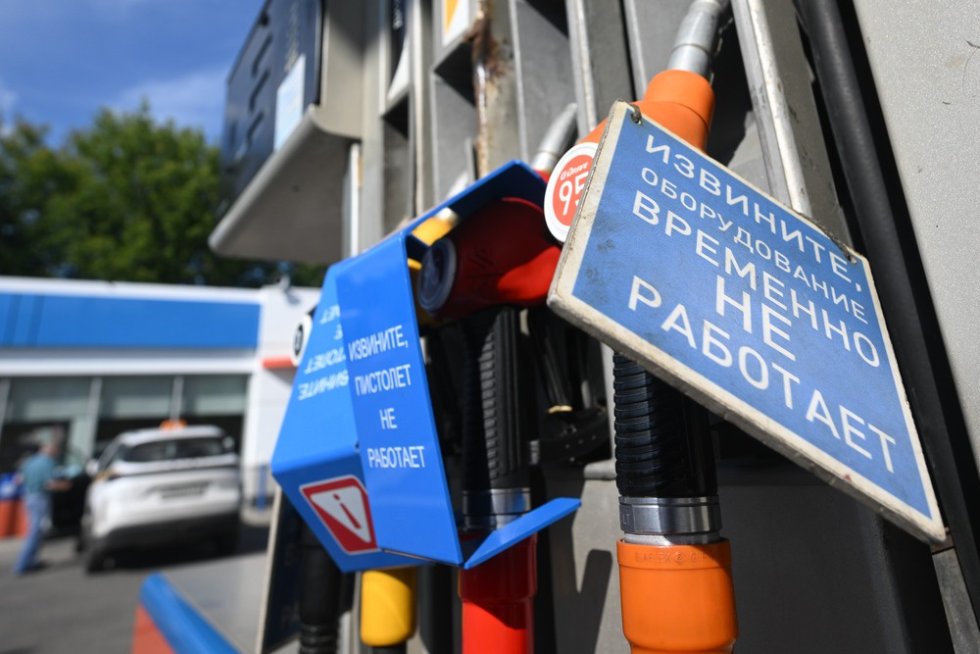
So far, there has not been any significant reaction in the market to this price increase. Prices for AI-92 and AI-95 gasoline are currently near the highs of this year but remain below last autumn's peaks. However, given that April has just begun, the rise in domestic oil prices may not yet be reflected in trading.
In Russia, the oil component of the price of a liter of gasoline fluctuates between 15% to 35%. The higher the oil price, the larger its share. However, the increases in export prices for oil and petroleum products do not directly translate into corresponding rises in wholesale or retail gasoline or diesel prices due to the structure of the domestic tax system.
Russia employs a mechanism of reverse excise tax for crude oil supplied for domestic refining, which partly offsets tax payments for refineries. This reverse excise framework includes a damping mechanism, which is a partial budgetary compensation to oil producers for supplying fuel to the domestic market at prices lower than export rates. The compensation size is directly proportional to the difference between the export alternative (European prices) and the indicative price set annually by the government for the domestic market. This damping can also be negative, meaning when the export price of fuel falls below the indicative prices, oil producers must pay the budget the resulting difference. This situation occurred in January and February (with payments in February and March), with oil producers incurring losses of 33.8 billion rubles through this damping mechanism during those two months. However, for March (to be paid in April), they are expected to receive somewhere between 150-200 billion rubles from the budget, although it remains unclear whether these payments will cover past losses and the drop in oil refining profitability.
As noted in a conversation with "RG," Yuri Stankevich, Deputy Chair of the State Duma Committee on Energy, emphasized that if the price of incoming crude for refineries rises significantly, the margins for these facilities shrink rapidly without compensation mechanisms. To restore these margins, refineries are likely to seek higher retail prices for gasoline and diesel. Hence, in the short term, upward pressure on wholesale and small-scale prices is inevitable. Retail prices tend to respond more slowly, lagging due to the damping mechanism and an implicit directive to curb prices that are socially sensitive. Additionally, the high tax component in the liter price (60-70%) makes the final price less volatile compared to raw material fluctuations.
According to Sergey Tereshkin, General Director of Open Oil Market, three-quarters of Russia's oil refining is conducted by vertically integrated oil companies (VIOCs) that control the entire chain of fuel production and supply from the well to the gas station. Companies engaged in oil production are unlikely to base their domestic crude sales to their refinery subsidiaries on global pricing, even with the tax controls on transfer pricing.
Higher procurement costs for raw materials are typical for independent refineries; however, such entities account for only a quarter of primary oil processing and an even smaller share of gasoline and diesel production. Therefore, despite rising global prices, the situation for Russian oil refining should not be overly dramatized, according to the expert.
Dmitry Gusev, Deputy Chair of the Board of the "Reliable Partner" Association and member of the expert council of the "Gas Stations of Russia" competition, believes that retail prices will continue to track inflation, while wholesale prices will rise. Despite export bans and geopolitical factors, Russia remains a part of the global oil and petroleum market, which continues to influence the domestic market. This influence is precisely what reduces the damping effect.
Stankevich clarified that damping merely softens but does not eliminate external pressure on the market. With sustained increases in oil prices, it becomes challenging to fully contain wholesale price hikes. Furthermore, the damping mechanism does not always entirely offset the rise in raw material costs. Its formula includes coefficients that can lead to "under-compensation" during peak periods.
Previously, estimates indicated that the damping system starts to falter in compensating for oil producers' costs when Urals prices exceed $90 per barrel. However, Urals pricing has yet to reach this level. There remains a question of whether it is possible to detach domestic pricing from external influences. Europe is a net importer of oil and petroleum products, and the price of domestically sourced raw materials and fuels is effectively tied to European pricing.
From the perspective of Sergey Frolov, managing partner at NEFT Research, this is not feasible within the current tax regime. The tax maneuver—elimination of export taxes on oil and petroleum products, along with increases in the mineral extraction tax (MET)—was a mistake that simplified tax exactions from the industry while largely placing Russian oil refining at the brink of profitability. In recent years, profitability has primarily been sustained by damping payments, which was initially intended as a temporary measure that functioned effectively only within a narrow range of external and internal conditions (thus constantly requiring adjustments).
Stankevich argues that under zero export duties and the current MET formula, fully detaching domestic prices from global movements is practically impossible without returning to a stricter system of state regulation or segmenting the oil market.
At present, it is economically indifferent for a producing company whether it sells oil for export or for the domestic market; it bases its decisions on world prices minus logistics and duties. To "decouple" domestic prices, it would be necessary to implement either a regulated (administrative) oil price for refineries, radically modify the MET to unlink it from global prices, or introduce differential taxation for crude intended for the domestic market. All three options imply some loss of budget revenues or their redistribution, distorting extraction incentives and increasing the risks of shortages or cross-subsidization.
In contrast, Vyacheslav Mishchenko, head of the Center for Analysis of Strategies and Technologies in the Fuel and Energy Sector, believes that we should focus on establishing our independent market and pricing mechanisms without tying ourselves to international benchmarks. In creating these mechanisms, it is essential to prioritize the domestic market in the current situation. Certainly, we need to enhance export deliveries, but only after meeting domestic economic demands. This raises the recurring question of equitability between exports and domestic supply. Traditionally, the industry has operated on the principle of "export alternatives," where supplies to domestic refineries should not be less profitable for oil companies than export options.
According to the expert, employing administrative measures and state price regulation to create a domestic market is not the optimal approach. Conditions must be established for creating independent pricing mechanisms—export quoting for Russian oil and the domestic market price. In this pairing, a new tax system should make exports and domestic supply equally profitable for refineries. However, this new system must be carefully constructed, step-by-step, without overreliance on administrative regulatory principles, while listening to and understanding the market. Only then will it be insulated from shocks, such as the ongoing global energy crisis.
Source:
RG.RU