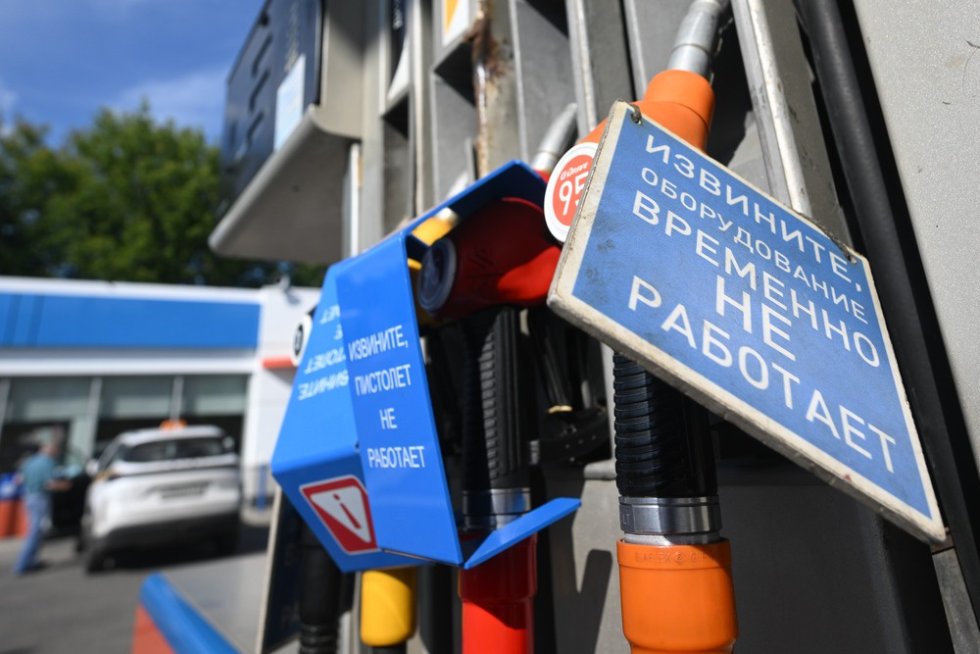
Last week, fuel prices at gas stations in the capital saw a sharp increase. The price of AI-95 gasoline rose by 0.3% over the course of seven days, while diesel fuel increased by 0.6%. According to the Moscow Fuel Association (MTA), the average price of AI-95 at Moscow gas stations reached 71.17 rubles per liter, while diesel fuel (DT) hit 77.93 rubles per liter.
Data from Rosstat for the entire country will only be available on the evening of May 27, but typically these figures align closely with MTA statistics in terms of dynamics. Moreover, there are more than 2,400 gas stations in Moscow and the surrounding area, accounting for 8.4% of all gas stations in Russia. While prices may vary by region, the overall trends are generally consistent across the country, with the exception of local shortages. Since the end of April, the weekly increase in gasoline prices across Russia has not exceeded 0.1% on average.
The acceleration in price hikes occurred amidst reports of massive drone attacks on oil refineries (NPPs) in the European part of Russia. While attacks in April targeted facilities primarily focused on exports, by early May, the emphasis had shifted to refineries supplying the domestic market (Moscow and its vicinity, Central Russia, the Northwest, the South, the Volga region, and the Ural). According to Reuters, production was halted or reduced at five NPPs, which are among the largest fuel suppliers in Russia. However, this is unlikely to be the primary reason for the price increases. More plausibly, the unscheduled repairs at NPPs served as a catalyst for price hikes, exacerbating existing internal issues in oil refining.
This is evidenced by, for instance, the unexpected rise in diesel prices. There is no shortage of diesel fuel in the country, as production nearly doubles domestic demand. Yet, DT emerged as the leader in price growth last week. Should Rosstat report statistics similar to MTA’s across the country, the rate of diesel price increases would outpace the overall inflation rate.
Additionally, the Ministry of Energy consistently emphasizes that the domestic market is well-stocked with gasoline, diesel fuel, and aviation kerosene, that the logistics infrastructure is functioning reliably, and that fuel reserves are at sufficient levels.
As noted in a conversation with "RG" by Dmitry Gusev, Deputy Chairman of the Supervisory Board of the "Reliable Partner" Association and member of the Expert Council of the "Gas Stations of Russia" competition, the price increase is not directly linked to the attacks on NPPs; rather, it is a reaction to the restraint of fuel exchange quotations and gas station prices. However, mere administrative measures are insufficient to prevent price increases; an oversupply is necessary. Currently, there are no economic incentives to increase oil refining volumes.
This primarily pertains to gasoline, whose production capacity exceeds the internal market's needs by only 10-15%. The volume of exchange sales for AI-95 gasoline has decreased by 27.5% from the same period last year as of May 26. The exchange serves as one of the primary sources of fuel acquisition for gas stations. As supply diminishes, prices rise.
Both gasoline and diesel are produced in greater quantities than consumed in Russia.
According to Dmitry Prokofyev, Director of External Communications at NEFT Research, the rise in prices for premium gasoline and diesel is driven by a combination of three converging factors. Refineries have faced an unexpected wave of unscheduled repairs. Against this backdrop, primary oil refining in May fell short of plans, resulting in physically less fuel being produced.
Pockofyev contends that there is also a divergence in regulations for gasoline and diesel. Starting in April 2026, the government imposed a complete ban on gasoline exports. Simultaneously, oil companies were mandated to curb the rise in retail prices at gas stations in 2026 to align with inflation levels, effectively closing the main avenue for compensating rising costs. No ban was placed on diesel exports. This created fundamentally different incentives: gasoline producers found themselves confined to the domestic market with limited margins, while diesel retained access to export alternatives. As global prices began to rise (due to the crisis in the Hormuz Strait), producers sought to redirect diesel flows towards exports, applying additional pressure on domestic prices. Furthermore, the seasonal factor cannot be overlooked; May marks the peak of sowing season when demand for diesel from agricultural sectors traditionally surges.
The rise in diesel prices is not a coincidence but a logical outcome of a market configuration where reduced domestic supply coincides with sustained seasonal demand amidst ongoing export alternatives, the expert believes.
The information environment has also played a role, according to Sergey Tereshkin, CEO of Open Oil Market. The market responds not only to the actual balance of supply and demand but also to expectations of reduced fuel availability, he asserts. The real picture is unlikely to emerge until June when the situation with fuel shipments from the largest NPPs becomes clearer. Additionally, the specifics of regulation traditionally play a role: exchange quotations for AI-95 are not considered when determining budget subsidies for oil companies, thus risks of accelerated price increases surface particularly in this market segment—even with stable fuel output.
Furthermore, Prokofyev notes that in the context of limited AI-95 supply, oil companies may prioritize deliveries to their own distribution structures. This directly raises the vulnerability of independent gas stations that operate "from truck to truck."
The risk of individual fuel type shortages in Central Russia and Moscow currently possesses a structural rather than systemic character, concentrating around specific fuel types and certain distribution channels. This is primarily related to logistical gaps and the market vulnerability of independent gas stations rather than an outright fuel shortage, believes the expert.
Source: RG.RU